C6 and Am7 are the same four notes. C, E, G and A in one order, A, C, E and G in another, and until somebody plays a bass note there is no telling which chord is on the stand. That is not trivia to file away, it is the working principle of the chord. A C6 is a tonic that refuses to sit completely still, because the ear can always find the A minor lurking in it, and jazz and western swing players spent decades exploiting that instability where a modern player would write Cmaj7 and be done.
Try It: C6 in the Chord Finder
Set the root to C, then to A, and compare the two chords note by note.
The Notes of C6
| Degree | Note | Interval from root | Semitones |
|---|---|---|---|
| 1 (root) | C | Perfect unison | 0 |
| 3 | E | Major 3rd | 4 |
| 5 | G | Perfect 5th | 7 |
| 6 | A | Major 6th | 9 |
Written out: C, E, G, A. Four white keys, no accidentals, and no enharmonic decision to make anywhere in the chord.
How C6 Is Built
Start with C major, C, E and G, and add the A a major 6th above the root. Nothing is altered and nothing is removed: C6 is a complete major triad with an extra consonance sitting on it.
The A is a chord tone, not a tension, and the difference is practical rather than semantic. You may double it, sustain it or hand it to the melody, none of which is safe with a genuine extension. It also means C6 is not a C13. A 13th chord implies a 7th underneath it, so C13 reads C, E, G, B♭, D, A. Take the B♭ and the D away and the A stops being the top storey of a tall chord. See Extended Chords and Jazz Harmony for where the taller chords begin.
C6 on the Piano
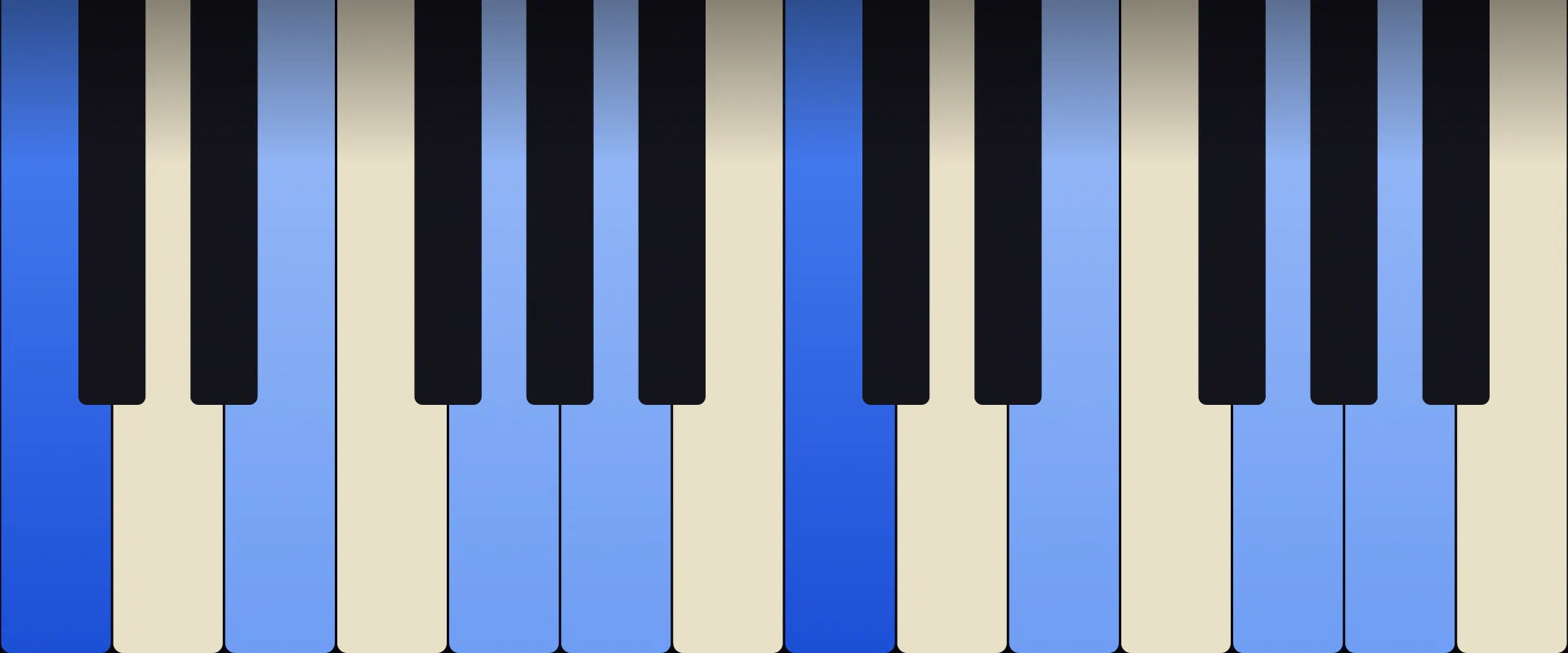
Four notes, four white keys, and the crowding is all at the top. Right hand takes thumb on C, second finger on E, third on G and fifth on A, so the last two fingers cover a whole step while the thumb and index share a comfortable major 3rd. The little finger does the extra work, worth knowing before you end a phrase on the chord and ask that finger to hold the sound.
Most players do not voice it that way for long. Drop the G, keep C, E and A, and the chord still reads as C6 while the hand relaxes. The other standard fix is to split it: C alone in the left hand, A, C and E in the right. That right hand is an A minor triad, and hearing it as one while the chord still works as the tonic of C is the quickest route into what a 6th chord is for.
Then there is the ending. Classical practice treats a 6th above the bass in a final chord as something to resolve, but swing and stride pianists made C6 the standard last chord of a tune in C, precisely because it stops the music without sealing it shut. Bebop swapped in Cmaj7, and the 6th ending has sounded like a particular decade ever since.
C6 on the Guitar
The open shape is x 3 2 2 1 0, one finger away from a chord every beginner already knows. Take open A minor, x 0 2 2 1 0, and move the bass from the open 5th string up to C at the 3rd fret. The notes are C, E, A, C, E: no G at all, a C6 with the 5th missing, the guitar quietly agreeing with the pianists about which note goes first.
The fingers sit between the 1st and 3rd frets exactly as they do in x 3 2 0 1 0, with the 3rd string fretted at the 2nd rather than left open, so no new stretch is involved: the usual grip is a flattened middle finger across the 4th and 3rd strings with the ring or little finger reaching for the bass C.
Let the 6th string ring by mistake and the low E turns the chord back into A minor with E in the bass. The C6 identity lives entirely in that one fretted bass note, so damping the 6th string here is not tidiness, it is the difference between two chords.
Both movable shapes are worth having. The A6 shape barred at the 3rd fret gives x 3 5 5 5 5, a flat fret column that is easy to grab and the grip western swing rhythm players lived in. The E6 shape at the 8th fret gives 8 10 10 9 10 8 and is a real handful: barre at the 8th, ring finger flattened over the 5th and 4th strings at the 10th, middle finger back on the 3rd string at the 9th, little finger out on the 2nd at the 10th. It buys a low C on the 6th string, which with a bass player in the room rarely earns its keep.
Inversions
| Inversion | Notes | Bass | Symbol |
|---|---|---|---|
| Root position | C E G A | C | C6 |
| 1st inversion | E G A C | E | C6/E |
| 2nd inversion | G A C E | G | C6/G |
| 3rd inversion | A C E G | A | C6/A |
The last row is the whole subject in one line. C6 with A in the bass is not a rare inversion a chart might call for once a year, it is Am7 in root position written from the other end. Which label gets used depends on the bass and on what comes next, and both are correct at once. Jazz pianists exploit it without naming it, voicing Am7 as a C major triad over an A. For the general case, see Chord Inversions and Voice Leading.
Voicings
Register settles the argument. With C low in the bass and the A on top of the G, the root stays the reference; put the A near the bottom and the ear reassigns the chord to A minor at once.
Adding one note changes the mood without changing the function. C, E, G and A plus a D is C6/9, the lush ending chord of a thousand arrangements, and on guitar it is x 3 2 2 3 3, no harder than the plain 6th. Changing the bass changes the chord entirely: an F underneath gives Fmaj9, a D underneath gives D11 with no 3rd. Four notes this evenly spaced are unusually willing to be reinterpreted.
| Shape | Frets | Result |
|---|---|---|
| C6 | x 3 2 2 1 0 | Open, no 5th |
| C6 | x 3 5 5 5 5 | A shape at the 3rd fret |
| C6 | 8 10 10 9 10 8 | E shape at the 8th fret |
| C6/9 | x 3 2 2 3 3 | Adds D, wider and softer |
| Am7 | x 0 2 0 1 0 | The same notes, A in the bass |
Which Keys Contain C6
- I of C major
- IV of G major
- V of F major
- I of C Lydian
- I of C Mixolydian
- III of A natural minor
Three of those have C as the tonic, which is no accident. C major, C Lydian and C Mixolydian disagree about exactly two notes, the 4th and the 7th, and C6 contains neither, so it is the home chord of all three. A soloist can play F or F♯, B or B♭ over it and none of it will be wrong.
Where C6 Shows Up
| Progression | Chords | Context |
|---|---|---|
| ii7, V7, I6 (C major) | Dm7, G7, C6 | The swing era ending |
| I6, vi, ii7, V7 (C major) | C6, Am, Dm7, G7 | Turnaround with a restless tonic |
| I6, IV6, I6 (C major) | C6, F6, C6 | Western swing and Hawaiian vamps |
| IV6, I (G major) | C6, G | C6 as a subdominant with a lift |
This root’s strongest claim on the chord is not a progression, it is a tuning. C6 is one of the two great steel guitar tunings, and the second neck of a double neck pedal steel is simply called the C6 neck: open the strings and the instrument is already playing C, E, G and A. Hawaiian and western swing players built an idiom out of sliding that shape around, and the sound of a lap steel is partly just the sound of this chord needing no fingers at all.
Rhythm guitar in swing bands works the same territory from the other side. A comping player holding three or four notes behind a horn section uses 6th chords rather than major 7ths because the 6th leaves the space under the octave open, while a major 7th claims it and clashes with anyone playing the root. That is why so many written guitar parts from the 1930s and 1940s ask for C6 where a modern chart would print Cmaj7.
The ambiguity earns its keep elsewhere too. Hold C, E, G and A in the right hand, walk the left from C to A to D, and the harmony reads C6, then Am7, then D11 while the right hand never moves.
Related Chords
- C Major Chord, the triad the A is added to
- A Minor Chord, the triad sitting inside C6, and the root of the Am7 reading
- C Sus4 Chord, the opposite trade: a note removed rather than added
- Seventh Chords: The Complete Guide for Cmaj7 and Am7
- Guitar Chord Shapes: The CAGED System for moving the 6th shapes up the neck
Learn More
Practice Chords
Drill chord recognition with a metronome, MIDI support, and score tracking.
Start PracticingRelated Articles
A Major 6th Chord: Notes, Voicings, and How to Play It
Aug 26, 2026 · 8 min
A♭ Major 6th Chord: Notes, Voicings, and How to Play It
Aug 26, 2026 · 8 min
B Major 6th Chord: Notes, Voicings, and How to Play It
Aug 26, 2026 · 8 min