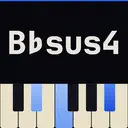
The suspended note in Bsus4 is E, and E is where this chord usually goes. B is the dominant of E major, so a player reaching for Bsus4 at a cadence is holding the tonic of the key inside the chord that is meant to be pulling towards it. To arrive, the chord first has to let that note go: E drops a semitone to D♯ for plain B major, and the D♯ then climbs back up to E when the tonic finally lands. The three notes are B, E and F♯.
Do not expect it to be an easy way out of B major, though. Bsus2 is the chord players use to dodge that barre. Bsus4 asks for a finger back.
Try It: Bsus4 in the Chord Finder
The Notes of Bsus4
| Degree | Note | Interval from Root | Semitones |
|---|---|---|---|
| 1 (Root) | B | Perfect unison | 0 |
| 4 | E | Perfect 4th | 5 |
| 5 | F♯ | Perfect 5th | 7 |
The fifth is untouched, so the chord is anchored. Between B and E sits a perfect fourth; between E and F♯ only a whole step, the tightest interval here and the one that decides how the chord has to be laid out.
How Bsus4 Is Built
Take B major, B D♯ F♯, and push the third up one semitone to E. That is the smallest move available, and it removes the note that would have told you whether the chord was major or minor.
The spelling comes free. The fourth letter above B is E (B, C, D, E) and B to E natural is already five semitones, so no accidental is needed. B major carries two sharps, D♯ and F♯. Bsus4 carries one. It is the plainest looking chord on this root.
Put the D♯ back and keep the E as well and the chord becomes Badd4, where D♯ and E grind a semitone apart, a deliberate effect rather than a suspension. Take the E away instead and B5 is left, B and F♯ alone.
Bsus4 on the Piano
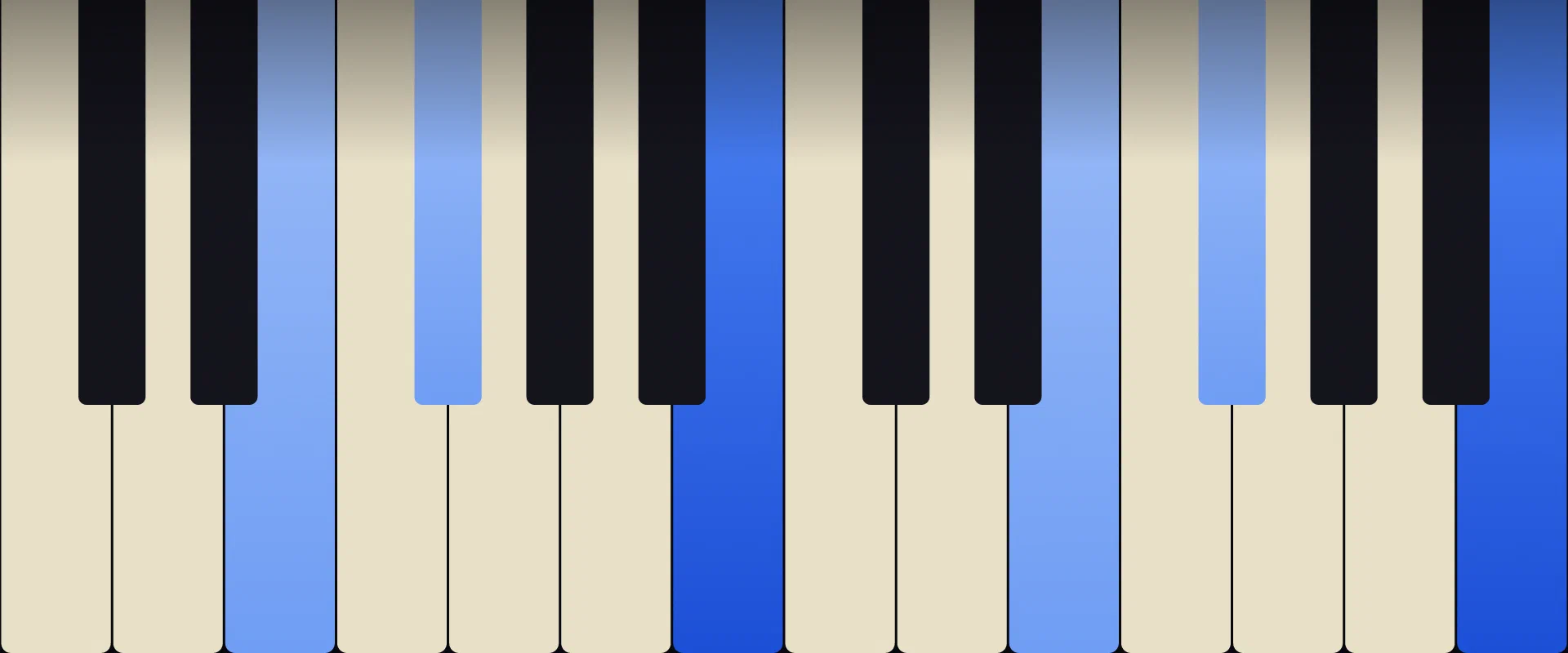
Two white keys and one black: B and E are white, F♯ is black. B major needs two black keys, so switching between them changes the shape of the hand rather than just one note.
Hold B major with the thumb on B, the middle finger on D♯ and the little finger on F♯. To reach Bsus4, the middle finger comes off the black key, forward and up a semitone onto E at the front of the keyboard. The thumb and little finger never move. Play the change slowly and you can feel the middle knuckle drop as the hand leaves the black key group, a bigger physical event than the sideways slide that turns B major into Bsus2.
Close position is a poor home for it. B, E and F♯ inside one octave puts a whole step at the top, where E and F♯ blur below middle C. Inverting fixes it: F♯, B, E from the bottom is two perfect fourths stacked, open and slightly hollow, with the E on top ready to fall to D♯. Pianists comping in E major go further and put B alone in the left hand with F♯ and E in the right, which leaves the resolving note where the ear can follow it.
Bsus4 on the Guitar
No open form exists on this root, so the barre shapes do the work, and the two of them behave in opposite ways.
At the second fret, the sus4 costs you something. B major there is x24442, and its difficulty is the ring finger, which has to lie flat across three strings at fret 4 while arching enough for the top string to sound at fret 2. Bsus4 is x24452: the second string moves up to fret 5, because that is where E sits. Nothing has to be flat and arched any more, but the fingers are now all spoken for, with the index barring fret 2, two fingers on the fourth and third strings at fret 4 and the little finger stretching to fret 5. Near the nut, where the frets are widest and the strings pull hardest, that is a genuine span.
A cheaper answer exists only because of how the guitar is tuned. Play x24400: index on the fifth string at fret 2, two fingers at fret 4 on the fourth and third strings, top two strings open. The open second string gives B and the open first gives E, so the suspension costs nothing and the chord rings out as B, F♯, B, B, E with no barre.
At the seventh fret the arithmetic flips. B major is 799877, one barre with three fingers stacked above it and the middle finger alone on fret 8. Bsus4 is 799977: the third string joins the two below it at fret 9, so the ring finger lies flat across the fifth, fourth and third strings and the middle finger has nothing to do. Up here the suspension is the easier grip, the exact reverse of fret 2. It is also the busiest part of the neck for this root, since the first box of the B minor pentatonic scale starts at the same barre and B, E and F♯ are three of its five notes.
Inversions
| Inversion | Notes | Bass Note |
|---|---|---|
| Root position | B E F♯ | B |
| 1st inversion | E F♯ B | E |
| 2nd inversion | F♯ B E | F♯ |
The first inversion has a second name. E, F♯, B from the bottom is Esus2 in root position, the same three notes with E underneath, so the chord that resolves to E major is one bass note away from being a chord built on E. A guitarist holding x24400 need only let the sixth string ring open and the harmony becomes an E drone, with no finger moving.
The second inversion earns its keep elsewhere. F♯, B, E is F♯7sus4 with the fifth left out, the standard chord placed in front of B. One handful of notes is therefore the dominant of E, a suspension over E, and the dominant of B, and only the bass says which.
Voicings
Give the E room. It is the note with somewhere to go, so keep it at the top or an octave clear of the root. On the guitar x24400 does this by accident, with the E ringing open above three lower notes.
For the classic strummed figure, alternate x24452 and x24442 without lifting the index barre. The little finger is the only thing moving, and the change from suspension to major happens on one string.
Which Keys Contain Bsus4
G, D, A and E are the four keys the guitar is happiest in, and B lands on a different degree of each, which is most of the explanation for how often the chord turns up.
The last entry matters for another reason. B major and B natural minor both contain E and F♯, so Bsus4 belongs to both untouched. A song that cannot decide between the two, which describes a great deal of guitar rock, can sit on it as a tonic and never choose.
Where Bsus4 Shows Up
| Progression | Numerals | Chords |
|---|---|---|
| The cadence in E | Vsus4, V, I | Bsus4, B, E |
| Rock loop in E minor | i, VI, III, Vsus4 | Em, C, G, Bsus4 |
| Tonic figure in B | I, Isus4, I | B, Bsus4, B |
| The vi, undecided | I, V, vi, IV in D | D, A, Bsus4, G |
The first row is the reason the chord exists on this root. E major is the key the instrument was practically designed around, its I and IV are open chords and its V needs a barre. Putting the suspension in front of that V stretches the arrival across two chords, and since the suspended note is E itself, the ear hears the destination early.
The second row uses the opposite property. E natural minor has a D natural, so its fifth chord is properly Bm, and countless songs sharpen it to B major at the cadence to get some pull. Bsus4 sits out of that argument: with no third at all it works over either reading and leaves the decision to whatever comes next.
The fourth row is the folk guitarist’s version. In D major, B is the vi and the written chord is Bm, which needs a barre. Bsus4 keeps every note inside D major, saves the barre, and brightens a chord that was there to darken the progression. That last part is the cost: the verse stops sounding like it contains a minor chord at all.
Related Chords
- B Major Chord
- B Minor Chord
- B Sus2 Chord
- Suspended Chords: Sus2, Sus4, and the Art of Tension
- Guitar Chord Shapes and the CAGED System
- B Minor Pentatonic Scale
Learn More
Practice Chords
Drill chord recognition with a metronome, MIDI support, and score tracking.
Start Practicing