Name the three notes of B♭sus4 and you have also named the three keys a wind section transposes in: B♭ for the trumpets, clarinets and tenor saxes, E♭ for the altos and baritones, F for the horns. The coincidence is not a law of harmony, but it is an honest map of where this chord lives. Concert B♭ is the home key of the wind band, and a suspension over it is a sound those players make dozens of times an evening without thinking about it.
Under a guitarist’s hand it is a chore. B♭ sits one fret above the nut, too low for any open string to help, so there is no open form and every voicing starts with a barre.
Try It: B♭sus4 in the Chord Finder
Set the root to B♭ and look at the gap where the 3rd would be.
The Notes of B♭sus4
B♭sus4 has three notes: B♭, E♭ and F.
| Degree | Note | Interval from B♭ | Semitones |
|---|---|---|---|
| 1 (root) | B♭ | Perfect unison | 0 |
| 4 | E♭ | Perfect 4th | 5 |
| 5 | F | Perfect 5th | 7 |
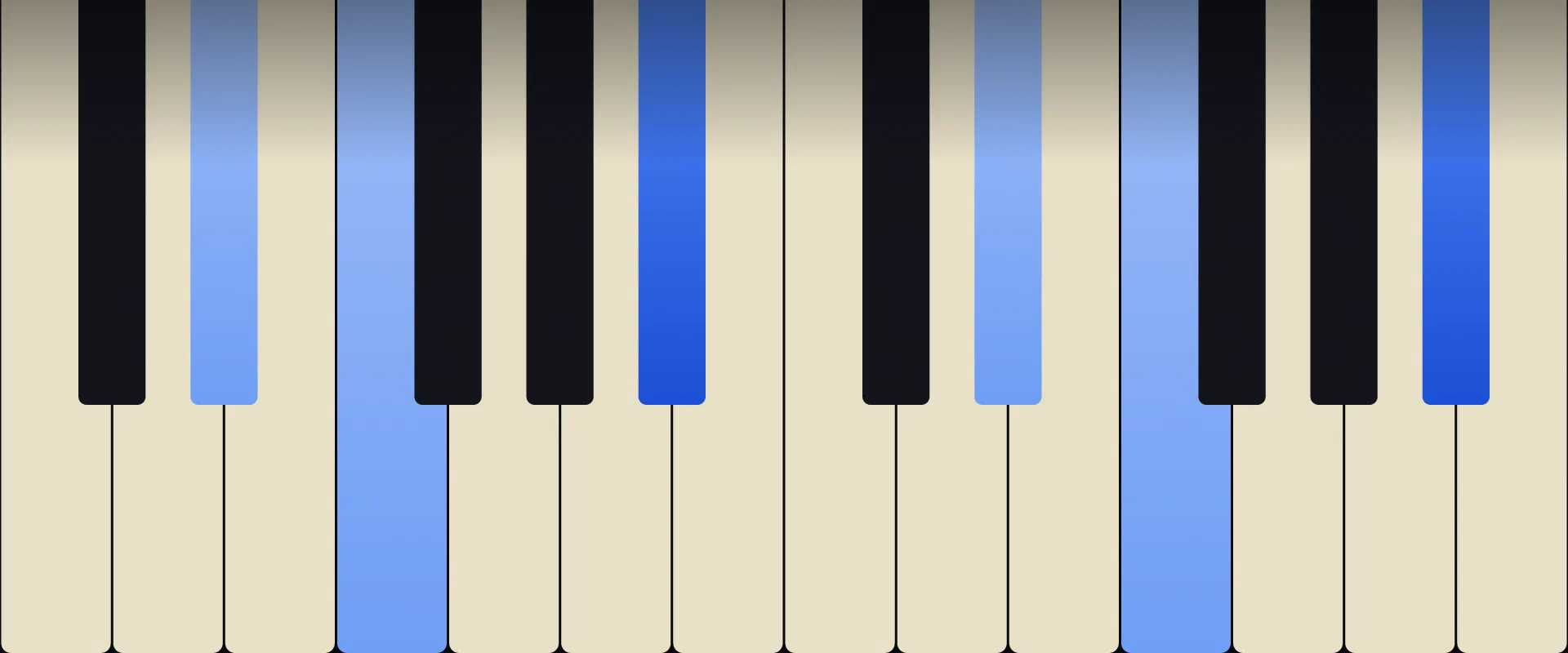
Two black keys and one white one. Because there is no 3rd, the chord is neither B♭ major nor B♭ minor, and a chart that simply says B♭sus means this.
How B♭sus4 Is Built
Take B♭ major, B♭ D F, and push the D up one semitone to E♭. The 4th does not sit on top of the triad as an added colour, it occupies the seat the 3rd has vacated. E♭ leans on the note it displaced and wants to fall back to D, and the moment it does you have plain B♭ major again.
Rotate the three pitches and they spell another chord entirely. E♭, F, B♭ is E♭sus2, root, 2nd and 5th, the same sounds with the bass a perfect 4th higher. Sus4 and sus2 are one set of notes read from two different ends, and the note underneath decides which name is correct.
B♭sus4 on the Piano
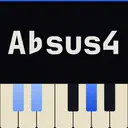
B♭ and E♭ are black, F is white. B♭ is the last key of the group of three, E♭ the second of the group of two, and F the white key that sits just before the group of three begins. The hand ends up well forward on the keyboard with the thumb and a long finger raised onto black, and most pianists find that a more secure place to be than a chord of three white keys.
The spacing is lopsided. B♭ up to E♭ is a perfect 4th and E♭ up to F only a whole step, so the hand is stretched at the bottom and bunched at the top. Take 1 on B♭, 3 on E♭ and 5 on F rather than crowding 1, 2 and 3 together, and keep the wrist high so the thumb stays forward on its black key.
Then practise the release, which is the easiest one on the instrument. Moving E♭ down to D means sliding a finger off the front edge of a black key onto the white key just below it, with no lift and no leap. Do it on a beat rather than in the gap between chords and you have played a suspension rather than an ornament.
B♭sus4 on the Guitar
Both movable shapes work, and one of them is genuinely pleasant, which is rare in this key.
The E shape lands at fret 6: 6 8 8 8 6 6, sounding B♭, F, B♭, E♭, F, B♭. Compare that with B♭ major in the same position, which is 6 8 8 7 6 6. Raising the 3rd string from fret 7 to fret 8 puts three notes in a row on one fret, and the ring finger can barre all three at once. B♭sus4 up here is easier to hold than the major chord it comes from, and the release back to B♭ major is one finger dropping a fret.
The A shape at fret 1 is the opposite bargain: x 1 3 3 4 1, a full index barre right against the nut where the action is highest and the string tension worst. B♭ major in that position, x 1 3 3 3 1, lets the ring finger barre fret 3 across three strings. The sus4 breaks that barre by pushing the 2nd string out to fret 4, so the little finger reaches a fret further while the index is already straining.
Most players avoid the problem rather than solve it. x x 3 3 4 1 gives F, B♭, E♭ and F on the top four strings with no barre anywhere, speaks more clearly than the fret 1 grip, and can be grabbed mid phrase. Leave the root to the bass player, who in this kind of arrangement is covering it already. The CAGED logic behind both shapes is set out in Guitar Chord Shapes and the CAGED System.
Inversions
| Inversion | Notes | Bass note | Symbol |
|---|---|---|---|
| Root position | B♭ E♭ F | B♭ | B♭sus4 |
| 1st inversion | E♭ F B♭ | E♭ | B♭sus4/E♭ |
| 2nd inversion | F B♭ E♭ | F | B♭sus4/F |
The bass does more work here than under any triad, because there is no 3rd to fix the chord’s identity. Put E♭ underneath and most listeners hear E♭sus2, settled rather than waiting. Put F underneath and the notes read as F, B♭ and E♭: root, 4th and flat 7th of F7sus4, the dominant of B♭ major. One set of three pitches serves as both the tonic and the dominant suspension of a single key. More in Chord Inversions and Voice Leading.
Voicings
Two stacked perfect 4ths, F up to B♭ up to E♭, is the voicing to know. It sounds open, sits under one hand, and carries no implication of major or minor.
Adding A♭ turns it into B♭7sus4, the standard approach to E♭. In a score, give the E♭ to one player and nobody else and the chord does its job without rehearsal. See Extended Chords and Jazz Harmony for how far the stack goes once a 7th is underneath.
Which Keys Contain B♭sus4
- I of B♭ major
- V of E♭ major
- II of A♭ major
- III of F♯ major
- I of B♭ natural minor
- contained in B♭ minor pentatonic
The first two entries matter most in practice: this is the tonic suspension of B♭ major and the dominant suspension of E♭ major, which between them cover most of the flat key repertoire a wind player will read.
The F♯ major entry is a warning about notation rather than a place to use the chord. That scale spells the same three sounds as A♯, D♯ and E♯, so one grip on the keyboard appears under two sets of letters, and a player reading E♯ where they expect F will hesitate.
The pentatonic entry is for improvisers. B♭ minor pentatonic adds only D♭ and A♭, neither of which can contradict a chord with no 3rd, so the whole scale sits over B♭sus4 without a note needing care.
Where B♭sus4 Shows Up
The textbook use is a suspension in the strict sense, prepared and then resolved:
F7 | B♭sus4 | B♭
That is V7, then Isus4, then I in B♭ major. The E♭ is not new when the second bar arrives: it is the 7th of F7, already sounding, and it stays put while the bass walks from F down to B♭. Only then does it fall to D. Give that E♭ to a tenor sax and the resolution happens inside a note that never stops.
The second use is the one hymn books and gospel piano share:
A♭ | B♭sus4 | B♭7 | E♭
Here it is IV, Vsus4, V7, I in E♭ major, and the chord delays the dominant rather than the tonic. The E♭ inside it is the key note itself, held over from the A♭ chord before, so the harmony leans homeward for a full bar.
Both examples show something a keyboard player can miss. On a piano a sus4 is one finger moving late. In a wind section it is a division of labour: one player holds E♭ across the bar line while the harmony changes underneath, and a second supplies the D when it resolves, so the suspension is two people rather than one gesture. That costs nothing to score, which is much of why this chord is everywhere in band writing and scarce in guitar rock.
Related Chords
- B♭ Major Chord, what this chord becomes when E♭ falls to D.
- E♭ Sus2 Chord, the identical three notes read from E♭ up.
- B♭ Sus2 Chord, the other suspension on this root, with C in place of E♭.
- Suspended Chords: Sus2, Sus4 and Tension, on how the two behave differently in context.
Learn More
Practice Chords
Drill chord recognition with a metronome, MIDI support, and score tracking.
Start Practicing