Hardly anyone plays Asus4 for a whole bar. It lands on a downbeat, holds for half a beat and falls back into A major, and the reason is anatomical. Open A already parks three fingertips side by side in the 2nd fret; x 0 2 2 3 0 keeps two of them there and sends a fourth finger to the 3rd fret of the second string. The shape had run out of fingers before this chord asked for one more. A century of rhythm guitar has turned that shortage into an ornament rather than a chord.
Try It: Asus4 in the Chord Finder
Play A major, push the C♯ up one semitone to D, and listen to the chord stop deciding anything.
The Notes of Asus4
| Degree | Note | Interval from root | Semitones |
|---|---|---|---|
| 1 (root) | A | Perfect unison | 0 |
| 4 | D | Perfect 4th | 5 |
| 5 | E | Perfect 5th | 7 |
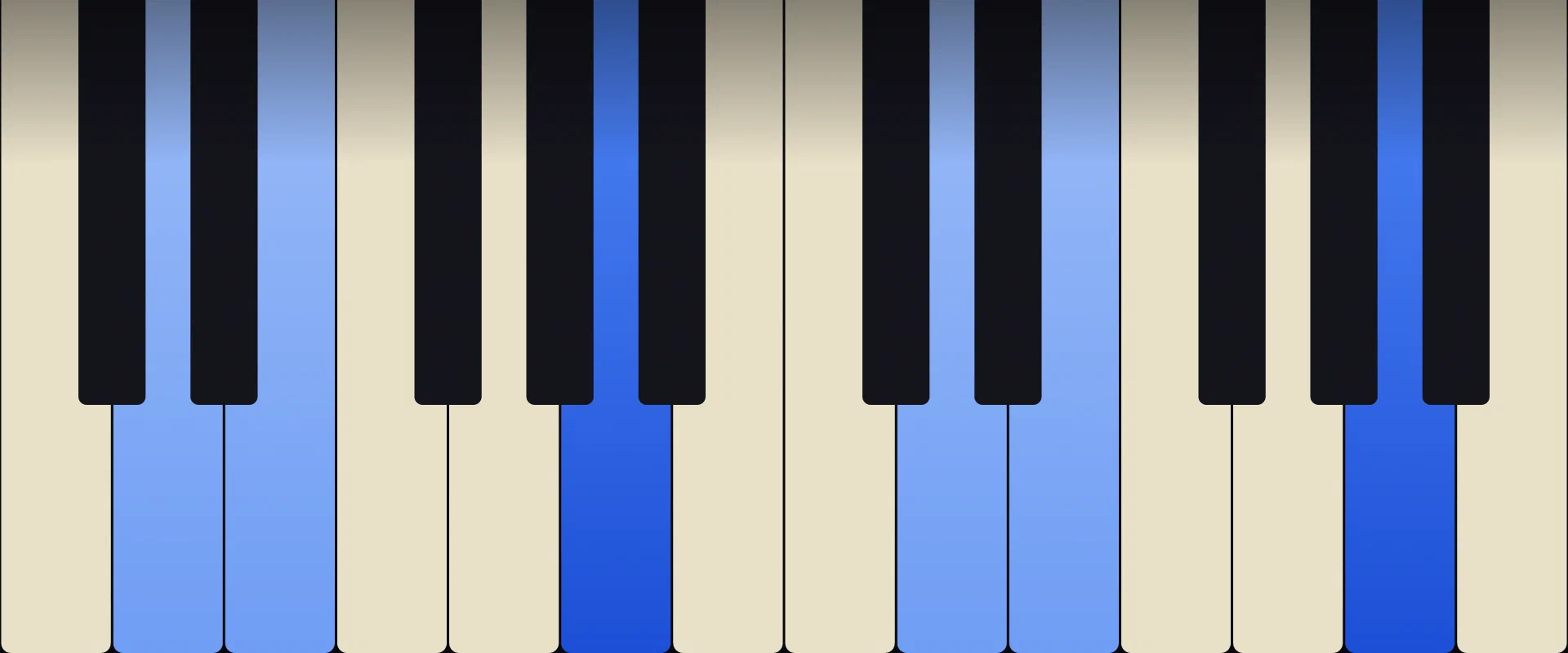
Written out: A, D, E. Three white keys and no accidentals. Those same three letters are the first three chords a beginner is taught in this key, and A and D are adjacent open strings on a guitar, tuned a perfect 4th apart. The defining interval of this chord is built into the instrument’s tuning.
How Asus4 Is Built
A suspended fourth takes the third out and puts the fourth in its place. C♯ rises a semitone to D, the chord loses its third, and with it goes any claim to being major or minor. What remains is a perfect 4th with a whole step stacked on top.
Strip the D away and you are left with A5, the open fifth string and the 2nd fret of the fourth. Asus4 is that bare interval with a fourth dropped inside it.
There is a second name for the same three pitches. Put D at the bottom and A, D, E reads D, E, A: root, major 2nd, perfect 5th, which is Dsus2. Every suspended fourth is the suspended second of the note it suspends, so the bass line alone decides which name a chart prints. On a guitar the demonstration takes one second. From the Asus4 grip, mute the fifth string and let the fourth ring open instead (x x 0 2 3 0). Not one note has changed, and the chord is now called Dsus2.
Chord charts sometimes print A4, meaning Asus4. Aadd4 is a different chord: A, C♯, D and E, with the third still there and D grinding against it a semitone away. That clash is why Aadd4 has no comfortable open shape.
Asus4 on the Piano
All three notes are white, but two of them are pinched. A and D both sit with black keys on either side, so their front sections are narrow and their backs are hemmed in; E has black only to its left and offers a wide landing on the right. The hand ends up with two cramped notes and one generous one.
Right hand 1, 3 and 5 suits it: thumb on A, middle finger a perfect 4th up on D, little finger on E next door. The shape is lopsided in a way triads never are, wide between thumb and middle, then almost touching between middle and little. Left hand 5, 3 and 1 mirrors it and feels stranger still, because the weakest pair of fingers gets the tight interval.
The resolution is where the keyboard teaches something. Slide the middle finger back off D and it lands on C♯, a black key up and to the left, so the finger travels into the keyboard as well as sideways. Slide it the other way, down onto C, and it stays out at the front: white key, no reach, A minor. One suspension, two destinations, and only one of them asks the hand to move in.
Voiced low the fourth muddies fast: A2 with D3 above it is thick and unclear. Put A alone in the left hand, D4 and E4 in the right, and the whole step at the top reads as colour rather than clash.
Asus4 on the Guitar
The standard shape gives you A, E, A, D, E from the fifth string up: two roots, two fifths and a single D. Everything the chord is named for hangs on one note, on the second string, played by whichever finger is left over.
Which finger that is matters. Fret the A shape with index, middle and ring on the fourth, third and second strings and the little finger has to reach past the ring finger to the 3rd fret, crowding an already full fret. Fret A with middle, ring and little instead and the move is clean, but most players do the opposite: index on the fourth string, middle on the third, ring on the second for A major, and the little finger jabbing the 3rd fret for the suspension. That puts all four fingers into a fret and a half of neck, and it is still the standard A to Asus4 to A figure, because the first and fifth strings stay open throughout, so the chord keeps sounding while the hand rearranges itself behind it.
Two escape routes help. Drop the first string and play x 0 2 2 3 x: nothing is lost, since that open E is already doubled, and no finger has to avoid flattening onto it. Or let open strings carry two of the notes, x 0 0 2 3 0, which needs only two fingers. It is thinner and more D heavy, but for fast changes or small hands it is the honest answer.
Away from the nut it gets worse. Asus4 is the Esus4 shape barred at the 5th fret, 5 7 7 7 5 5: an index barre across six strings plus three fingers stacked in the 7th. Guitarists overwhelmingly stay at the nut and reach for a capo instead.
Inversions
| Inversion | Notes | Bass | Symbol |
|---|---|---|---|
| Root position | A D E | A | Asus4 |
| 1st inversion | D E A | D | Dsus2 |
| 2nd inversion | E A D | E | Asus4/E |
The first inversion is barely an inversion. With D underneath, a listener hears Dsus2 and a chart should say so.
The second inversion has a curiosity attached to it. E, A, D is a perfect 4th on top of a perfect 4th, a quartal voicing rather than a stack of thirds, and it is also exactly what the sixth, fifth and fourth open strings of a guitar sound when strummed on their own. Play 0 0 0 x x x and you have the second inversion of this chord with no left hand at all.
Voicings
| Voicing | How to play it |
|---|---|
| Open Asus4 | x 0 2 2 3 0, the standard shape |
| Without the top string | x 0 2 2 3 x, same notes, less to choke |
| Two-finger version | x 0 0 2 3 0, thinner and quicker |
| Barre at the 5th fret | 5 7 7 7 5 5, the Esus4 shape moved up |
| Open strings only | 0 0 0 x x x, second inversion, no fretting |
| Piano, spread | A2 in the left hand, D4 and E4 in the right |
Which Keys Contain Asus4
- I of A major
- V of D major
- II of G major
- I of A natural minor
- IV of E natural minor
- I of A dorian
This chord has no third, so it turns up in well over forty of the scales on this site. The absence is what to notice. E major has D♯ rather than D and therefore cannot hold this chord at all, though it takes A and E happily. That is the opposite of what a guitarist expects, since E is the key where an A chord feels most at home.
Where Asus4 Shows Up
| Progression | In this key | Chords |
|---|---|---|
| Vsus4, V, I | D major | Asus4, A, D |
| I, IV, V with a suspension | A major | Asus4, A, D, E |
| i, ♭VII, IV | E natural minor | Em, D, Asus4 |
| I, ♭VII, IV | A mixolydian | Asus4, G, D |
The first row is the classical use and the sharpest. In D major, A is the dominant and its third, C♯, is the leading note. Suspending that note replaces it with D, the tonic itself, so a Vsus4 in this key is the home note sitting stubbornly on top of the chord that is supposed to be pulling away from it. When the D finally gives way to C♯, the chord starts pulling again and the cadence works. Hymn writers and stadium rock bands use the same mechanism.
In A itself the suspended note is the subdominant, a milder effect. The chord hovers rather than strains, so it turns up under held vocal notes and at the start of choruses more often than at cadences.
Guitar tuning explains why this suspension outnumbers most others on record: A, D and E are the open fifth, fourth and sixth strings, so ringing open notes reinforce it anywhere in first position. Fiddlers get the same gift, since a violin tuned G, D, A, E has three of its four open strings inside the chord.
Related Chords
- A Major Chord the chord this one resolves to
- A Sus2 Chord the other suspension, one fret lower on the same string
- A Minor Chord the other way out of the suspension
- Suspended Chords: Sus2, Sus4 and Tension
- Guitar Chord Shapes: The CAGED System
Learn More
Practice Chords
Drill chord recognition with a metronome, MIDI support, and score tracking.
Start Practicing