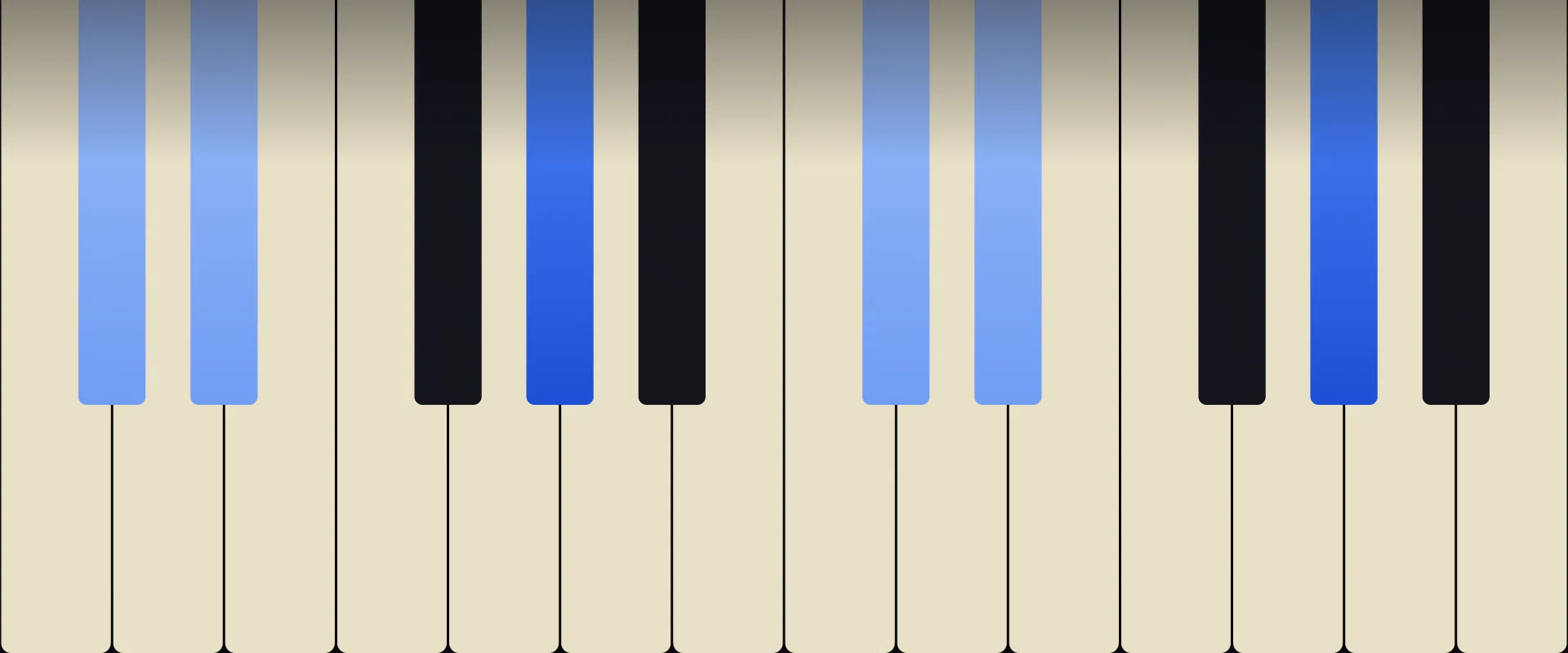
Nothing has been decided while this chord is sounding, and that is what it is for. A♭sus4 holds D♭ in the place where the third belongs, so a gospel pianist can put the full weight of the tonic under a singer and still leave the ending waiting. A♭ is the key that repertoire lives in, and the tonic suspension is part of its vocabulary rather than an effect laid on top. The chord costs nothing at a keyboard, where all three notes are black keys. It costs a barre or a capo on a guitar, which is why organists know it far better than guitarists do.
Try It: A♭sus4 in the Chord Finder
The Notes of A♭sus4
| Degree | Note | Interval from root |
|---|---|---|
| 1 | A♭ | Perfect unison |
| 4 | D♭ | Perfect 4th, 5 semitones |
| 5 | E♭ | Perfect 5th, 7 semitones |
Written low to high in root position: A♭ D♭ E♭.
How A♭sus4 Is Built
Take A♭ major, A♭ C E♭, and lift the C one semitone to D♭. The third has gone, and its replacement stands only a semitone above it, near enough that the ear hears D♭ leaning on the missing C rather than standing in for it. A suspension carries an obligation to fall, and until it falls the chord is neither major nor minor.
These three notes answer to two other names, depending on which of them the bass takes. Read them from D♭ and you get D♭ E♭ A♭, which is D♭sus2, a chord with no tension in it at all. Read them from E♭ and you get E♭ A♭ D♭, a perfect fourth stacked on a perfect fourth, which is E♭7sus4 with the fifth left out. The second one matters in practice, because E♭ is the dominant of A♭: drop an E♭ underneath this chord and the tonic suspension becomes the dominant that resolves to it, with nothing in the right hand moving.
A♭sus4 on the Piano
Three black keys, arranged so the hand can find them without looking. D♭ and E♭ are the group of two, A♭ is the middle of the group of three, so the grip is one pair plus one landmark and the palm stays forward for all of it. Right hand root position sits best as 1 on A♭, 4 on D♭ and 5 on E♭: the thumb takes the fourth below, and the two weak fingers want a level wrist so they can lean on their black keys rather than press.
The resolution is the part worth drilling. D♭ falls to C, so the finger has to leave the black keys for a white one and the whole hand draws back towards the player as the chord settles into A♭ major. Practise it as one gesture rather than two chords: that small retreat is what a listener hears as the release.
Second inversion is the voicing to own here. E♭ A♭ D♭ spreads a minor 7th under the right hand, 1 on E♭ and 5 on D♭, and since nothing in it is a third it sounds neither bright nor dark, only wide. Give it an E♭ in the left hand and you have the gospel dominant. Give it an A♭ instead and the same right hand becomes a tonic that has not finished arriving. One note, two functions, and it is the note nobody is listening to.
A♭sus4 on the Guitar
There is no open form, and both barres cost more than the plain major does. The E shape at the 4th fret runs 4 6 6 6 4 4: index across the 4th fret, then three notes in a line at the 6th on the A, D and G strings, which in practice means a second barre laid down by the ring finger. Two barres in one grip is what the fourth costs, and the result is six stopped strings with no ring in them. The A shape at the 11th fret, 11 13 13 14 11 on the top five strings, is thinner still, and it lands where the frets are cramped.
So the real question in this key is where the capo goes, and the sus4 answers it differently from the major chord.
Capo 1, playing G shapes. The Gsus4 shape, 3 3 0 0 1 3, sounds A♭sus4. It works, but it takes all four fingers, it swaps an open B string for a fretted C, and the only strings left ringing are the D and the G. Capo 1 is still right for the key as a whole, since G shapes give open forms for D♭, E♭ and Fm.
Capo 4, playing E shapes. Esus4, 0 2 2 2 0 0, sounds A♭sus4, and it is the easiest suspension on the instrument: E major with one finger shifted and three strings left open. Behind a capo at the 4th fret those open strings sound A♭ and E♭, both chord tones, so the fourth rings against them instead of being smothered in a barre.
That reverses the usual verdict for the key. A guitarist in A♭ takes capo 1 for the songs and capo 4 for this chord, which is also where a keyboard-heavy band wants the guitar sitting. Without a capo, use the bottom four strings of the E shape, 4 6 6 6, and mute the rest.
Inversions
| Inversion | Notes low to high | Bass note |
|---|---|---|
| Root position | A♭ D♭ E♭ | A♭ |
| 1st inversion | D♭ E♭ A♭ | D♭ |
| 2nd inversion | E♭ A♭ D♭ | E♭ |
First inversion changes the subject rather than the colour. With D♭ underneath, the ear stops hearing a suspension and hears a settled D♭sus2, so reach for it when you want the tension to evaporate instead of resolving.
Voicings
Doubling the root on top, A♭ D♭ E♭ A♭, settles which of the three possible names is in force before the ear has to guess, and it is what you want the first time the chord appears.
Add G♭ above it and you have A♭7sus4, A♭ D♭ E♭ G♭, the chord a soul band vamps on for eight bars before anybody sings.
The move worth stealing is the one that keeps falling. Let D♭ drop to C for A♭ major, then let that C drop again to B♭ and the chord is A♭sus2, A♭ B♭ E♭. Two suspensions sit either side of the third, and walking the middle voice down through all three is a whole gospel introduction played with one finger.
Which Keys Contain A♭sus4
With no third to contradict anybody, the chord belongs to major and minor keys alike:
The last four spell the chord G♯ C♯ D♯. Same sounds, different notation: a key signature made of sharps has no business writing D♭. The chord also sits inside E♭ minor pentatonic, so a soloist can improvise over it in five notes without contradicting it.
Where A♭sus4 Shows Up
| Progression | In letters | Where it lives |
|---|---|---|
| Isus4, I, IV | A♭sus4, A♭, D♭ | Gospel and soul in A♭ |
| Vsus4, V7, I | A♭sus4, A♭7, D♭ | Hymns and standards in D♭ |
| Vsus4, V, i | G♯sus4, G♯, C♯m | Rock and metal in C♯ minor |
The first row is the reason the chord exists in this key. A♭ sits where most voices have weight without strain, so choirs, gospel bands and songwriters writing for a singer end up there constantly, and opening the tonic as a suspension gives the vocal somewhere to enter before the harmony commits. Because D♭ is also the fourth degree of the key, the chord doubles as a hint of the IV that usually follows it.
The second row is the same three notes doing the opposite job. In D♭ major, A♭ is the dominant, and holding the tonic D♭ over it before letting it fall to C is the oldest cadence formula in written music. Hymn books are full of it, and so is every ballad that parks the bass on the fifth for two bars before the last chord.
The third row is where guitar players meet these pitches without recognising them. C♯ minor is a comfortable rock key, its dominant is G♯, and a suspension there is written G♯sus4, G♯ C♯ D♯. A band can build a whole riff on that shape at the 4th fret and never once think the word A♭.
Related Chords
- A♭ Major Chord the chord the fourth falls into
- A♭ Sus2 Chord the suspension on the other side of the third
- Suspended Chords: sus2, sus4 and Tension for what the two suspensions do differently
- Guitar Chord Shapes: The CAGED System for how the E and A shapes move up the neck
- A♭ Major Scale the key this chord calls home
Learn More
Practice Chords
Drill chord recognition with a metronome, MIDI support, and score tracking.
Start Practicing