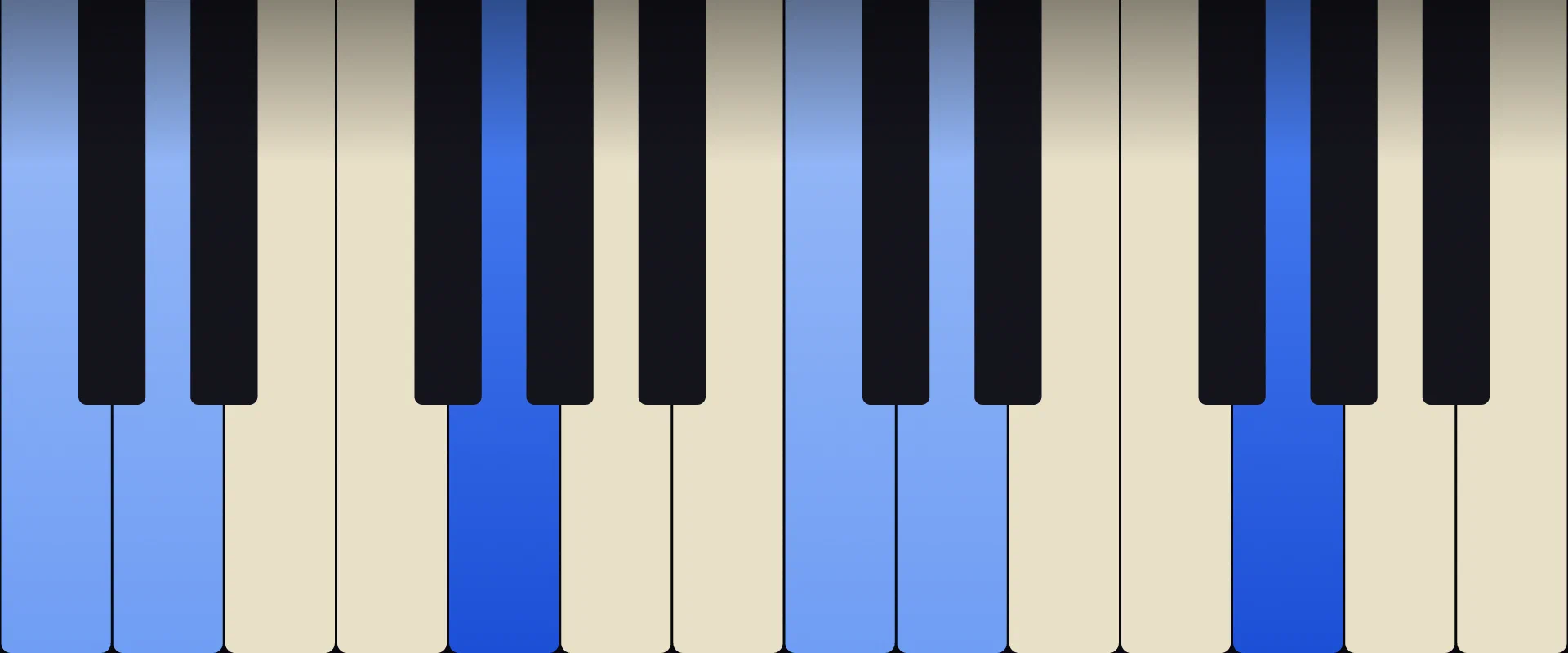
The bar before a chorus lands, in the key of C, is very often this chord. Gsus4 is G, C and D, and the C sitting in the middle of it is the tonic of the key, parked on top of the dominant and refusing to move out of the way. Nothing can resolve while it is there. Drop that C one semitone to B and the leading tone finally appears, the dominant becomes a real dominant, and the C major that follows sounds like an arrival instead of the next chord along.
Delaying the leading tone is why the V sus4 is the hardest working suspension in popular music, and Gsus4 collects more of that work than most: C major is the key beginners write in, G is its dominant, and there is not an accidental in the chord.
Try It: Gsus4 in the Chord Finder
The Notes of Gsus4
| Degree | Note | Interval from Root | Semitones |
|---|---|---|---|
| 1 (Root) | G | Perfect unison | 0 |
| 4 | C | Perfect 4th | 5 |
| 5 | D | Perfect 5th | 7 |
The symbol is Gsus4, sometimes G4 in older guitar charts. A bare Gsus with no number means this chord too: the fourth was the only suspension in common use when the shorthand was invented.
How Gsus4 Is Built
Take G major, G B D, and push the third up a semitone. B becomes C, and with the note that decides between major and minor gone, the chord is neither. What is left is a perfect 4th and a perfect 5th above the root, two consonant intervals that grind against each other because they are only a whole step apart at the top.
That whole step is the engine. C wants to fall to B, because a fourth resolving down to a third is the oldest voice leading gesture in Western music. Sus2 chords sit still for eight bars. This one leans.
Rotate the notes and a second chord appears. C, D, G measured from C is Csus2, so the two are one set of pitches with two names and the bass decides which you hear. Measured from D, the stack D, G, C is two perfect 4ths piled up, which is where jazz pianists get their quartal voicings. Add F on top and it becomes G7sus4, G C D F, the version jazz charts mean and a different chord that deserves its own page.
Gsus4 on the Piano
All three notes are white, but the hand does not sit the way it does on a triad. G major spaces the fingers evenly, 1, 3 and 5 on alternate white keys. Gsus4 puts a fourth at the bottom and a whole step at the top, so the thumb reaches G, the ring finger lands on C, and the little finger is crowded onto the D right next door. Right hand 1, 4, 5. Left hand 5, 2, 1, with the same lopsided feel.
Practise the resolution as a single finger drop. Hold G and D with the thumb and little finger, put the ring finger on C, then move only that finger back to B under finger 3. The outer notes never shift, so the ear hears one voice fall and the chord change quality underneath it.
A suspension is properly three events, and the keyboard makes all three visible. Play F major, F A C. Move F to G and A to D but leave C exactly where your finger already is: that is Gsus4, with the suspended note prepared by the previous chord rather than struck fresh. Then drop C to B for G major and go on to C. Held, suspended, resolved, and the point is that the C is never re-attacked.
Register wants care. C and D a whole step apart below middle C rumbles and obscures the root, so keep that pair in the right hand and let the left take G alone.
Gsus4 on the Guitar
The open B string is the obstacle here, and it is the reason no chart lists Gsus4 among the standard open chords. On a guitar in standard tuning that string is already sounding B, the exact note the suspension exists to remove, so it cannot simply be left ringing the way it is in open G.
Stop it at the 1st fret and the chord appears: 3 3 0 0 1 3 sounds G, C, D, G, C, G. The reach is the awkward part, since the index has to sit at the 1st fret while three fingers hold the 3rd. On the four thinnest strings the same notes come easily as x x 0 0 1 3, the version most players grab mid song.
A second open form dodges the stretch entirely. Fret 3 3 0 0 3 3 and the B string gives D instead of C, so the whole hand parks at one fret. Heavier and less pointed, but it keeps the top two strings ringing across a progression.
| Form | Frets | Notes sounded |
|---|---|---|
| Open, full | 3 3 0 0 1 3 | G C D G C G |
| Open, four string | x x 0 0 1 3 | D G C G |
| Open, one fret | 3 3 0 0 3 3 | G C D G D G |
| E shape barre | 3 5 5 5 3 3 | G D G C D G |
| A shape barre | x 10 12 12 13 10 | G D G C D |
Most of the time nobody fingers the chord at all. The B string at the 1st fret, hammered on and pulled straight off, plays the suspension and its resolution with one finger while the strumming hand keeps going. That ornament puts the sound on far more records than the full grip does.
Away from the nut, the E shape barred at the 3rd fret is the loud version, and fret 3 is a forgiving place for a barre. The A shape at the 10th puts the fingers where the frets are cramped and drops the low root, so it is a thin substitute.
Inversions
| Inversion | Notes | Bass | Symbol |
|---|---|---|---|
| Root position | G C D | G | Gsus4 |
| 1st inversion | C D G | C | Gsus4/C |
| 2nd inversion | D G C | D | Gsus4/D |
Neither inversion behaves like a normal one. Put C in the bass and the chord stops being a suspended dominant and becomes Csus2, a stable and unhurried tonic. Put D in the bass and D, G, C reads as a rootless D7sus4, pulling towards G instead of C. Three notes, three destinations, decided entirely by the bass, which is worth knowing before writing a slash chord that changes the key by accident.
Voicings
Where the C sits changes how urgently the chord wants to resolve. Buried in the middle of the texture it is a colour. Put it on top, as x x 0 0 1 3 nearly does, and it becomes a melody note the listener is waiting to hear fall.
Spacing matters more than doubling. The one fret guitar form gives three Gs, two Ds and a single C, so the suspension is a thin thread through a fifth heavy chord. On piano the opposite works better: G low, then C and D close together an octave or more above it, with nothing in between to blur them.
Which Keys Contain Gsus4
Six keys where this chord does real work:
- V of C major
- V of C natural minor
- I of G major
- II of F major
- VII of A natural minor
- I of G mixolydian
The first two are the useful pair. This is the dominant of C major and the dominant of C minor at once, because the note that separates those keys is E and E is not in the chord. A suspended dominant does not commit to the key it is resolving into, so a song that borrows freely between C major and C minor can hold Gsus4 across the seam and let the resolution decide where it landed.
Where Gsus4 Shows Up
| Progression | Chords | Typical use |
|---|---|---|
| Vsus4, V, I in C | Gsus4, G, C | Pop and rock cadences |
| IV, Vsus4, V, I in C | F, Gsus4, G, C | Hymns, gospel, choral writing |
| vi, IV, Vsus4, V | Am, F, Gsus4, G | The bar before a chorus |
| Isus4, I in G | Gsus4, G | Intros and song openings |
| ii, Vsus4, I in C | Dm, Gsus4, C | Ballads, with the third never arriving |
| III, IIIsus4, i in E minor | G, Gsus4, Em | Modal rock vamps |
Row three is worth hearing on purpose. Am, F and Gsus4 all contain C, so a singer can hold one note across three chord changes while the harmony moves underneath, and the C only turns tense on the last of them. That is how a vocal line sits still and gathers pressure without going anywhere.
Row five hides a different trick. Going straight from Gsus4 to C skips the resolution: the suspended C stays put and becomes the root of the next chord, so the dominant never sounds its leading tone. The cadence lands softer and slightly unfinished, which is why ballad writers use it and hymn arrangers do not.
There is a practical reason so much of this happens in G rather than on some other dominant. Guitar tuning puts C on the 1st fret of the B string, within a hammer-on of a chord every player knows, and Gsus4 to G to C is three chords with only one moving voice on a keyboard.
Related Chords
- G Major Chord, what the suspension resolves into
- G Minor Chord, the other resolution, a whole step down instead of a semitone
- G Sus2 Chord, the third moved down rather than up
- C Sus2 Chord, the same three notes with C in the bass
- G Diminished Chord, which alters the fifth rather than the third
- Suspended Chords: Sus2, Sus4 and Tension
- The C Major Scale
- The G Major Scale
- Guitar Chord Shapes: The CAGED System
Learn More
Practice Chords
Drill chord recognition with a metronome, MIDI support, and score tracking.
Start Practicing