F♯ minor is the relative minor of A major, and A major is one of the two or three keys guitar music never leaves. That single fact matters more than any complaint about six sharps: F♯sus4 sits inside the most-played loop on the instrument, and anyone who has held an F♯m barre for four bars has heard a finger lift out of it and land somewhere brighter.
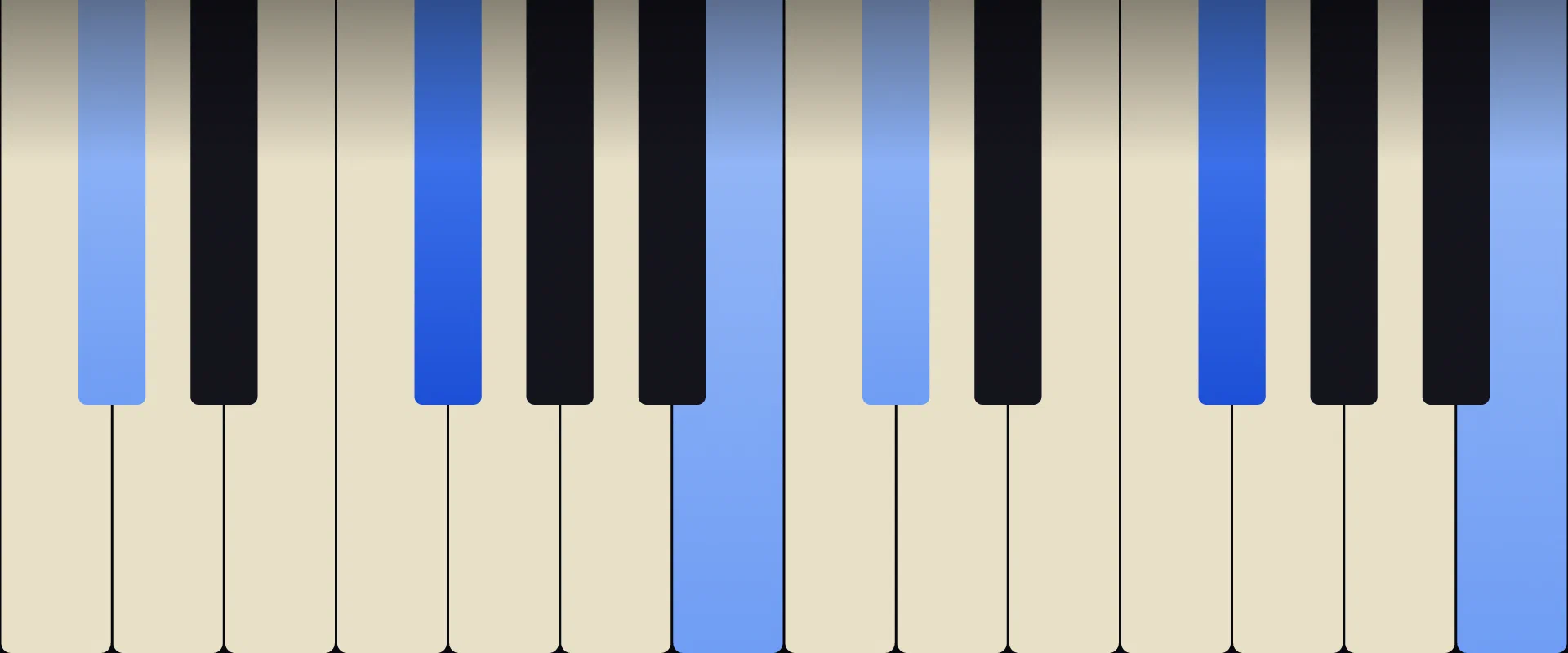
The notes are F♯, B and C♯: two black keys with one white key wedged between them, and on a guitar one open string with two fretted notes either side of it.
Try It: F♯sus4 in the Chord Finder
The Notes of F♯sus4
F♯sus4 contains three notes.
F♯, B, C♯
| Degree | Note | Interval from root | Semitones |
|---|---|---|---|
| 1 | F♯ | Root | 0 |
| 4 | B | Perfect 4th | 5 |
| 5 | C♯ | Perfect 5th | 7 |
Both sharps land on black keys and the B needs no accidental at all, which is unusual for a chord whose root carries one. Written from the flat side the same sound becomes G♭, C♭ and D♭, and the C♭ there is played on the B key.
How F♯sus4 Is Built
Take F♯ major, F♯, A♯ and C♯, and push the A♯ up one semitone to B. Take F♯ minor, F♯, A and C♯, and push the A up two semitones to the same B. The suspended chord sits directly above both thirds, one fret from the major and two from the minor, which is why it can precede either without committing to either.
The outer perfect fifth, F♯ up to C♯, is untouched. What changes is the interior: a perfect fourth from F♯ to B, then a whole tone from B to C♯. The fourth is stable and the whole tone on top is the part that itches.
Turn the chord over so B is lowest and the same three notes read B, C♯, F♯, which is Bsus2 in root position. Every sus4 is the sus2 of the note a fourth above it, and here neither name asks for an accidental the other does not already use.
F♯sus4 on the Piano
The hand sits half in and half out of the black keys, and the awkward note is the B. It lies directly between A♯ and C♯, so the finger playing it must go into the narrow slot behind those two black keys rather than resting at the front of the white key. Play B too far forward and the F♯ underneath slips off the back edge.
Right hand, use 1 on F♯, 3 on B and 5 on C♯. The thumb is deep in the keyboard on a narrow key, so keep the wrist level with the black keys rather than dropped. Left hand, 5 on F♯, 3 on B, 1 on C♯.
Invert it to C♯, F♯, B and something useful appears: two perfect fourths stacked, C♯ up to F♯ and F♯ up to B, both five semitones. That is a quartal voicing, the shape modal jazz reaches for when it wants weight without a stated quality. Spread it across two hands, C♯ low down with F♯ and B above, and the chord stops sounding like a delayed F♯ anything.
F♯sus4 on the Guitar
No open form exists, but one of the three notes is sitting there for free: the second string, open, is B. Every practical voicing here either uses that string or works around it.
The E shape barred at the 2nd fret is the workhorse, 2 4 4 4 2 2. Compare it with the F♯ major barre, 2 4 4 3 2 2, and only one note moves: the third string goes up a fret, from A♯ to B. Against the F♯m barre, 2 4 4 2 2 2, that same string moves up two. This is why the chord is so common in guitar music. It is not a new grip, it is a finger you already have arriving one or two frets late, and the hammer back down is the gesture the progression is built on. The cost is the position: the 2nd fret is where string tension is highest, and holding a six string barre there is work.
The A shape barred at the 9th fret gives x 9 11 11 12 9. The frets are narrow up there so the stretch is nothing, but the little finger has to reach past the ring finger to the 12th fret, and the voicing is thin: the lowest note available is the F♯ on the fifth string.
The lazy option beats both. Fret x 4 4 4 0 2 and the open B rings in the middle of the chord: C♯, F♯, B, open B, F♯. One finger flat across three strings at the fourth fret, one on the top string, no barre at all. For acoustic work a capo is simpler still. Capo the 2nd fret and play an open Esus4, or capo the 4th and play an open Dsus4. Both land exactly here, which is how the chord reaches records made by players who never read a sharp.
Inversions
| Inversion | Notes | Bass note |
|---|---|---|
| Root position | F♯ B C♯ | F♯ |
| 1st inversion | B C♯ F♯ | B |
| 2nd inversion | C♯ F♯ B | C♯ |
The 1st inversion is Bsus2 note for note, and in a song sitting in B major that is what a listener hears. The 2nd inversion is the quartal stack above. Only the bass decides between the three readings, which is the subject of Chord Inversions and Voice Leading.
Voicings
Keep B and C♯ apart at the bottom. A whole tone low in the register turns to mud, so put F♯ and C♯ in the left hand and drop the B in above them, where it reads as a suspension rather than a clash. On guitar the compact version is x x 4 4 2 2 on the top four strings. Letting the second string ring open instead loses the C♯, so save that one for when a bass supplies the fifth.
Which Keys Contain F♯sus4
The first two rows are the point. F♯sus4 is the tonic chord of F♯ major and of F♯ natural minor at once, because the note that separates those keys, A♯ against A, is exactly the note it does not have.
The list runs far past six. It also appears from the flat side, where E♭ natural minor spells the identical sound as G♭, C♭ and D♭ on its third degree. Same frets, different page of the score.
Where F♯sus4 Shows Up
B, C♯m, F♯sus4, F♯, B in B major. The dominant with its third held back, and the held note is the tonic B itself, refusing to leave. When it drops to A♯ the cadence lands. Worship songs and pop ballads in B major run this figure constantly: it lets a whole bar of dominant pass unresolved.
A, E, F♯sus4, F♯m, D in A major. The vi chord arrives suspended and then falls into itself. The loop keeps its familiar shape, but the minor is delayed by two beats, and on guitar the change is one finger on the third string. Capo acoustic pop lives here.
F♯sus4, F♯, Bm in B minor. The same chord as the dominant of a minor key. Its B is the tonic sounding a bar early, so the resolution into Bm arrives with the tonic already ringing and only an inner voice moving. Folk and rock in B minor use it in place of the plain F♯ major dominant, which announces the cadence far earlier.
The chord travels between instruments unevenly. Pianists reach it deliberately, since a hand landing in six sharps went there on purpose. Guitarists arrive sideways, from a capo or from a barre they were already holding, which is why F♯sus4 turns up more in guitar-led repertoire than the key signature would suggest.
Related Chords
- F♯ Major Chord, the usual resolution, one fret away
- F♯ Minor Chord, the other resolution, two frets away
- F♯ Sus2 Chord, the other suspension on this root
- Guitar Chord Shapes: The CAGED System
Learn More
- Suspended Chords: sus2, sus4 and Tension
- Diatonic Chords: A Beginner’s Guide
- The Circle of Fifths Explained, where six sharps sits and why B, E and A major are its neighbours
- The F♯ Major Scale, the home key, in which E♯ is played on a white key
Practice Chords
Drill chord recognition with a metronome, MIDI support, and score tracking.
Start Practicing