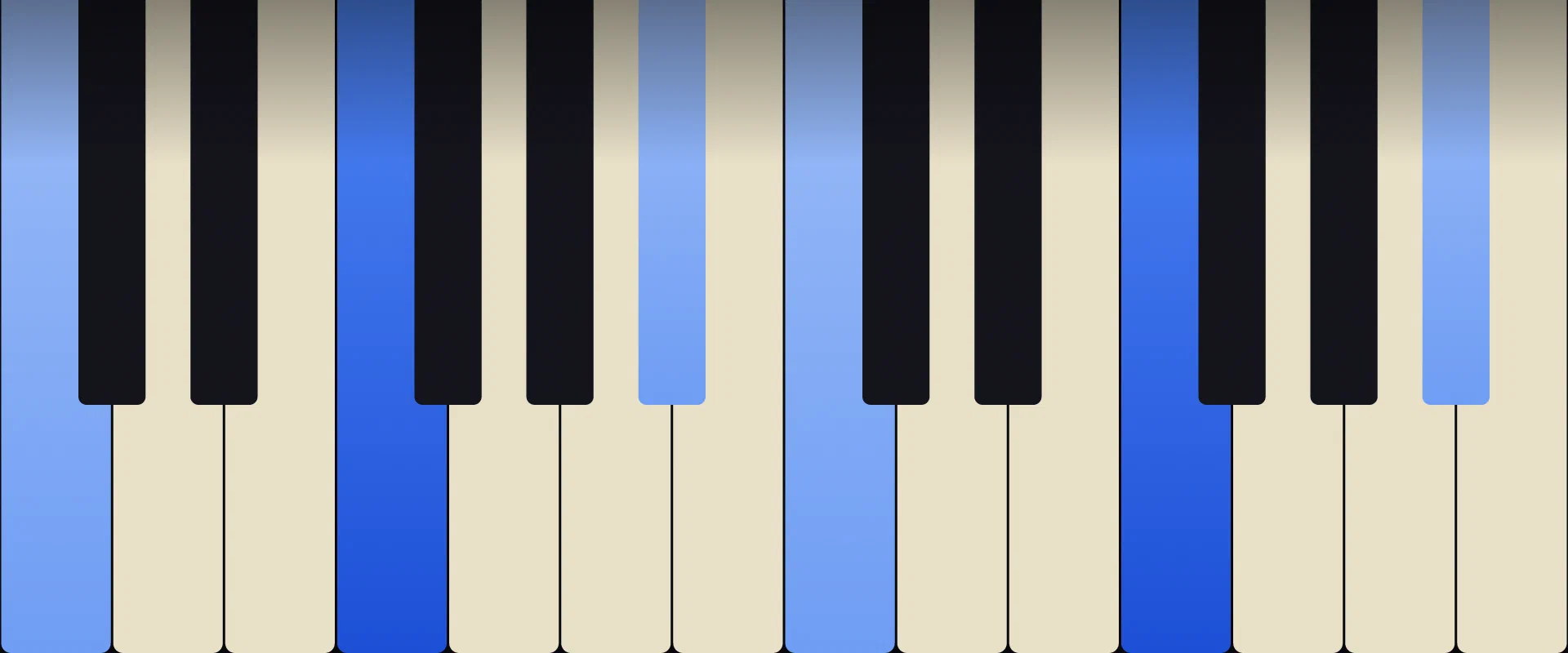
Play F, then Fsus4, then F again while a song sits in C major and you have briefly left the key. The suspended note is B♭, and C major has no B♭. Do the same on the tonic, Csus4 back to C, and the suspended note is F, which was in the key all along. One suspension delays a chord, the other tints it.
Its older home is one step away. In B♭ major, F is the V chord, and holding B♭ across the bar line before letting it fall to A is the cadence hymnals, brass bands and gospel choirs have run on for centuries.
Try It: Fsus4 in the Chord Finder
Set F as the root and play the sus4 against F major. One note moves, and it is the one that decides the chord’s quality.
The Notes of Fsus4
| Degree | Note | Interval from Root | Semitones |
|---|---|---|---|
| 1 (Root) | F | Perfect unison | 0 |
| 4 | B♭ | Perfect 4th | 5 |
| 5 | C | Perfect 5th | 7 |
Five semitones, then two. The wide gap sits at the bottom and the whole step at the top, so the upper notes lean on each other while the root stands alone underneath.
How Fsus4 Is Built
Start from F major, F, A and C, and push the A up one semitone to B♭. The 3rd is what makes a triad major or minor, so taking it out leaves a chord with no quality to report. Notice which note replaced it: B♭ is the single flat in F major’s key signature, so this chord is the root, the 5th and the one accidental that defines its own key.
Turn it over and the name changes. B♭, C, F read upwards from B♭ is a root, a 2nd and a 5th, which is B♭ sus2. Every sus4 has a sus2 twin a perfect 4th above it, and this one shares its twin with the key it acts as dominant in.
Fsus4 on the Piano
Five of the twelve sus4 chords need no accidental at all. This one needs exactly one, and that single black key changes how the hand sits.
Right hand: thumb on F, middle finger on B♭, little finger on C. Left hand: little finger on F, index on B♭, thumb on C. The middle of the hand pushes forward into the black keys while the outer fingers stay on white ones, so the wrist tilts instead of sitting flat the way it does on F major.
The resolution is a semitone drop with the hand otherwise still: let the middle finger fall off the back of B♭ onto A, the white key wedged between the second and third blacks of that group, and F major arrives. Strike the B♭ on the beat, resolve it after, and listen for how little moves. Then add a low B♭ with your left hand: not one key in the right has moved and the chord has a new name.
Fsus4 on the Guitar
There is no open form, and here that costs less than usual. The full chord is the E shape barred at the 1st fret, 1 3 3 3 1 1, sounding F, C, F, B♭, C, F.
Compare it with the F major barre, 1 3 3 2 1 1. One digit differs, the 3rd string moving from fret 2 to fret 3, and it is the digit that causes the trouble. In F major the middle finger has to arch over the barre and land in the middle of the grip, which is what collapses under a beginner’s hand. In the sus4 that finger is gone: three notes sit together at fret 3 on the 5th, 4th and 3rd strings, and the ring finger can lie flat across all three. Players who cannot yet hold F can often hold Fsus4, which is an odd thing to find out about a chord taught as an ornament of the harder one.
The 1st fret is still the worst place to barre, since the string is clamped a fret away at the nut and there is no slack to take up. If it fights back, drop the two lowest strings: x x 3 3 1 1 is one finger away from the four string F, x x 3 2 1
- Drop one more and x x x 3 1 1 gives B♭, C and F, this chord without its root and B♭ sus2 with one. Higher up, x 8 10 10 11 8 is the A shape at fret 8, and it rings far more easily than anything at the nut.
The suspension itself is nearly free once the barre is down. Hold the shape and pull off the 3rd string from fret 3 to fret 2, and B♭ has resolved to A with no other finger moving.
Inversions
| Inversion | Notes | Bass Note | Symbol |
|---|---|---|---|
| Root position | F, B♭, C | F | Fsus4 |
| 1st inversion | B♭, C, F | B♭ | Fsus4/B♭ |
| 2nd inversion | C, F, B♭ | C | Fsus4/C |
No chart writes the first inversion that way. With B♭ underneath it is simply B♭ sus2, because the lowest note of an ambiguous stack is the one the ear elects as root. The second inversion is a perfect 4th on top of a perfect 4th, C to F to B♭, which is the shell of C7sus4, so that rotation points straight at F’s own dominant.
Voicings
Give the 4th room. Held tight under the 5th it reads as a rub, so lift the B♭ an octave to sound as an 11th, or leave the root to a bass player and voice only B♭ and C.
Add E♭ on top and you have F7sus4, what a gospel or soul player holds before the cadence in B♭. The flat 7th sharpens the pull without restoring the 3rd.
Putting the 3rd back is the move that misfires: F, A, B♭ and C sets A against B♭ a semitone apart in one hand, so spread them, A low and B♭ high.
| Shape | Frets, low to high | Sounding notes |
|---|---|---|
| E shape, barred at fret 1 | 1 3 3 3 1 1 | F, C, F, B♭, C, F |
| Four strings | x x 3 3 1 1 | F, B♭, C, F |
| Top three strings | x x x 3 1 1 | B♭, C, F |
| A shape, barred at fret 8 | x 8 10 10 11 8 | F, C, F, B♭, C |
| F7sus4, fret 1 | 1 3 1 3 1 1 | F, C, E♭, B♭, C, F |
Which Keys Contain Fsus4
- I of F major
- I of F natural minor
- V of B♭ major
- IV of C natural minor
- IV of C dorian
- Contained in F minor pentatonic
C major is absent and cannot join. The F major triad is C major’s IV chord, but suspend its 3rd and the chord walks out of the key. The last line matters for soloists: five notes, no clash.
Where Fsus4 Shows Up
| Progression | Chords | Where it lives |
|---|---|---|
| I, IV, Vsus4, V | B♭, E♭, Fsus4, F | Hymn and gospel cadences in B♭ |
| IV, IVsus4, IV, I | F, Fsus4, F, C | Acoustic and piano pop in C |
| i, VII, isus4, i | Fm, E♭, Fsus4, Fm | Minor vamps over an F pedal |
The first line is the chord doing its original job. B♭ and E♭ are the keys brass players and gospel choirs live in, so a choir holding the B♭ of an E♭ chord across into the F is suspending in the strict sense: a note kept, then made to fall.
The second behaves differently. That B♭ tugs the ear towards F’s own key for a beat before the music snaps back to C, which is why the move sounds richer than the same wobble on the tonic.
The third shows the suspension in a minor context. F minor is F, A♭ and C, so the sus4 raises the A♭ a whole step rather than lowering anything, and the chord brightens without going major. Slow soul and film cues sit on that alternation over a held F for bars at a time. Guitar bands drift towards the keys their open strings spell, while piano, horns and choirs live in B♭ and F, so this is a suspension you are likelier to have sung than strummed.
Related Chords
- F Major Chord is where the B♭ falls to.
- F Minor Chord is the other resolution, a whole step down.
- F Sus2 Chord suspends with G and stays inside C major.
- B♭ Sus2 Chord is these three notes with the bass moved.
- Suspended Chords: Sus2, Sus4 and Tension covers how both suspensions resolve.
Learn More
F sits one step anticlockwise from C on the circle of fifths and B♭ one step further, which is why this chord belongs to B♭ and not to C. For F7sus4, see Seventh Chords: The Complete Guide, and for the 4th voiced as an 11th, see Extended Chords and Jazz Harmony. For every scale containing this chord, see Scales for Piano and Guitar: The Complete Reference Guide.
Practice Chords
Drill chord recognition with a metronome, MIDI support, and score tracking.
Start Practicing