Add a finger to an open E and you do not have to take anything away. Drop the little finger onto the third string at the 2nd fret, in front of the index finger already parked at the 1st, and the G♯ behind it simply stops sounding. That is Esus4: 0 2 2 2 0 0, E, A and B, six strings ringing in the loudest register the guitar owns, bought with one extra fingertip and no rearrangement of the hand. Hammer it on, pull it off, and E major returns. There is a tidier reason to know this chord as well. E, A and B are the roots of the I, the IV and the V of E major, so these three notes are the skeleton of an entire key held down at once.
Try It: Esus4 in the Chord Finder
Set the root to E, then look at the chord on E major and again on E natural minor. It comes through the switch unchanged, because the third those two scales argue about is the one note it refuses to play.
The Notes of Esus4
Esus4 takes the root, perfect 4th and perfect 5th:
E, A and B
| Degree | Note | Interval from Root |
|---|---|---|
| 1 (Root) | E | Perfect unison |
| 4 | A | Perfect 4th |
| 5 | B | Perfect 5th |
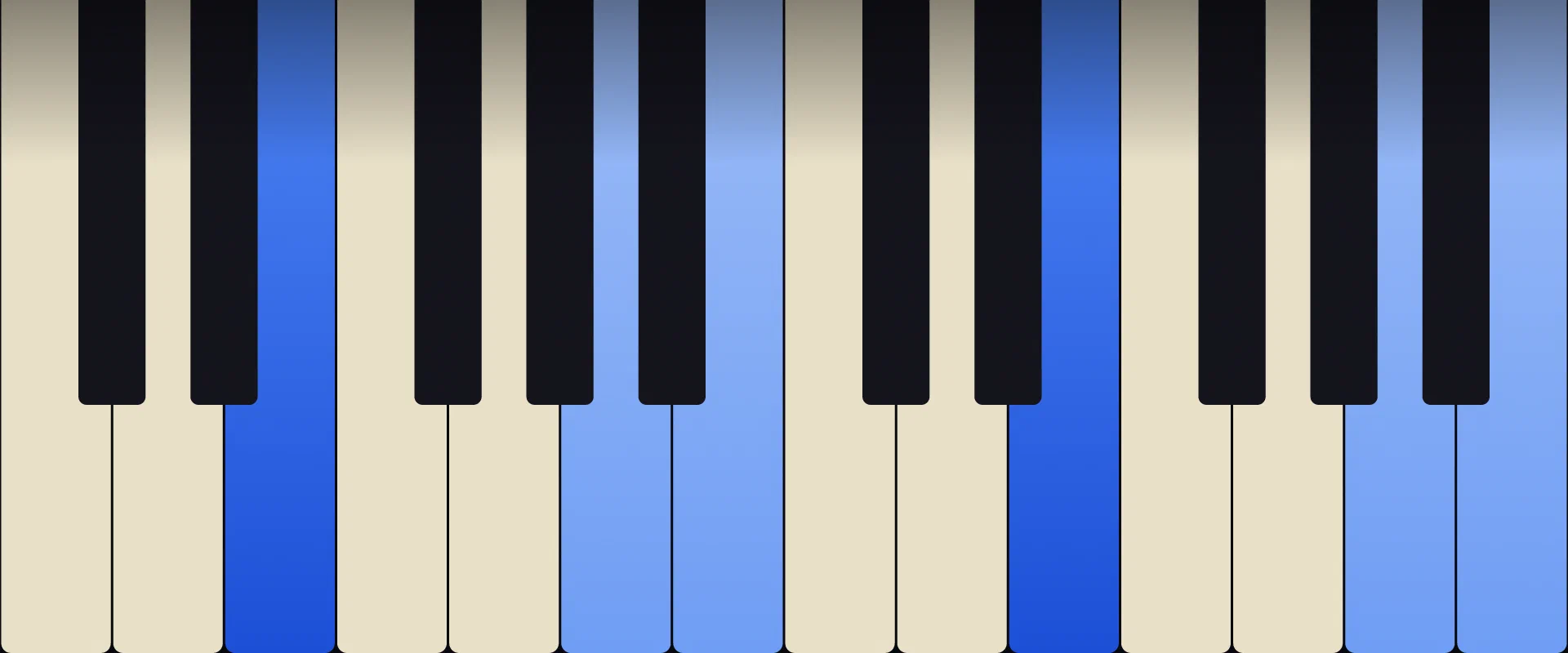
Not one accidental, so all three notes are white keys. They are also three of the six open strings on a guitar in standard tuning, which is the practical reason this chord rings the way it does.
How Esus4 Is Built
Start from E major, E, G♯ and B, and push the G♯ up one semitone to A. The third is replaced rather than added to, so the chord has no opinion about major or minor and can precede either.
Rotate it and the identity changes. Take A as the lowest note and A, B, E is Asus2, the same three pitches with the fourth reinterpreted as a root and the root reinterpreted as a fifth. Every sus4 chord has a sus2 partner a fourth above it, and here the partner is the other great open guitar key.
Two near neighbours are worth keeping apart. E7sus4 adds D and turns the chord into a dominant. Eadd4 keeps the G♯ and puts A beside it, a much sourer sound: the suspension works only because the third has left the room.
Esus4 on the Piano
Three white keys and no black ones, arranged wide at the bottom and tight at the top. E up to A is a perfect fourth, a comfortable stretch for any hand, and then A to B is a single step, two neighbouring white keys.
Right hand: thumb on E, second finger on A, third finger on B, which leaves the fourth and fifth free for a melody note above the chord.
Left hand: fifth finger on E, second finger on A, thumb on B.
With no accidental to feel for, the hand gets no tactile landmark and beginners lose the shape whenever they look away. Use the pair of adjacent whites at the top as the anchor: find A and B, then reach back for E.
Voiced tightly in the middle of the keyboard, A and B rub against one another and the chord sounds unresolved rather than open. Take E down an octave in the left hand and leave A and B alone in the right, and the same three notes turn wide and patient, which is how a slow tempo wants them.
Esus4 on the Guitar
The open form, 0 2 2 2 0 0, sounds E, B, E, A, B, E from the bottom up. Three E’s, two B’s and exactly one A: the suspension is a single voice sitting on top of what is otherwise a very loud open fifth. That ratio is why the chord holds up under distortion where a denser voicing would smear, and why it belongs to rock rhythm playing rather than to jazz comping.
The fingering matters more than the diagram suggests. From an open E fingered with index, middle and ring, the little finger is already free, so it lands on the third string at the 2nd fret without disturbing anything. It stops the string ahead of the index finger, so the G♯ underneath never sounds and there is nothing to lift. The result is a suspension you can flick in and out mid-bar at any tempo, which is what makes it the default ornament for anyone strumming in E.
Two variations pay for themselves. x 0 2 2 0 0 mutes the sixth string and lets the open fifth ring, and those identical fingers now sound A, E, A, B, E, which is Asus2. Nothing moved except the bass. x x 2 2 0 0 is the two finger version, E, A, B, E, light enough to drop into a fingerpicked passage.
For a compact voice, take the Asus4 shape and barre it at the 7th fret: x 7 9 9 10 7. The frets are narrower up there, the chord loses its open strings and therefore its ring, and it stops when you mute it, which a busy arrangement often wants. Barre the open form instead and you have the movable sus4 shape that gives Fsus4 at the 1st fret and Gsus4 at the 3rd.
Inversions
| Voicing | Notes | Bass note |
|---|---|---|
| Root position | E A B | E |
| 1st inversion | A B E | A |
| 2nd inversion | B E A | B |
Because there is no third, the bass note does not merely colour these voicings, it renames them. With A underneath, the first inversion is heard as Asus2 and nothing about the upper voices contradicts that reading. The second inversion is stranger and more useful: B, E, A is B with a fourth and a minor seventh above it, which is B7sus4 without its fifth, the standard suspended dominant of E major. Put the notes of this chord over a B bass and they become the thing that resolves back to E.
Voicings
- Open form, 0 2 2 2 0 0, six strings and the full weight of the low E.
- Two finger partial, x x 2 2 0 0, the same chord at a quarter of the volume.
- Over the fifth, x 0 2 2 0 0, which the ear takes as Asus2.
- Barred at the 7th fret, x 7 9 9 10 7, tight and stoppable.
- Piano spread, E an octave down in the left hand with A and B alone in the right.
Doubling the A is the one thing to avoid. One fourth suspends the chord, two of them start to sound like the arrangement mislaid its third.
Which Keys Contain Esus4
Exactly five major keys contain all three notes, and they are the five that guitar music defaults to:
- degree 1 (I) of E major
- degree 5 (V) of A major
- degree 2 (II) of D major
- degree 6 (VI) of G major
- degree 3 (III) of C major
- rooted on degree 1 of, and entirely contained in, E minor pentatonic
The minor side is just as generous: with no third to conflict, the chord also sits on the tonic of E natural minor, E Dorian and E Phrygian. The pentatonic entry explains a good deal of guitar music, though. E, A and B are the first, fourth and fifth notes of E minor pentatonic, so a soloist in the most heavily used scale on the instrument is improvising over three notes they are already leaning on.
Where Esus4 Shows Up
As the tonic ornament in E. I, Isus4, I: E, Esus4, E, played as a hammer-on and pull-off inside one bar rather than as three separate chords. Folk, rock and country rhythm guitar in E use this as punctuation, the way a pianist uses a grace note, and it is common enough that listeners hear it as part of the E chord rather than as a chord change.
As the suspended dominant in A. Vsus4, V, I: Esus4, E, A. The fourth, A, is the note the progression is heading for, so sounding it early over an E bass makes the arrival feel inevitable. Country and gospel playing in A lean on this hard, and because both E and A are open shapes the whole gesture costs one finger and one strum.
As a tonic that has not chosen a mode. In E Dorian or E natural minor, the same chord resolves the other way, with A falling to G rather than rising to G♯. Modal folk material in E exploits that: hold Esus4 over a drone and the fiddle or the voice decides afterwards whether the piece is major or minor.
The chord is impatient by nature. Held for a whole bar with nothing arriving, it stops sounding like tension and starts sounding like an unfinished thought, which is why almost every use above measures its life in beats.
Related Chords
- E Major Chord: Notes, Voicings, and How to Play It is the chord the fourth resolves into, and the shape this one is built on top of.
- E Minor Chord: Notes, Voicings, and How to Play It is the other available resolution.
- E Sus2 Chord: Notes, Voicings, and How to Play It suspends downwards instead, and costs far more on the fretboard.
- Suspended Chords: Sus2, Sus4, and the Art of Tension covers the family and how suspensions resolve.
Learn More
- Diatonic Chords: A Beginner’s Guide to Building Chords from Scales explains the third that this chord removes.
- Chord Inversions and Voice Leading on why the bass note decides between Esus4 and Asus2.
- Guitar Chord Shapes and the CAGED System shows how the open form moves up the neck.
- E Major Scale: Notes, Chords, and How to Play It is the key whose I, IV and V roots make up these three notes.
Practice Chords
Drill chord recognition with a metronome, MIDI support, and score tracking.
Start Practicing