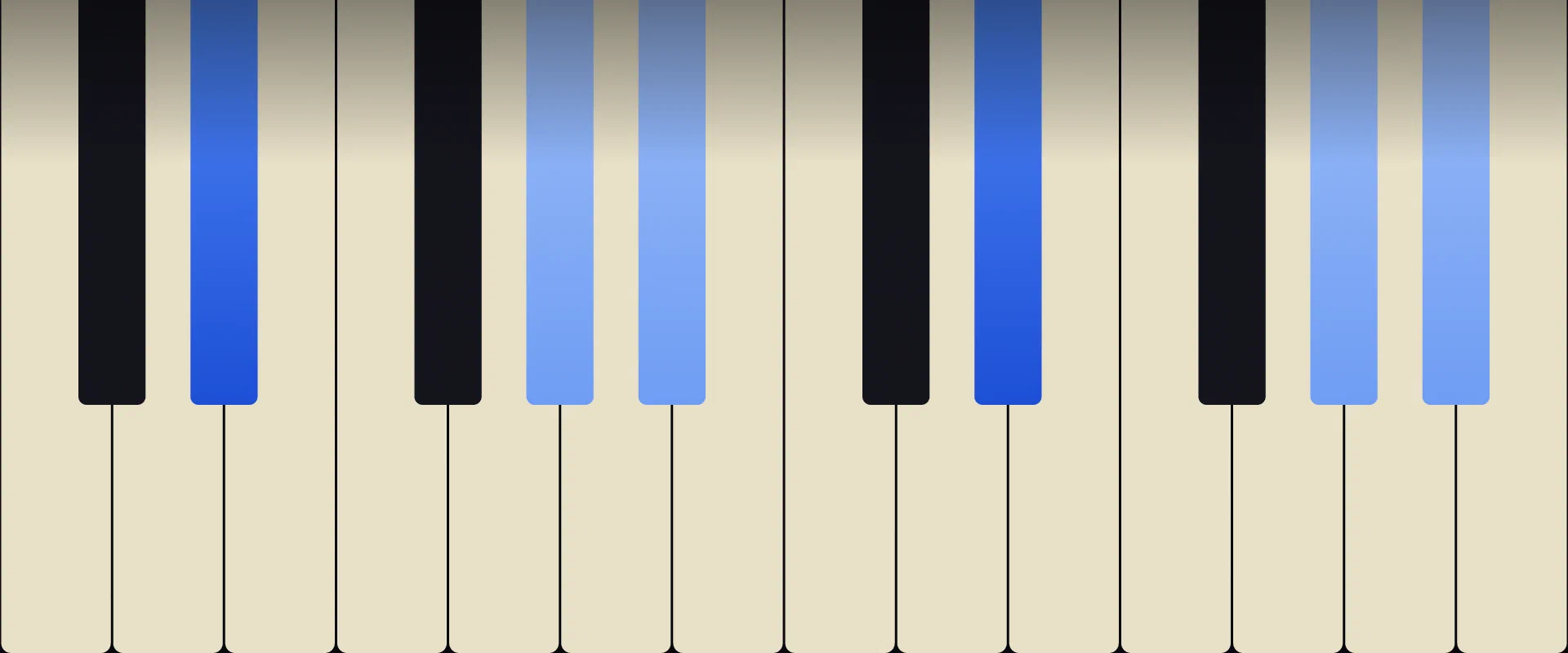
Three notes, and not one of them is a white key. E♭sus4 is E♭, A♭ and B♭, one of only three suspended fourths in the twelve keys that a pianist plays entirely on the raised plane, and the hand finds it by feel: the right hand key of a group of two, then the middle and right keys of the next group of three. Guitarists get the opposite bargain. No open form exists, the chord starts as a barre at the 6th fret, and the alternative further up is worse.
Try It: E♭sus4 in the Chord Finder
The Notes of E♭sus4
The chord contains three notes: E♭, A♭ and B♭.
| Degree | Note | Interval from root | Semitones |
|---|---|---|---|
| 1 | E♭ | Root | 0 |
| 4 | A♭ | Perfect 4th | 5 |
| 5 | B♭ | Perfect 5th | 7 |
Written E♭sus4, shortened to E♭sus on a crowded chart, and occasionally E♭4. Put D♭ on top for E♭7sus4, the jazz workhorse, and note that D♭ is black as well: the four note version still touches nothing white.
How E♭sus4 Is Built
Take E♭ major, E♭ G B♭, and push the G up a semitone to A♭. The third is gone, the fourth has taken its seat, and a chord with no third is neither major nor minor. That counts for more here than elsewhere, because E♭ major and C minor share a key signature and this chord belongs to both without a note changing.
The layout is bottom heavy. A perfect fourth from E♭ up to A♭, then one whole tone from A♭ to B♭: the wide interval underneath, the tight one on top. Sus2 has that the other way round, which is why this chord sounds braced rather than open.
Read the same three pitches from A♭ and they spell A♭sus2, A♭ B♭ E♭. A sus4 chord and the sus2 built on its own fourth are always the same collection, so the two differ only in which note the music has decided is home.
E♭sus4 on the Piano
The whole chord sits on black keys, which changes how the hand behaves. Fingering is 1 on E♭, 3 on A♭ and 5 on B♭ in the right hand, 5, 3, 1 in the left, and all three fingers rest at the same depth, well back towards the fallboard, with no tilt and no plane change anywhere in the grip. Pianists are trained out of putting the thumb on a black key when running scales; here there is nowhere else to put it, and the even footing makes this one of the most stable three note shapes on the instrument.
That evenness also makes the resolution easy to see. Let the middle finger fall a semitone from A♭ to G and the hand steps forward onto white for one note only, while the thumb and little finger stay put. The suspension resolving is a single finger changing plane. Send that finger to G♭ instead and you land on E♭ minor without leaving the raised plane at all.
There is a bonus here that belongs to this root and no other. The five black keys are exactly E♭ G♭ A♭ B♭ D♭, which is E♭ minor pentatonic, so the old trick of improvising on black keys only is improvising in this chord’s own home scale. Hold E♭, A♭ and B♭ in the left hand, let the right hand wander anywhere on black, and nothing you touch can be wrong.
E♭sus4 on the Guitar
There is no open E♭sus4 and no faking it. The working grip is the Asus4 shape barred at the 6th fret, x 6 8 8 9 6: index across the 6th, ring finger flattened over the D and G strings at the 8th, little finger reaching to the 9th on the B string, root on the 5th string. Compare that with the sus2 in the same position, which keeps everything on a single fret above the barre, and you have the honest cost of the fourth. That small barre with a pinky one fret beyond it fails first when the tempo climbs.
The Esus4 shape barred at the 11th fret, 11 13 13 13 11 11, buys a low E♭ and charges heavily: a full barre, a second three string barre above it, and all of it where the frets crowd together and the neck joint argues with your thumb.
Drop the top string, x 6 8 8 9 x, and every note survives with less to hold. Smaller still is x x 8 8 9 x, three adjacent strings giving B♭, E♭ and A♭, two perfect fourths stacked under one finger and the little finger. Funk and gospel players use that fragment in preference to the barre.
For a whole evening in this key, the honest answer is a capo at the 1st fret. Everything turns into D shapes: Dsus4 sounds E♭sus4, D sounds E♭, G sounds A♭ and A sounds B♭.
Inversions
| Inversion | Notes | Lowest note |
|---|---|---|
| Root position | E♭ A♭ B♭ | E♭ |
| 1st inversion | A♭ B♭ E♭ | A♭ |
| 2nd inversion | B♭ E♭ A♭ | B♭ |
First inversion, A♭ B♭ E♭, is the A♭sus2 described above sitting in its own root position. Play it over an A♭ bass and no listener hears a chord of E♭.
Second inversion, B♭ E♭ A♭, is the interesting one. Two perfect fourths stacked, and over a B♭ bass it reads as B♭7sus4 without the fifth, precisely the shell a jazz pianist grabs for that chord. B♭7sus4 resolves to E♭, so this chord contains, in one of its own inversions, the chord that resolves to its root.
Voicings
Give it air. E♭ alone in the left hand with A♭ and B♭ an octave above lets the whole tone at the top ring instead of beat. Packed below middle C, that pair turns to mud.
Keeping E♭ and A♭ close at the bottom with B♭ thrown high makes the fourth the body of the sound instead, which suits organ and string writing. On guitar, prefer the three note fragment to the barre whenever a bass player is present.
Which Keys Contain E♭sus4
- I of E♭ major
- V of A♭ major
- II of D♭ major
- III of C natural minor
- IV of B♭ natural minor
- Contained in E♭ minor pentatonic
The same three black keys turn up on the sharp side of the circle under other names. Our page for B major spells this chord D♯ G♯ A♯ on the third degree. Identical sounds, identical keyboard shape, and only the letters change, because a key holding five sharps cannot spell a note E♭.
Where E♭sus4 Shows Up
Vsus4, V, I in A♭ major: E♭sus4, E♭, A♭. The textbook use. The A♭ in the suspension is the tonic of the key being approached, so the chord already contains its own destination and the drop to G at the last moment is what releases it.
Isus4, I over a held bass: E♭sus4, E♭. Open a brass fanfare this way and the first sound is broad and non-committal, with no third to say whether the piece is happy or sad, then the A♭ falls to G and the key arrives. Hymn and anthem writing has done this for two centuries.
Cm, E♭sus4, E♭, B♭ in C minor. Here the chord sits on the third degree of a minor key, delaying the arrival at the relative major, and because the suspension has no third of its own the switch from minor to major is postponed by a whole bar.
B♭7sus4, B♭7, E♭. Play it against the first example. With B♭ underneath, E♭ is the suspended note and must fall to D. With E♭ underneath, A♭ is suspended and must fall to G. One collection, two opposite gravities, decided by the bass alone.
Now the reason this chord is written far more often than a guitarist would guess. Concert E♭ is the friendliest key in a wind band: alto and baritone saxophones read it as C major with an empty key signature, trumpets and clarinets as F major with one flat. Marches and band charts pile into E♭, A♭ and B♭ for that reason, and a suspension in that world is a section’s decision rather than one player’s. Four saxophones must release the fourth on the same beat, so arrangers hand the A♭ to one inner voice and let it step down to G while the others hold, which is heard as a change of colour rather than a change of chord.
Related Chords
- E♭ Major Chord
- E♭ Minor Chord
- E♭ Sus2 Chord
- Suspended Chords: Sus2 and Sus4
- Guitar Chord Shapes: The CAGED System
Learn More
Practice Chords
Drill chord recognition with a metronome, MIDI support, and score tracking.
Start Practicing