One alternate guitar tuning is famous enough to be known by its six letters, and those letters spell this chord. DADGAD is D, A, D, G, A, D: six strings, three pitch classes, every one of them a note of Dsus4. Davey Graham settled on it in the early 1960s after hearing oud players in Morocco, and Celtic guitarists took it over wholesale. Jimmy Page recorded “Black Mountain Side” and “Kashmir” in it. Pierre Bensusan has used almost nothing else for decades.
Standard tuning is nearly as generous. Strings five, four and three, open, sound A, D and G, which is this chord with its fifth underneath. Strum those three and Dsus4 is already sounding, before a finger has gone down.
Try It: Dsus4 in the Chord Finder
The Notes of Dsus4
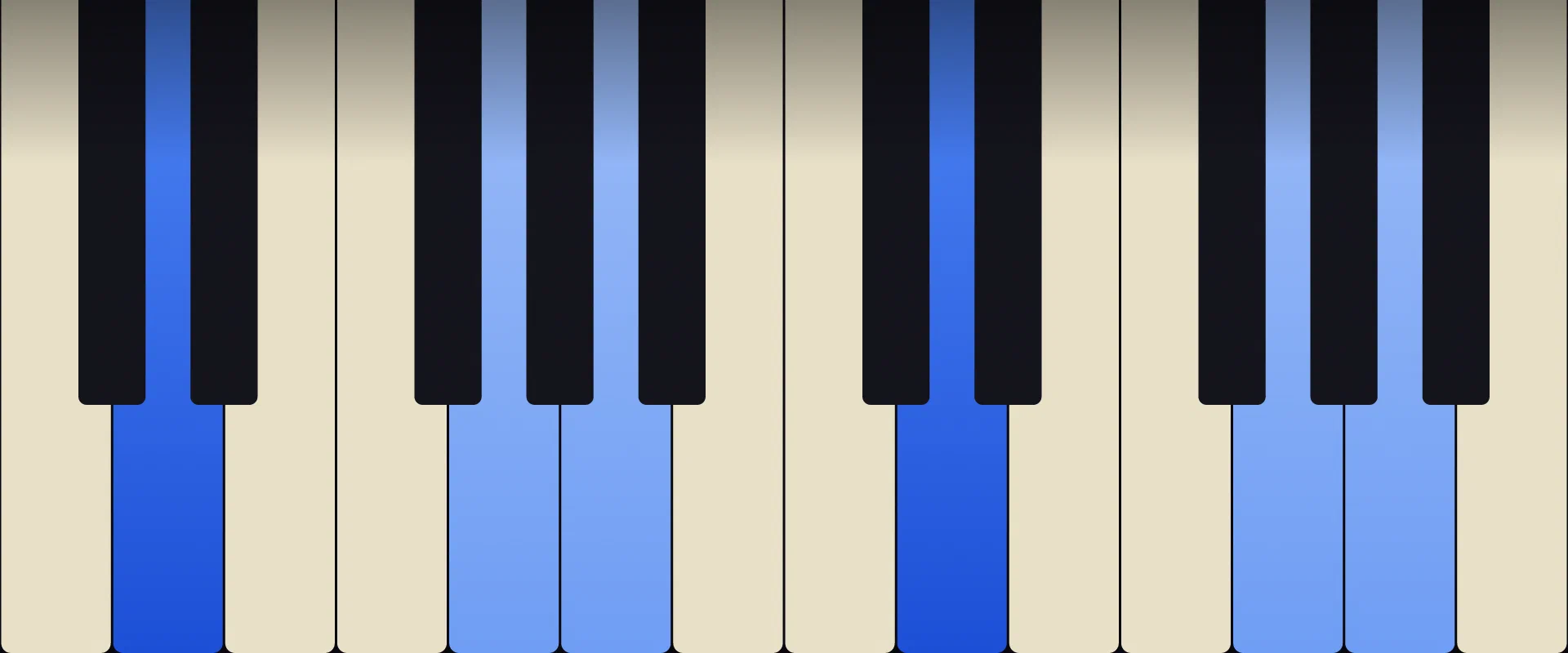
Dsus4 is three notes: D, G and A.
| Degree | Note | Interval from Root | Semitones |
|---|---|---|---|
| 1 (Root) | D | Perfect unison | 0 |
| 4 | G | Perfect 4th | 5 |
| 5 | A | Perfect 5th | 7 |
There is no third, so there is neither F nor F♯ in the chord, and no m or maj in its symbol.
How Dsus4 Is Built
Take D major, D F♯ A, and push the F♯ up one semitone to G. Take D minor, D F A, and push the F up two. Both journeys arrive here, which is the whole point: the note that would tell major from minor has been replaced by the note a step above it, and the chord declines to say which key it belongs to.
The same three pitches read differently from another bass. G, A, D is Gsus2, the suspended second built on this chord’s own fourth, so Dsus4 and Gsus2 are one chord seen from two ends. Stacked as A, D, G they become two perfect fourths piled up, which is exactly what those three open guitar strings sound like and why the voicing feels modal rather than unresolved.
Dsus4 on the Piano
All three notes are white keys, but the spacing is lopsided and the fingering has to acknowledge it. From D up to G is a fourth, from G up to A a single step. Right hand 1, 4, 5 handles that neatly: thumb on D, ring finger on G, little finger on A. Left hand mirrors it as 5, 2, 1. The common 1, 3, 5 grip fights the shape, because it leaves the middle finger straddling a fourth while the two outer fingers sit on neighbours.
What matters more is what the G does next. A suspension is a note held over from somewhere else, and its job is to fall to the third. In this chord that fall is oddly informative to the hand. Let the ring finger drop a semitone and it lands on F♯, the black key at the front of the group of three, and the chord becomes D major. Let it drop a whole step instead and it stays on white keys, one to the left, and the chord becomes D minor. Same finger, one movement, different colour of key under it depending on which mood you chose.
Practise it with the outer fingers frozen. Hold D and A with thumb and little finger, sound the G, then move only the ring finger. Everything a suspension does is contained in that one voice moving while the rest of the chord stands still.
Dsus4 on the Guitar
The open form is x x 0 2 3 3 and it costs one extra finger over an open D. Index at the 2nd fret of the G string for A, ring at the 3rd fret of the B string for D, little finger at the 3rd fret of the top string for G, and the open D string underneath. The three fretted fingers of an ordinary D chord do not move at all. The little finger simply arrives.
That is unusual work for the weakest finger, and it is often the first job it is given. Take it off and the chord falls back to D. Release the top string altogether and you get Dsus2. None of it disturbs the bass, which sits on the open D string throughout.
Higher up the neck the Asus4 shape barres at the 5th fret, x 5 7 7 8 5, which puts A in the bass and gives a fuller, less jangly version. The Esus4 shape at the 10th fret, 10 12 12 12 10 10, is the only common grip that gets a low D underneath the chord, but the frets are narrow up there and it asks for a full barre in exchange for something available free at the nut.
In DADGAD there is nothing to fret. Strum all six strings and the chord rings across three octaves, with the root doubled twice and no third anywhere to argue with the melody.
Inversions
| Inversion | Bass Note | Notes | Symbol |
|---|---|---|---|
| Root position | D | D, G, A | Dsus4 |
| 1st inversion | G | G, A, D | Dsus4/G |
| 2nd inversion | A | A, D, G | Dsus4/A |
First inversion is the one that changes its name under you. With G in the bass most ears hear Gsus2, a settled chord with a decorative second, rather than a suspension waiting to resolve. Second inversion, A D G, is the stacked fourths sound, and because it is what the open fifth, fourth and third strings do, guitarists produce it constantly without meaning to.
Voicings
Guitar, open (x x 0 2 3 3). The default. Four strings, bright, root in the bass.
Guitar, DADGAD (all six open). The tuning is the chord. Nothing else in this list rings longer.
Guitar, barre at fret 5 (x 5 7 7 8 5). Fuller body, fifth in the bass, movable to any root.
Guitar, open strings 5, 4 and 3. A, D and G with nothing fretted, the quartal version.
Piano, close (D, G, A under one hand). Tight and a little stiff on its own, useful in an inner voice.
Piano, spread (D low, G and A above). The fourth opens into the bass and the suspended note sits high where its resolution can be heard.
Which Keys Contain Dsus4
A chord with no third survives in far more keys than a triad does. Six worth knowing:
- I of D major
- V of G major
- II of C major
- V of G natural minor
- VII of E natural minor
- I of D mixolydian
Read the second and fourth entries together. The dominant of G major and the dominant of G minor disagree about one note, the third, and that is exactly the note Dsus4 leaves out. Suspend the fourth and both keys borrow the same chord, which lets a composer put off the decision until the last possible beat.
Where Dsus4 Shows Up
The cadential suspension in G. Write V to I in G major and you get D to G. Hold the G over from the previous bar and sound it against D and A, and the D chord arrives as Dsus4 before resolving to D major and moving on to G. Figured bass calls this V4 to 3. Bach’s chorales are full of it, and the small irony is that the suspended note is the tonic of the key, heard early and in the wrong voice, before the bass has any right to it.
The rock ornament in D. D, Dsus4, D, Dsus2, over and over, played with one finger on the top string while the strumming hand keeps going. It is one of the most recorded gestures in rock and folk guitar, and it survives because the harmony never actually changes. The band stays on D. That is worth stating precisely: a textbook sus4 falls to the third and the music carries on somewhere new, whereas the guitar version almost always returns to the D it came from. The tension is decorative rather than structural, which is a different job for the same chord.
Modal accompaniment in Celtic music. Plenty of Irish and Scottish tunes in D move between a major and a minor seventh over the course of eight bars. An accompanist playing D major has to follow every one of those turns. An accompanist droning on Dsus4 does not, because the chord holds no opinion the tune can contradict. That, rather than any exotic sound, is the practical reason DADGAD spread through the tradition.
Related Chords
- D Sus2 Chord, the same idea a step below.
- G Sus2 Chord, these three notes read from G instead.
- D Major Chord, where the suspension usually lands.
- D Minor Chord, the other resolution the chord keeps open.
- Suspended Chords: Sus2, Sus4 and Tension for the family as a whole.
- The D Major Scale, whose first, fourth and fifth degrees these are.
Learn More
Practice Chords
Drill chord recognition with a metronome, MIDI support, and score tracking.
Start Practicing