Drop the sixth string of a guitar already tuned a semitone flat and the bottom four open strings ring C♯, G♯, C♯ and F♯. Every note of this chord, nothing fretted. Drop C♯ is the tuning a large part of modern metal and metalcore lives in, and it hands the player this suspension before a finger goes down. C♯ minor is one of the standard keys for heavy guitar music, and a chord built without a third sits in that key without ever sounding minor.
Try It: C♯sus4 in the Chord Finder
The Notes of C♯sus4
| Degree | Note | Interval from root | Semitones |
|---|---|---|---|
| 1 | C♯ | Root | 0 |
| 4 | F♯ | Perfect 4th | 5 |
| 5 | G♯ | Perfect 5th | 7 |
The weight sits at the bottom. Five semitones separate C♯ from F♯, then just two more take you to G♯, so the chord is a wide gap with a tight pair perched on top. A sus2 on the same root has that arrangement the other way round.
Reorder the notes as F♯, C♯, G♯ and they become two perfect fifths stacked. Those letters are neighbours at the far end of the sharp side of the circle of fifths: F♯ major carries six sharps, C♯ major seven, and G♯ major would need eight, which is why nobody writes it. Spelled from the most heavily accidented corner of the system, this chord often reaches the page as D♭sus4 instead.
How C♯sus4 Is Built
Take C♯ major, C♯, E♯ and G♯, and push the third up a semitone. E♯ becomes F♯ and the chord stops being major without becoming anything else. The move clears a notation irritation on the way past: E♯ carries an accidental but is played on the white key F, and readers stumble over it every time. C♯sus4 has no such note.
A suspension is named for what happens next. Let F♯ fall a semitone to E♯ and you arrive at C♯ major. Let it fall a whole step to E natural and you arrive at C♯ minor. Same chord, same finger, two different keys, and nothing in C♯sus4 predicts which is coming.
Turn it over once and it changes name. First inversion is F♯, G♯, C♯, and read from F♯ those are root, second and fifth: F♯sus2. Every C♯sus4 is an F♯sus2 waiting for somebody to put F♯ in the bass.
C♯sus4 on the Piano
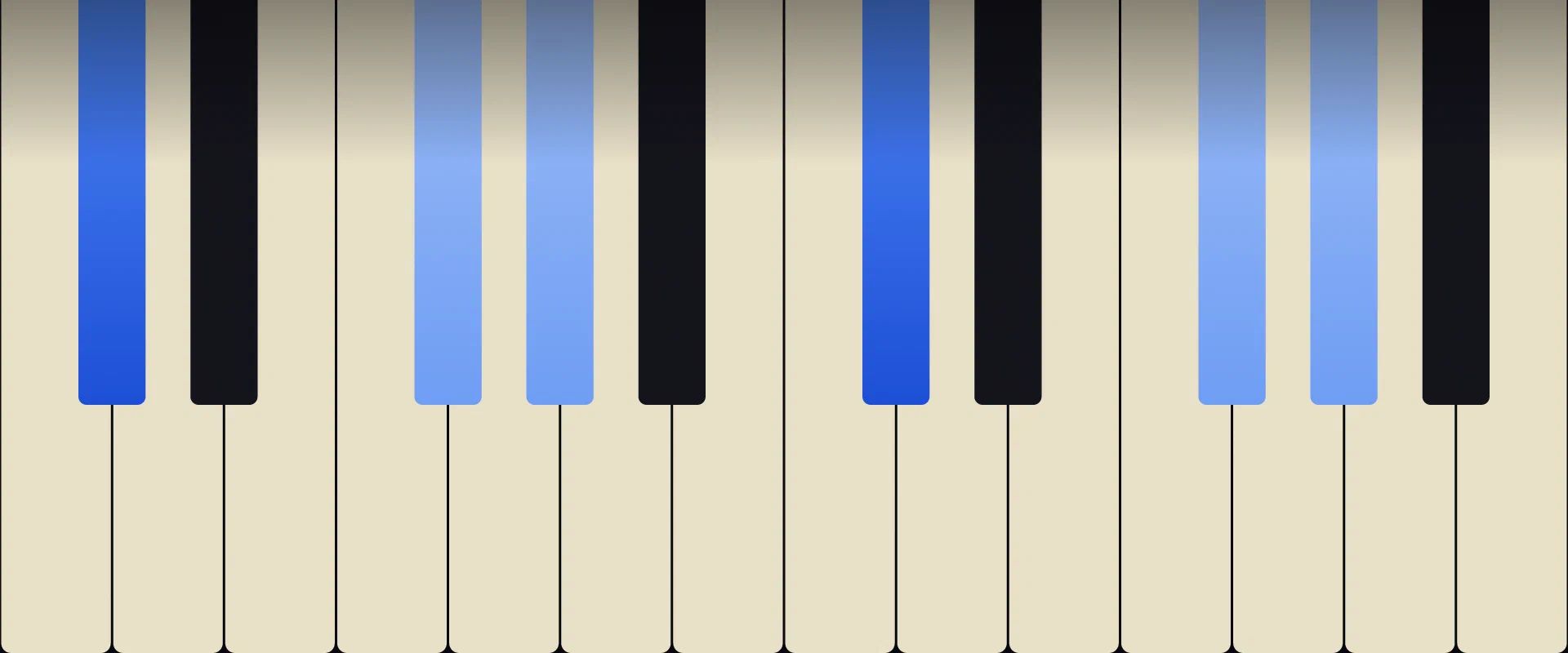
Three black keys and not one white key among them, though the shape is not the neat handful that suggests. C♯ is the left key of the pair. F♯ and G♯ are the first two of the group of three. Between them lie E and F, the two white keys that meet with no black key in the gap. The hand straddles the one place where the black key pattern breaks, and that break is the landmark: find the notch, thumb on the black key to its left, two fingers on the two immediately right.
Right hand, root position: 1 on C♯, 3 on F♯, 5 on G♯. The span is a perfect fifth, all three fingers rest on the same raised plane, and the wrist wants to sit forward so the thumb meets its key rather than reaching up at it. Fingers 4 and 5 will cover F♯ and G♯ if the thumb is needed lower down, but two adjacent black keys under the two weakest fingers is the one genuinely awkward option here.
Resolving is where the layout earns its keep. F♯ down to E♯ for C♯ major sends the middle finger forward onto white, one step out of the raised row. F♯ down to E natural for C♯ minor sends the same finger to the next white key along. Either way one finger leaves the black plane while the outer two hold still, which is why keyboard players working in C♯ minor reach for this suspension whenever they want a resolution a listener can hear arriving.
C♯sus4 on the Guitar
No open form exists. The open strings offer E, A, D, G and B, and this chord contains none of them, so at concert pitch it is a barre or nothing.
The kinder barre is the E form at the 9th fret, 9 11 11 11 9 9. Index flat across the 9th, ring finger flat across the 11th on the fifth, fourth and third strings, and that is the whole grip. It is easier than the E major barre in the same position, because raising the third from the 10th fret to the 11th lines all three middle notes up under one finger instead of an arch. The cost is height: the spacing is tight, the strings behind the barre are stiff, and the voicing loses the low end that makes a sus4 sound spacious.
The A form at the 4th fret, x 4 6 6 7 4, is the fuller sound and the harder stretch. Barre the 4th, take the fourth and third strings at the 6th, then reach the second string at the 7th with the little finger. Low to high it gives C♯, G♯, C♯, F♯, G♯, and there is not one open string to disguise a buzz.
Which is why the chord usually arrives by another route. In half step down tuning, the setup a great deal of rock has used since the 1960s, the open Dsus4 shape, x x 0 2 3 3, sounds exactly here. The instrument is a semitone lower and the player goes on thinking in D. A capo at the 1st fret with an open Csus4, or at the 4th with an open Asus4, does the same job. And drop C♯ gives the chord away on four open strings, which is why the shape recurs so insistently in down tuned riff writing that nobody involved would call it a suspension.
Inversions
| Inversion | Notes | Lowest note |
|---|---|---|
| Root position | C♯ F♯ G♯ | C♯ |
| 1st inversion | F♯ G♯ C♯ | F♯ |
| 2nd inversion | G♯ C♯ F♯ | G♯ |
Root position sounds unfinished: F♯ stands directly against the root and the ear reads it as a note that has not arrived. First inversion is F♯sus2 under another name.
Second inversion is the one worth practising. G♯ up to C♯ is a fourth and C♯ up to F♯ is another, so the chord becomes two stacked fourths, the quartal voicing modal jazz and film scoring are built on. With G♯ lowest it also reads as G♯7sus4 missing its fifth, the dominant of C♯ minor with the third suspended, which is very often what it is doing.
Voicings
Spread it out. Left hand takes C♯ and G♯ as a bare fifth low down, right hand puts F♯ and C♯ above, so the fourth lands more than an octave clear of the root instead of grinding against it. Adding the seventh is the standard next step. C♯7sus4, C♯ F♯ G♯ B, sits behind countless cadences and gets written in shorthand: put a B major triad over a C♯ bass and a lead sheet calls it B/C♯, which sounds as C♯9sus4.
Doubling matters more here than in most chords. There are three notes and one of them is the tension, so doubling F♯ makes the chord sound suspended and doubling C♯ makes it sound settled. Both barre forms double the root and fifth by default, but a pianist can decide how badly the chord wants to resolve simply by choosing which finger to double.
Which Keys Contain C♯sus4
- I of C♯ natural minor
- V of F♯ major
- V of F♯ natural minor
- IV of G♯ natural minor
- II of B major
- I of D♭ major
That list could have run to fifty entries, since a chord with no third fits any scale supplying its root, fourth and fifth. The last one is the same chord in the opposite spelling: the D♭ major page writes it D♭, G♭ and A♭, identical keys under the fingers. One more that is not a key at all: C♯ minor pentatonic, C♯, E, F♯, G♯ and B, holds this chord whole, so most riffs in this key are already noodling inside it.
Where C♯sus4 Shows Up
| Progression | Chords | Turns up in |
|---|---|---|
| i, isus4, i in C♯ minor | C♯m, C♯sus4, C♯m | Down tuned rock, metalcore |
| V7sus4, V7, i in F♯ minor | C♯7sus4, C♯7, F♯m | Blues rock and soul cadences |
| Vsus4, V, I in F♯ major | C♯sus4, C♯, F♯ | Worship, stadium rock |
| I, Isus4, I in D♭ major | D♭, D♭sus4, D♭ | Piano written pop |
The first row matters most on this root, and it is texture rather than function. Lifting the third of a tonic minor chord to the fourth and dropping it back keeps a static harmony breathing. Because a sus chord is neither major nor minor, the same three notes serve a C♯ minor riff and a C♯ major chorus equally well, and a guitarist in a down tuning produces them without leaving the region the riff already occupies. That is the practical reason C♯sus4 appears in recorded music far more often than plain C♯ major.
Rows two and three are the older use, the suspension delaying a cadence. C♯ is the dominant of F♯ in both forms of that key. In F♯ minor the seventh gets added almost automatically; in F♯ major the plain triad is enough, and the delay is now such a fixture of worship and arena rock that the sus4 often never resolves at all.
Row four is the same sound with a different passport. Songwriters at a piano in D♭ major write D♭sus4 and never think about sharps, while a guitarist covering the song will capo, play C or D shapes, and never think about flats.
Related Chords
- C♯ Major Chord, where the F♯ falls a semitone to E♯
- C♯ Minor Chord, where the same F♯ falls a whole step to E
- C♯ Sus2 Chord, the other suspension on this root and the one guitarists find harder
- F♯ Sus2 Chord, these three notes read from F♯ instead of C♯
- Suspended Chords: Sus2, Sus4 and Tension
- Guitar Chord Shapes: The CAGED System for moving the A and E forms up the neck
Learn More
Practice Chords
Drill chord recognition with a metronome, MIDI support, and score tracking.
Start Practicing