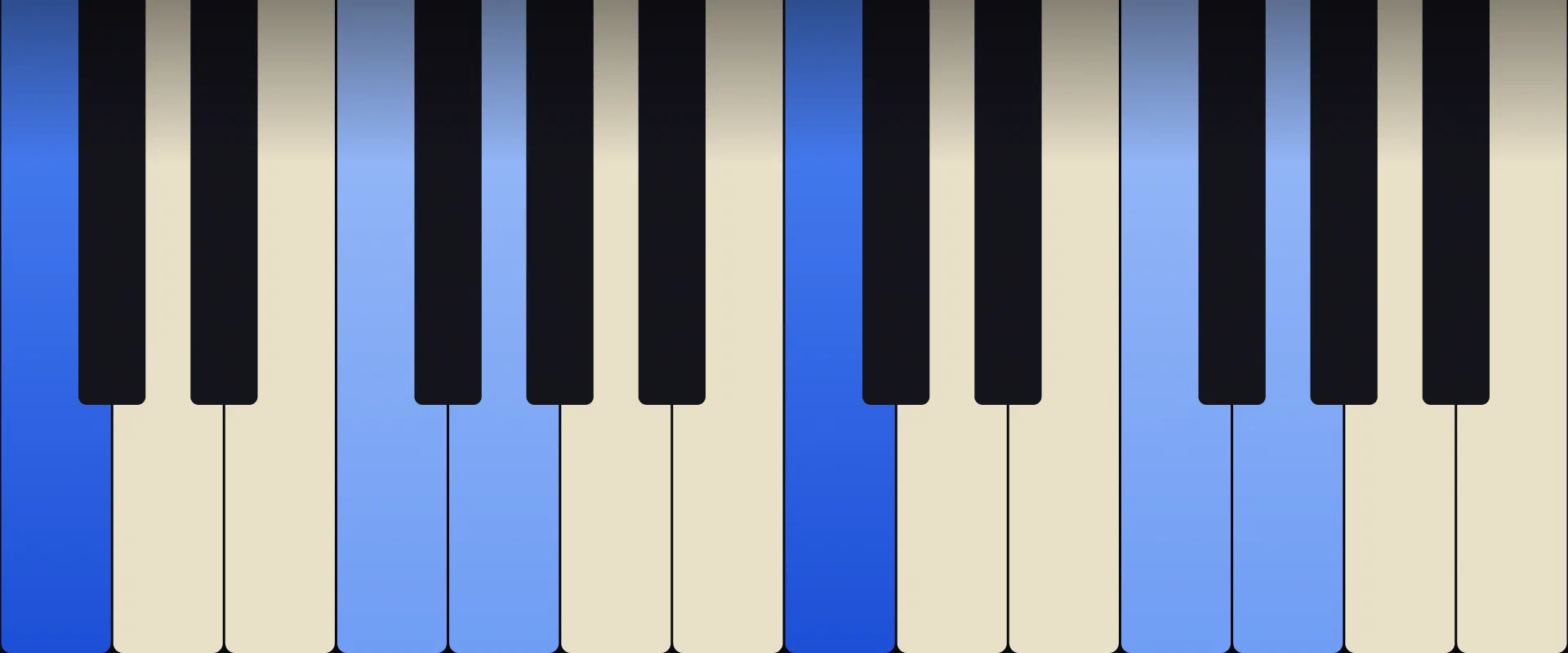
The F in Csus4 leans on the E right next to it, and on a keyboard those two notes are adjacent white keys with nothing in between. That semitone is why the chord carries the name it does. C, F and G, and the F is not a colour added on top of anything: it is a note held over from the chord before, waiting to fall. Counterpoint teachers called that holding a suspension centuries before anyone wrote a chord symbol, and the 4 to 3 version of it, arriving over a cadence, is the most heavily used dissonance in Western music. Csus4 is that gesture frozen into a name. Guitar pop later took the gesture, threw away the resolution and left the chord standing.
Try It: Csus4 in the Chord Finder
Set the root to C, find the 4th sitting where the 3rd should be, then play C major after it.
The Notes of Csus4
| Degree | Note | Interval from root | Semitones |
|---|---|---|---|
| 1 (root) | C | Perfect unison | 0 |
| 4 | F | Perfect 4th | 5 |
| 5 | G | Perfect 5th | 7 |
Written out: C, F, G. Three white keys, no accidentals, and the two upper notes only a step apart at the top of the chord.
How Csus4 Is Built
Take C major, C, E and G, and push the E up one semitone to F. The perfect 5th is untouched, so the chord keeps its footing. What vanishes is the 3rd, and with it any claim to being major or minor. The symbol says sus4 rather than add4 for a reason: C, E, F and G together is Cadd11, a far more astringent chord, because the E and the F grind against each other. Here the E has gone and the F stands in for it.
Reorder the same three notes as F, G, C and you have a root, a 2nd and a 5th, which is Fsus2. Which of the two names applies depends on the bass note and on where the chord goes next. See Suspended Chords: sus2 and sus4 for how the two halves of the family behave.
Csus4 on the Piano
Right hand: thumb on C, third finger on F, fourth on G. Left hand: fifth on C, second on F, thumb on G. The wide interval, a perfect 4th, is at the bottom of the shape and the tight one, a whole step, is at the top, which is why Csus4 still speaks low on the keyboard where a chord with a 2nd near the bass turns to mud. C and F an octave below middle C are still two audible notes.
The shape is only half of its own definition. To hear it as a suspension rather than as a sonority, prepare the F first: play an F major triad, keep the third finger on the F, drop the bass to C, and then let that one finger fall to E. Thumb and fourth finger never move. In C major that fall is white key to white key, a semitone that looks like a whole step, which is one reason this is the suspension teachers reach for.
Resolve into C minor instead and the same finger travels a whole tone and changes plane, F down to E♭, reaching in between the black keys while thumb and fourth finger stay out on the flat white ground. The gesture is identical, the hand position is not, and players who have only practised the major version fumble the first time a minor key asks for it.
Csus4 on the Guitar
Sus4 chords are a gift here when the root happens to be an open string. Dsus4, Asus4 and Esus4 are one added finger on a shape a beginner already owns, because the open strings hand over the 4th and the 5th for free. C is not an open string root, so every version of the chord costs something.
The open position shape is x 3 3 0 1 1: C on the 5th string at the 3rd fret, F on the 4th at the 3rd, the open 3rd string supplying G, and a small index barre over the top two strings for a second C and a second F. Doubling the F makes the suspension loud, and the resolution to open C at x 3 2 0 1 0 drops both of them onto E at once. Two voices landing together is more than the chart asked for, and it sounds like it.
For a movable form, the E shape barred at the 8th fret, 8 10 10 10 8 8, is the dependable one. The three fretted notes above the barre line up in one fret column, a flattened ring finger covers all of them, and the 6th string delivers a genuinely low C. The A shape at the 3rd fret, x 3 5 5 6 3, inverts the usual order of things for this root: plain C major as an A shape barre there is comfortable, but the suspension pushes the 2nd string three frets above the barre with no spare finger well placed to take it.
Inversions
| Inversion | Notes | Bass | Symbol |
|---|---|---|---|
| Root position | C F G | C | Csus4 |
| 1st inversion | F G C | F | Csus4/F |
| 2nd inversion | G C F | G | Csus4/G |
A suspension is defined against its bass, so inverting one dismantles it. F, G, C with the F underneath is heard as Fsus2 and nothing about it sounds unfinished, while G, C, F piles two perfect 4ths on each other and belongs to modal jazz rather than to counterpoint. For the mechanics behind that, see Chord Inversions and Voice Leading.
Voicings
Put the F where it can be heard. Classical writing keeps a suspended note in an upper voice: an F buried between C and G reads as a slightly odd chord, while an F sitting on top reads as a note that has not landed yet. Low C in the left hand, then G, C and F rising in the right, makes the point.
Add a B♭ and the chord becomes C7sus4, C, F, G and B♭, the standard gospel and soul dominant. Add the D as well and the right hand is holding a plain Gm7 over a C bass, which is how most pianists play it and why charts sometimes write it as Gm7/C.
| Shape | Frets | Result |
|---|---|---|
| Csus4 | x 3 3 0 1 1 | Open strings, doubled F |
| Csus4 | 8 10 10 10 8 8 | E shape at the 8th fret |
| Csus4 | x 3 5 5 6 3 | A shape at the 3rd fret |
| C7sus4 | x 3 3 3 1 1 | Gospel and soul dominant |
| Cadd11 | x 3 3 0 1 0 | Not a suspension, the 3rd is there |
Which Keys Contain Csus4
With no 3rd to declare, it fits keys that agree on little apart from C, F and G. Six that matter:
- I of C major
- V of F major
- II of B♭ major
- I of C natural minor
- IV of G natural minor
- I of C Dorian
The second entry carries the history. C is the dominant of F major, the 4 to 3 suspension over the dominant is the cadential formula, and much of this chord’s working life has been spent as the V of F rather than as the tonic of C.
Where Csus4 Shows Up
| Progression | Chords | Context |
|---|---|---|
| IV, Vsus4, V, I (F major) | B♭, Csus4, C, F | The cadential 4 to 3 suspension |
| I, Isus4, I (C major) | C, Csus4, C | Rhythm parts decorating a tonic |
| Isus4, ♭VII, IV (C Mixolydian) | Csus4, B♭, F | Rock vamp, never resolved |
| i, Isus4, i (C minor) | Cm, Csus4, Cm | Same suspension, whole tone fall |
The first row is the historical chord and the other three are what became of it. An organist approaching a cadence in F major takes the F out of the B♭ chord, holds it over the new C bass and lets it drop to E halfway through the beat. Hymnals are full of that. The same F to E movement also closes a plagal cadence in C major, the amen at the end of a hymn, where F major steps down to C. What differs is the bass: there the whole chord moves, while in Csus4 the bass has sat on C all along and only the middle voice gives way.
Strummed pop treats the chord as rhythm rather than as grammar, and here the guitar shapes the music. Because open Csus4 needs two fingers to move, songs in C tend to hang their suspensions on other chords, or the guitarist capos at the 5th fret and plays G shapes, which turns the awkward Csus4 into an easy Gsus4 fingering. A recording nominally in C is often a G-shaped part in disguise. Keyboard players have no such problem, and park C7sus4 over a C pedal for eight bars at a time precisely because it refuses to say which key it is in.
Related Chords
- C Major Chord, the chord the F is waiting to fall into
- C Sus2 Chord, the other suspension, leaning up towards the 3rd instead of down
- F Sus2 Chord, the same three notes read from F
- Suspended Chords: sus2 and sus4 for the wider family
- Guitar Chord Shapes: The CAGED System for moving the barre forms around the neck
Learn More
Practice Chords
Drill chord recognition with a metronome, MIDI support, and score tracking.
Start Practicing