Ask guitarists which common chord still catches them out after a couple of years and a good number will say B major. It has no open form, it sits at the second fret where the frets are widest and the strings pull hardest, and the usual grip asks one finger to lie flat across three strings while arching enough at the tip to let a fourth ring underneath.
Bsus2 is what a great many players reach for instead, and the reason is that exact finger. Its notes are B, C♯ and F♯, and dropping the D♯ takes away the string causing the trouble. This page is about that trade, and what the missing third costs when the music needed it.
Try It: Bsus2 in the Chord Finder
The Notes of Bsus2
| Degree | Note | Interval from Root | Semitones |
|---|---|---|---|
| 1 (Root) | B | Perfect unison | 0 |
| 2 | C♯ | Major 2nd | 2 |
| 5 | F♯ | Perfect 5th | 7 |
A whole step at the bottom and a perfect fourth above it. The fifth is intact, so the chord is stable, but nothing in it says major or minor.
How Bsus2 Is Built
Take B major, B D♯ F♯, and move the third down a whole step to C♯. Nothing is added and nothing is raised. The third is simply gone, and the third is what decides a triad’s quality, so Bsus2 belongs to B major and B minor equally: C♯ is the second degree of both.
“Suspended” is a leftover from counterpoint, where the note was held over from the previous chord and had to resolve down by step. Modern use dropped the obligation, and Bsus2 will happily sit still for eight bars.
One neighbour is worth keeping straight. Put the D♯ back while keeping the C♯ and you have Badd9, a major chord with a colour note rather than a chord missing its third. Guitarists conflate the two constantly, but Badd9 still tells you the key is major and Bsus2 does not.
Bsus2 on the Piano
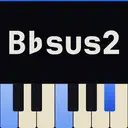
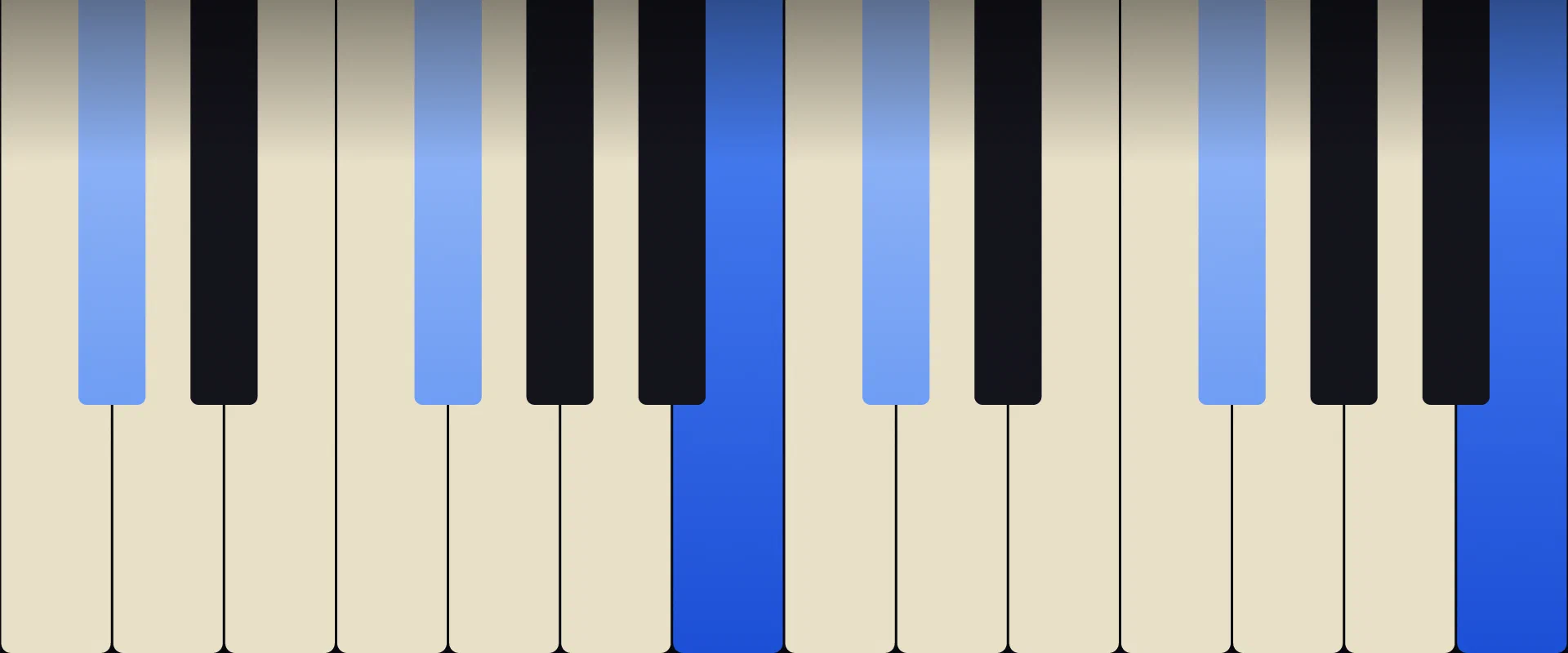
One white key and two black, the same count as B major but a different reach. B major uses D♯ and F♯, one black key from each group. Bsus2 uses C♯ and F♯, so the hand still spans both groups but the lower black key has shifted sideways.
That shift is the entire alteration and it is a pleasure to play. Hold B major with 1 on B, 3 on D♯ and 5 on F♯, then slide the middle finger left onto C♯ without lifting it off the back of the keyboard. C♯ and D♯ are neighbours in the group of two, so the finger travels the width of one black key at the same depth. Slide it back and B major returns.
Close position is not how the chord wants to sound, though. B and C♯ a whole step apart in the middle of the keyboard is a smudge. Spread it: B alone in the left hand, F♯ and C♯ in the right, so the second sits a ninth above the root with the fifth between them. The low register suits it because a third down there turns muddy while a bare fifth stays clear.
Bsus2 on the Guitar
No open form exists, so both routes are barred, and they pull in opposite directions.
The A shape at the second fret is why this chord is popular. B major there is x24442: index barring fret 2, ring finger flattened across the fourth, third and second strings at fret 4, its tip still high enough for the first string to sound at fret 2 underneath. That one finger doing two jobs is what makes B major hard.
Bsus2 is x24422. The second string drops from fret 4 to fret 2 and joins the barre, because C♯ sits there. Only the fourth and third strings now need fret 4, so the ring finger and the little finger take one each and nothing has to be flat and arched at once. The notes come out B, F♯, B, C♯, F♯. A chord many players avoid becomes one they can hold for a whole verse.
Smaller again is xx4422, top four strings, index across fret 2 and ring across fret 4. F♯ ends up in the bass, which changes the name more than the sound.
The E shape reverses the rule, which is worth knowing before treating sus2 as a universally easier option. B major on the sixth string root is 799877, one barre at fret 7 with three fingers stacked above it. Bsus2 there is 7 9 11 11 7 7, pushing the fourth and third strings out to fret 11, four clear of the barre. Up there the suspension is the harder chord, and the saving belongs to fret 2 alone.
Below both sits B5, x244xx, dropping the C♯ as well to keep only B and F♯. Ranked by how much they commit, Bsus2 lands between them: one note more than the power chord, one note less than B major.
Inversions
| Inversion | Notes | Bass Note |
|---|---|---|
| Root position | B C♯ F♯ | B |
| 1st inversion | C♯ F♯ B | C♯ |
| 2nd inversion | F♯ B C♯ | F♯ |
The second inversion is the useful one. F♯, B, C♯ from the bottom is F♯sus4 in root position, the same three notes with a different one underneath. Every sus2 has a sus4 twin, but this pairing earns its keep because F♯ is B’s dominant: in a song in B major, one grip covers both the tonic suspension and the dominant suspension, and the bass decides which the bar contains.
Put C♯ underneath instead and it reads as C♯7sus4 without its fifth, the standard approach chord to F♯. Three notes, three functions, all ordinary in the key of B.
Voicings
Keep the second away from the root. On the piano that means B low with F♯ and C♯ above, and on guitar it happens by itself: x24422 stacks B, F♯ and B before the C♯ arrives on the second string, so the whole step never sounds as a whole step.
To make it behave like a suspension rather than a colour, put the C♯ on top and move it: up to D♯ for plain B major, down to B for a bare fifth. To make it a place to stay, double the F♯ and bury the C♯ inside, where the ear takes it as texture.
Which Keys Contain Bsus2
Five major keys, and B lands on a different degree in each. That range is why the chord shows up so much: D, A, E and B are the keys guitarists live in.
The last entry is the important one. B minor and B major both contain C♯ and F♯, so the same three notes serve either. Nothing else in the list can say that.
Where Bsus2 Shows Up
| Progression | Numerals | Chords |
|---|---|---|
| The vi, third dropped | I, V, vi, IV in D | D, A, Bsus2, G |
| Standing in for ii | I, ii, V, I in A | A, Bsus2, E, A |
| Tonic figure in B | I, Isus2, I | B, Bsus2, B |
| Cadence, one grip | Vsus4, V, I in B | F♯sus4, F♯, B |
The first two rows are one manoeuvre in two keys. In D major, B is the vi; in A major, B is the ii. Either way the written chord is Bm, and taking the D out to put C♯ in its place gives Bsus2, a minor chord with its minor removed. On acoustic guitar this is close to a default: it brightens a progression that would otherwise dip, and it saves a barre both times.
The fourth row is the twin at work. F♯sus4 to F♯ to B is an ordinary cadence in B major, and its first chord is the grip you learned as Bsus2 with a different note underneath.
Now the cost. In E major, B is the dominant, and the D♯ inside B major is the leading note of the key, the note that makes the ear expect E. Substitute Bsus2 there and the leading note leaves with the third. What comes back is modal, pleasant and unmotivated: the cadence stops pulling. In a strummed song where the harmony is scenery that is often an improvement. At the end of a chorus that has to land on E it is not, and a player who has substituted their way round B major for a year usually hears the difference before they can name it.
Bsus2 is a fine chord and a poor excuse. Use it because the open fifth and the ringing C♯ are what the song wants. Learn x24442 anyway.
Related Chords
- B Major Chord
- B Minor Chord
- B Augmented Chord
- Suspended Chords: Sus2, Sus4, and the Art of Tension
- Guitar Chord Shapes and the CAGED System
- B Major Scale: Notes, Chords, and How to Play It
Learn More
Practice Chords
Drill chord recognition with a metronome, MIDI support, and score tracking.
Start Practicing