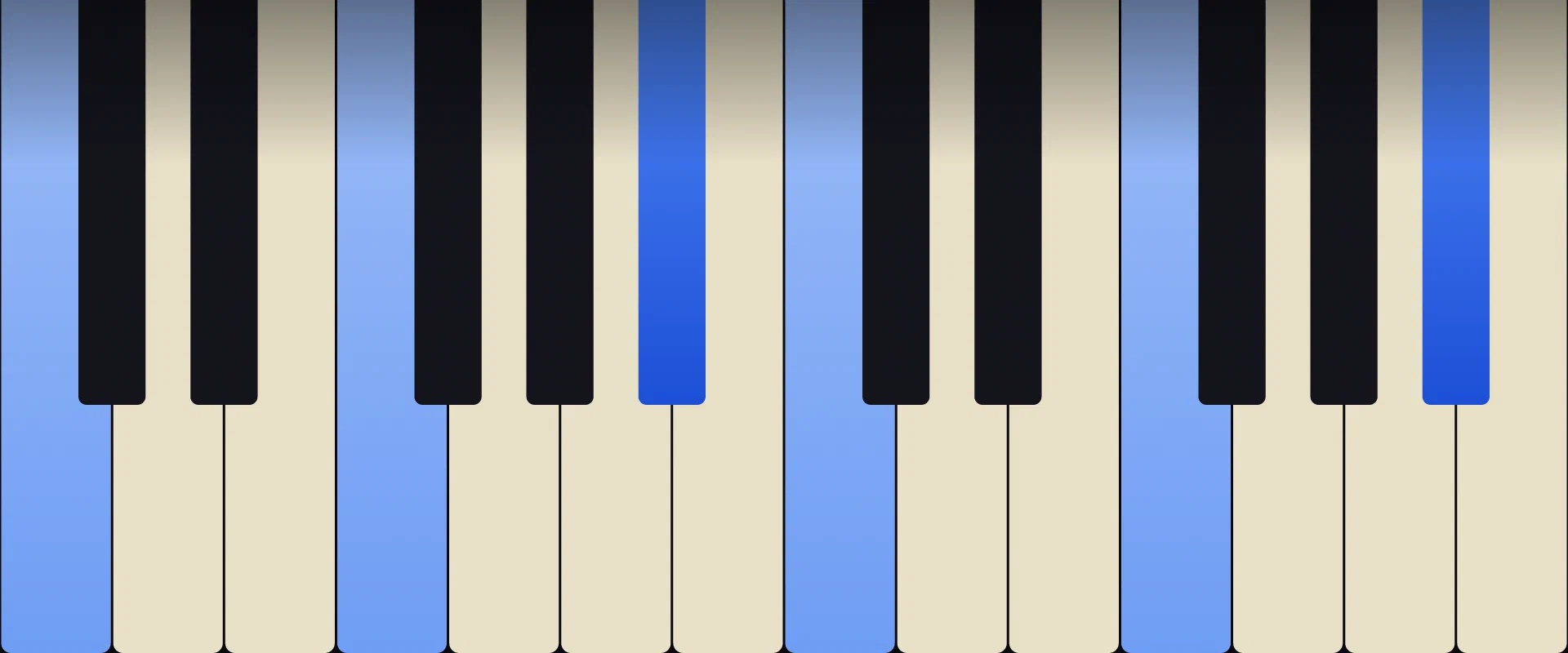
Hand this chord to a trumpet player and the part in front of them says Csus2: C, D and G, three notes without a single accidental. Their instrument is built in B♭, so concert B♭ leaves it as a written C, and a whole section of the band reads this chord as the plainest thing on the page. That explains a lot about B♭sus2, which is ordinary in wind writing and awkward under a guitarist’s fingers.
Try It: B♭sus2 in the Chord Finder
Set the root to B♭ and notice what is missing: there is no 3rd anywhere in this chord.
The Notes of B♭sus2
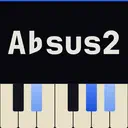
B♭sus2 has three notes: B♭, C and F.
| Degree | Note | Interval from B♭ | Semitones |
|---|---|---|---|
| 1 (root) | B♭ | Perfect unison | 0 |
| 2 | C | Major 2nd | 2 |
| 5 | F | Perfect 5th | 7 |
Written B♭sus2 or, on older charts, B♭2. One black key and two white ones.
How B♭sus2 Is Built
Take B♭ major, B♭ D F, and pull the D down to C. The 3rd is not flattened, it is gone, and with it goes the chord’s opinion about being major or minor. What is left is a root, the note next door to it and a perfect 5th holding the whole thing open.
B♭ major and B♭ minor both take C as their 2nd degree and F as their 5th, so this chord belongs to each of them without altering a note. That is why arrangers reach for it when the harmony has not declared itself yet.
Rotate the notes and you get the chord’s twin. F, B♭ and C is Fsus4, the same three pitches with the 5th underneath. Only the bass note and the chord that follows decide which one you have written.
B♭sus2 on the Piano
Only B♭ is black. C and F are white, and the shape is compact rather than comfortable: B♭ is the last black key of a group of three and C is the white key immediately past it, so the root and the 2nd sit almost on top of one another with only B in between. Taking them with 1 and 2 in close position crowds the thumb against the second finger, which is why pianists find B♭sus2 clumsier than its three easy notes suggest.
The fix is spacing. Play B♭ low in the left hand, then F and C above it with the right, so the 2nd sounds a ninth above the root instead of a whole step. Down near the bass a major 2nd is thick and beats badly; an octave higher it is bright and clear.
For one hand, take 1 on B♭, 2 on C and 5 on F, and keep the wrist high so the thumb stays forward on the black key. Then practise the release: the second finger moving from C up to D turns the chord into B♭ major, and doing that on a beat rather than between chords is the whole suspension idea in one movement.
B♭sus2 on the Guitar
Nothing rings open here, and both textbook barres are unpleasant. The A shape lands at fret 1, x 1 3 3 1 1, a full index barre right against the nut where the action is highest, with the ring and little fingers holding fret 3. The E shape lands at fret 6, 6 8 10 10 6 6, a barre plus a two finger stretch four frets beyond it. For a chord whose character is openness, both are a poor trade.
So guitarists do one of two things. The first is to drop the low root and play a partial on the middle strings: x x 3 3 1 1 gives F, B♭, C, F on four strings with no barre at all and speaks far better than the full grip. Add the fifth string, x 1 3 3 1 x, if you need B♭ underneath.
The second is to capo. At fret 3 the open Gsus2 shape, 3 0 0 0 3 3, sounds B♭, C and F with three strings ringing open, and keeps the sustain that the barres kill. This is why records in B♭ so often turn out to be guitar parts played in G, and why the guitarist and the horn section can be reading different letters for one sound.
Inversions
| Inversion | Notes | Bass note | Symbol |
|---|---|---|---|
| Root position | B♭ C F | B♭ | B♭sus2 |
| 1st inversion | C F B♭ | C | B♭sus2/C |
| 2nd inversion | F B♭ C | F | B♭sus2/F |
Inversion is not cosmetic for a chord with no 3rd. With C in the bass you have two stacked fourths, C to F to B♭, which sounds rootless and modern rather than suspended. With F in the bass most ears simply hear Fsus4, the B♭ above turning into a suspension waiting to fall to A. Only root position reliably sounds like B♭ anything. More on how bass notes rewrite a chord’s meaning in Chord Inversions and Voice Leading.
Voicings
Spread it. B♭ F C low to high, root then 5th then the 2nd an octave up, is the voicing worth memorising, and the one guitar and harp writing reach naturally.
For winds, give the C and the B♭ to different players and let both sustain. There is no major third here to be tempered, so a pair of instruments a whole tone apart can hold the chord indefinitely and the 2nd shimmers rather than beats.
Changing the bass reuses the same three notes several ways. Put E♭ underneath and B♭ C F become the 5th, 6th and 9th of E♭6/9, still with no 3rd. Put G there and you have Gm11 without its 5th. Put C there and it is C7sus4 short of a 5th. One player moves, the harmony changes completely, which is why film and library scoring leans on it. See Extended Chords and Jazz Harmony for where those larger names come from.
Which Keys Contain B♭sus2
B♭, C and F sit together in a great many scales, because three of the five most common flat keys contain all three notes. The ones worth knowing:
- I of B♭ major
- IV of F major
- V of E♭ major
- I of B♭ natural minor
- III of G natural minor
- contained in B♭ major pentatonic
The first and fourth entries are the interesting pair: the same chord is degree 1 of both B♭ major and B♭ natural minor, which no triad manages. The pentatonic entry matters for improvisers, since every note of B♭ major pentatonic sits happily over this chord, giving you a five note scale that cannot contradict a harmony with no 3rd in it.
Where B♭sus2 Shows Up
The oldest use is as a delay on the way into the tonic:
B♭sus2 | B♭ | E♭ | F
That is Isus2, I, IV, V in B♭ major, with C falling to D on the second bar. Played on a piano it sounds like a decoration. Scored for winds it is a structural device, because the C can be sustained by one instrument while another moves, so the resolution happens inside a chord that never stops sounding.
Wider than that, the chord earns its place in arrangements precisely because of the hole where the 3rd should be:
Gm | B♭sus2 | E♭ | F
Here B♭sus2 sits between vi and IV in B♭ major, and the missing 3rd is the arranger’s gift to whoever is playing on top. Leave clarinets and low brass holding B♭, C and F, and a solo line supplying D makes the bar major while a line supplying D♭ makes it minor, with nobody in the section changing a note. That is difficult to do with a triad and trivial with this chord.
For anyone reading transposed parts, the whole picture is worth having in one place. Concert B♭sus2 is written Csus2 for trumpet, clarinet and tenor sax, Gsus2 for alto and baritone sax, and Fsus2 for horn in F. Four different chord symbols, one sound, which is a good argument for learning how to transpose a song into any key rather than memorising grips.
Related Chords
- B♭ Major Chord, what this chord becomes when C moves up to D.
- B♭ Minor Chord, the other resolution, with C falling to D♭.
- B♭ Augmented Chord, the same root with its 5th raised instead of its 3rd removed.
- Suspended Chords: Sus2, Sus4 and Tension, on how sus2 and its Fsus4 twin behave differently.
Learn More
Practice Chords
Drill chord recognition with a metronome, MIDI support, and score tracking.
Start Practicing