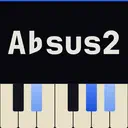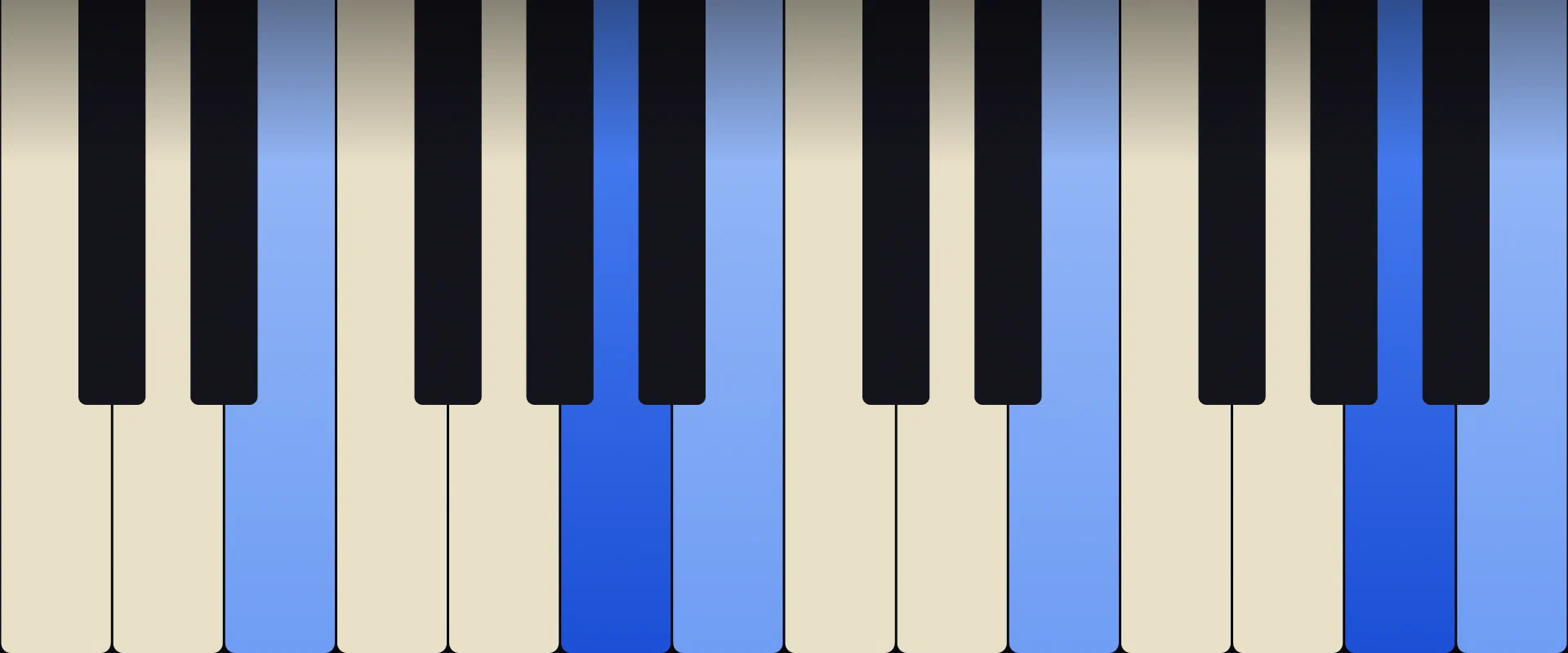
Hold an open A chord, lift the finger off the second string, and you have it. x 0 2 2 0 0 is Asus2, and the instrument hands you most of it for nothing: the B and the top E ring open, the fifth string gives the root open, and two fingers do the rest. All three notes, A, B and E, exist as open strings in standard tuning, which is true of very few chords and is the reason this one turns up on so many records.
Try It: Asus2 in the Chord Finder
Play A major, then swap the C♯ for a B and listen to the chord lose its opinion about whether it is major or minor.
The Notes of Asus2
| Degree | Note | Interval from root | Semitones |
|---|---|---|---|
| 1 (root) | A | Perfect unison | 0 |
| 2 | B | Major 2nd | 2 |
| 5 | E | Perfect 5th | 7 |
Written out: A, B, E. No accidentals, three white keys, nothing to remember. The key of A major carries three sharps and this chord uses none of them, which is a hint in itself: the note that would have carried an accidental, C♯, is the note that has gone.
How Asus2 Is Built
A suspended second replaces the third rather than adding to it. Move the C♯ of A major down to B and the chord has no third at all. It cannot be major, it cannot be minor, and it will happily sit in a passage of either.
From the other direction, Asus2 is a power chord with one note added: A5 is just A and E, and dropping a B into it gives the bare fifth a colour without giving it a quality.
The chord has a twin. A, B and E rearranged with E at the bottom reads E, A, B, which is Esus4: root, perfect 4th, perfect 5th. Every sus2 chord is the sus4 of its own fifth, so these are the same three notes under two names, and which one a chart prints depends on the bass alone.
Asus2 Is Not Aadd9
Chord charts swap these two constantly, and a reader searching for one often wants the other, so it is worth being exact. Aadd9 is A, C♯, E and B: a complete A major triad with a B added above it. Asus2 is A, B and E, with no C♯ anywhere. Only one of them has a third.
The consequences are audible. Aadd9 is unambiguously major with a sparkle on top, and it rubs gently, since C♯ and B sit a whole tone apart in the upper voices. Asus2 has no rub and no quality, just an open, hollow ring. If the melody sits on C♯, you want Aadd9. If the point is to avoid committing, you want Asus2.
On a guitar the shapes sit close enough to explain the confusion: x 0 2 2 0 0 suspended, x 0 2 4 2 0 for the added ninth, where the B shifts to the 4th fret of the third string so the C♯ can come back.
Asus2 on the Piano
Three white keys, and their geography is worth noticing. The thumb on A lands wedged between the second and third black keys of the group of three, in the narrowest slot on the keyboard. B and E are the two keys with nothing black to their right, so both upper notes have a full wide front to land on.
Right hand 1, 2 and 5 works best: thumb on A, index on B a whole step above, little finger stretching a perfect 4th to E. Left hand 5, 4 and 1 mirrors it. That tight 1 and 2 pairing feels odd at first, since most triads spread the lower fingers out rather than jamming them onto neighbouring keys.
Switching to and from A major is almost free. Drop the middle finger onto C♯ and lift the index for the major chord, reverse it to suspend again. Nothing travels back into the keyboard for Asus2, so the chord can be played at the front edge of the keys and alternated fast.
Spacing changes the character more than usual. Kept closed, A and B side by side make a soft cluster with the E above. Put A alone in the left hand with B and E in the right and the same notes turn wide and floating, the layout arrangers reach for when a chord should sound like open air.
Asus2 on the Guitar
The cost of this chord is one lifted finger, and that fact has shaped how it gets used. From x 0 2 2 2 0, the crowded three fingertip block at the 2nd fret loses a member and becomes two fingers on the fourth and third strings, with the second string ringing open beside them. The only demand left is keeping the finger on the third string from leaning over and choking that open B, a matter of arching the knuckle rather than pressing harder.
Because the top two strings are open, the chord keeps sounding after the fretting hand relaxes, which turns the second string into a switch. Fret it at the 2nd fret for A major, leave it open for Asus2, take the 3rd fret for Asus4. One hand position, three chords, no interruption to the strum, and hammering the C♯ back on after a suspended downbeat is one of the most recorded gestures in rock rhythm guitar.
Let the low open E string ring as well, playing 0 0 2 2 0 0, and the same notes rename themselves Esus4. Nothing is fretted differently; only the lowest sounding note has changed.
Moved up the neck the shape needs a barre. x 12 14 14 12 12 is the same chord an octave higher, useful above a busy arrangement, while the sixth string rooted route is a wide stretch and rarely worth it. Most players stay at the nut and let a capo transpose for them, since the grip survives intact: the same two fingers give Bsus2 at the 2nd fret.
Inversions
| Inversion | Notes | Bass | Symbol |
|---|---|---|---|
| Root position | A B E | A | Asus2 |
| 1st inversion | B E A | B | Asus2/B |
| 2nd inversion | E A B | E | Esus4 |
The second inversion has a name of its own, and that is the honest way to write it: with E underneath, listeners hear Esus4, not an inverted Asus2.
First inversion is the interesting one. B up to E is a perfect 4th and E up to A is another, so B, E, A is a stack of two fourths. Quartal voicings are a staple of modal jazz and film writing because they suggest a key without naming a quality, and this one lies comfortably under the hand.
Voicings
| Voicing | How to play it |
|---|---|
| Open Asus2 | x 0 2 2 0 0, the standard shape |
| Esus4 in disguise | 0 0 2 2 0 0, open low E in the bass |
| Twelfth fret | x 12 14 14 12 12, the same chord an octave up |
| Aadd9 for contrast | x 0 2 4 2 0, the C♯ restored |
| Piano, spread | A2 in the left hand, B3 and E4 in the right |
| Piano, quartal | B, E and A stacked in fourths, rootless feel |
Which Keys Contain Asus2
- I of A major
- V of D major
- IV of E major
- II of G major
- I of A natural minor
- IV of E natural minor
A chord with no third fits almost everywhere, and the full list runs past forty scales on this site. The six above matter in pairs. A major and A natural minor both contain it, so Asus2 can be the tonic of either without giving the mode away, and E major and E natural minor both contain it, so it serves as IV in either.
Where Asus2 Shows Up
| Progression | In this key | Chords |
|---|---|---|
| I, V, IV | A major | Asus2, E, D |
| V, IV, I | D major | Asus2, G, D |
| i, IV | E natural minor | Em, Asus2 |
| I, ♭VII, IV | A mixolydian | Asus2, G, D |
The D major row explains why the chord is everywhere. In D, an A chord is the dominant, and its third, C♯, is the leading note of the key, the note that creates the pull home. Suspending it removes that pull. Asus2 still sits on the dominant, but it hovers instead of pushing, which is what a writer wants under a held vocal note or in a loop with no resolution.
Guitar tuning does the rest. G, D, A and E are the keys the instrument is built around, and A, B and E are open strings, so the shape drops into any of them without leaving first position. On a twelve string the open B and E ring twice over, which is the jangle behind a great deal of folk rock.
The E minor row is the same trick from the other side. A guitarist vamping on Em can use Asus2 as the IV chord and never decide whether the song is minor or major, because the chord that would settle it, Am or A, is the one being avoided. Asus4, one finger higher, tightens the idea instead of loosening it, which is why the two appear within bars of each other.
Related Chords
- A Major Chord the chord one finger away
- A Minor Chord the other side of the third that Asus2 leaves out
- A Augmented Chord for the same root altered upward instead
- Suspended Chords: Sus2, Sus4 and Tension
- Guitar Chord Shapes: The CAGED System
Learn More
Practice Chords
Drill chord recognition with a metronome, MIDI support, and score tracking.
Start Practicing