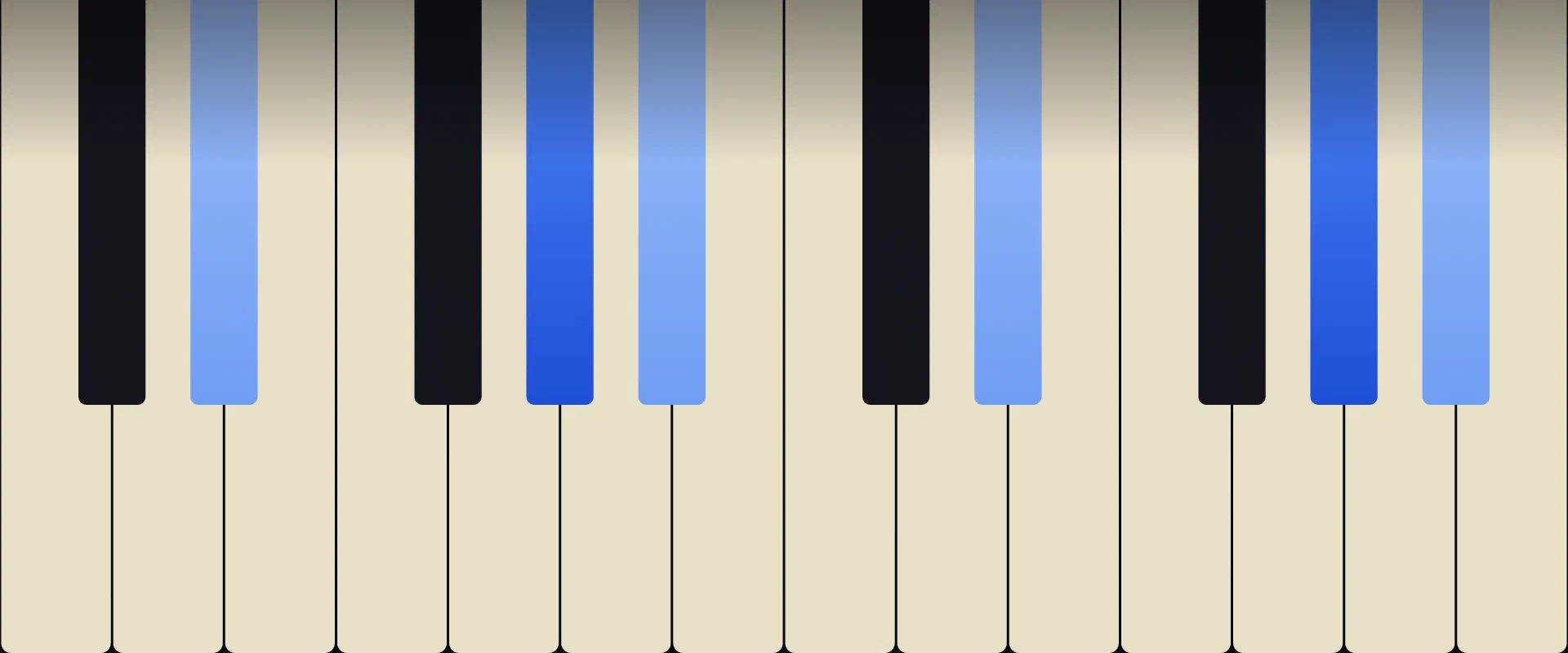
Your hand never touches a white key. A♭, B♭ and E♭ are all black, so this is a chord a pianist can find in the dark, in a badly lit pit or with eyes on a singer, and one that a guitarist may go years without ever seeing written down. That split runs through everything about it. A♭ is a voice key and a gospel key, so the chord turns up as a soft, undecided tonic in exactly the repertoire that guitars are least involved in.
Try It: A♭sus2 in the Chord Finder
The Notes of A♭sus2
| Degree | Note | Interval from root |
|---|---|---|
| 1 | A♭ | Perfect unison |
| 2 | B♭ | Major 2nd, 2 semitones |
| 5 | E♭ | Perfect 5th, 7 semitones |
Written low to high in root position: A♭ B♭ E♭.
How A♭sus2 Is Built
A♭ major is A♭ C E♭. Pull the C down a whole tone to B♭ and the third of the chord is gone. Nothing has replaced it that carries any mood, because a major second above the root is neither the major third that would make the chord bright nor the minor third that would make it dark. A♭sus2 is genuinely undecided, which is why writers reach for it when a line of melody needs somewhere open to sit.
The three notes have a second life. Stack them as E♭ A♭ B♭ and you have E♭sus4, the same pitches with a different note claiming the bottom, and the two behave nothing alike. In E♭ the A♭ is a fourth straining to fall to G, a delay with an obligation attached. In A♭ the B♭ owes nobody anything and will ring for eight bars. The bass and the key decide which chord you are playing.
A♭sus2 on the Piano
Three black keys and no white ones means the hand sits fully forward, every finger at the same depth. Nothing reaches back, and no thumb is stranded on a white key while the long fingers work above it, which is the usual complaint about flat key chords. Right hand root position takes 1 on A♭, 2 on B♭ and 5 on E♭. Thumb and index are on neighbouring black keys with only the A key between them, so keep them loose rather than pinched.
Second inversion is the one to know. E♭ A♭ B♭ puts the two adjacent black keys at the top under 4 and 5, with the thumb on E♭ a fourth below, and it is the shape gospel players actually use because the right hand can then walk the top note up to C and turn the chord into A♭ major without the thumb moving at all.
Better still, spread it. A♭ in the left hand, E♭ a fifth above, B♭ a fifth above that: two stacked perfect fifths, one chord, no thirds anywhere, open all the way up. This is the voicing that makes A♭sus2 sound like a place rather than a delay, and it is the reason the chord suits pads, organ and anything meant to sit under a voice.
There is a bonus in the all-black spelling: the other two black keys, D♭ and G♭, each sit a whole tone from the nearest chord tone, so a player improvising by feel up there cannot land a semitone rub. Beginners are often told to noodle on the black keys, and this is the chord that makes the advice sound clever.
A♭sus2 on the Guitar
There is no open form, and the honest barre is hard. The movable sus2 shape rooted on the 6th string wants the index across the 4th fret, the little finger at the 6th on the A string and two more fingers out at the 8th fret on the D and G strings. That is a four fret span with a barre already holding, noticeably harder than the plain major barre in the same position.
The shape rooted on the A string at the 11th fret is easier to hold and thinner to hear, and that far up the frets are close enough together that the chord loses the openness a sus2 is chosen for.
A better answer lives on the top four strings. Put the root at the 6th fret of the D string, E♭ at the 8th on the G, A♭ again at the 9th on the B and B♭ at the 6th on the top E. Four notes, no barre, and the second sitting up where the ear hears it as colour rather than as a missing third.
The answer most working guitarists use, though, is a capo at the 4th fret with the open Esus2 shape: open low string, 2nd fret on the A, 4th fret on the D and the G, top two strings open. Everything rings, the voicing gets back the open string sound the chord is usually chosen for, and the rest of the key arrives in familiar shapes. If a singer calls A♭ and you own a capo, this is not a compromise, it is the correct setting.
Inversions
| Inversion | Notes low to high | Bass note |
|---|---|---|
| Root position | A♭ B♭ E♭ | A♭ |
| 1st inversion | B♭ E♭ A♭ | B♭ |
| 2nd inversion | E♭ A♭ B♭ | E♭ |
First inversion is worth a warning. With B♭ at the bottom under two stacked fourths, the ear tries to hear a B♭ chord with a suspended fourth rather than an A♭ chord at all, so keep A♭ or E♭ low unless that ambiguity is the effect you want. E♭ is the safe alternative, being the dominant of A♭.
Voicings
Doubling the root at the top, A♭ B♭ E♭ A♭, is the standard keyboard version and it settles the question of which chord this is before the ear can ask. Guitarists get the same effect for free from the capoed open shape, where the root appears in two octaves.
The two useful moves out of it are both small. Let B♭ rise a whole tone to C and you have A♭ major. Keep the B♭ and add C beside it and you have A♭add9, A♭ B♭ C E♭, the sus2 colour with the third put back, which is what arrangers tend to want under a lead vocal.
Which Keys Contain A♭sus2
Because a sus2 has no third, it belongs to more keys than a triad does, including both major and minor ones that would disagree about the third:
- I of A♭ major
- IV of E♭ major
- V of D♭ major
- III of F natural minor
- VI of C natural minor
- VII of B♭ natural minor
It also sits entirely inside A♭ major pentatonic, which is the practical version of the same point: every note of the chord is in the five note scale a soloist would use over it, so the chord and the solo cannot argue.
Where A♭sus2 Shows Up
| Progression | In letters | Where it lives |
|---|---|---|
| Isus2, I, IV, V | A♭sus2, A♭, D♭, E♭ | Gospel, worship, pop ballad |
| I, IVsus2, V | E♭, A♭sus2, B♭ | Rock in E♭, guitar bands |
| i, IIIsus2, VI | Fm, A♭sus2, D♭ | F minor, film and R&B |
The first row is the reason this chord exists in this key. A♭ sits in the part of most voices where the tone has body and the singer is not yet pushing, so choral directors, gospel players and songwriters writing for a vocalist land on it constantly. Opening on the sus2 and letting B♭ fall into place as C gives a soft entry, and the whole gesture happens on black keys under one hand.
The second row is where guitarists actually meet it. Bands that tune down a semitone to E♭ play what feels like the key of E, and the IV chord that feels like A becomes A♭. An Asus2 shape fingered in E♭ tuning sounds A♭sus2 with open strings ringing, so a player can have used this chord for years while thinking of it as something else entirely.
The third row uses the missing third. In F minor, a chord built on A♭ would normally be A♭ major and would firmly say major, which can be more brightness than a dark passage wants. Replacing the C with B♭ removes the commitment and the harmony stays neutral. That neutrality also makes this a good pivot: the same three notes belong to F minor and to A♭ major, so a piece can slip between the two on a chord that never took sides.
Related Chords
- A♭ Major Chord the chord the suspension resolves into
- A♭ Minor Chord the other place the third could have gone
- A♭ Augmented Chord for what happens when the fifth moves instead
- Suspended Chords: sus2, sus4 and Tension for how sus2 and sus4 differ in function
- A♭ Major Scale the key this chord most often calls home
Learn More
Practice Chords
Drill chord recognition with a metronome, MIDI support, and score tracking.
Start Practicing