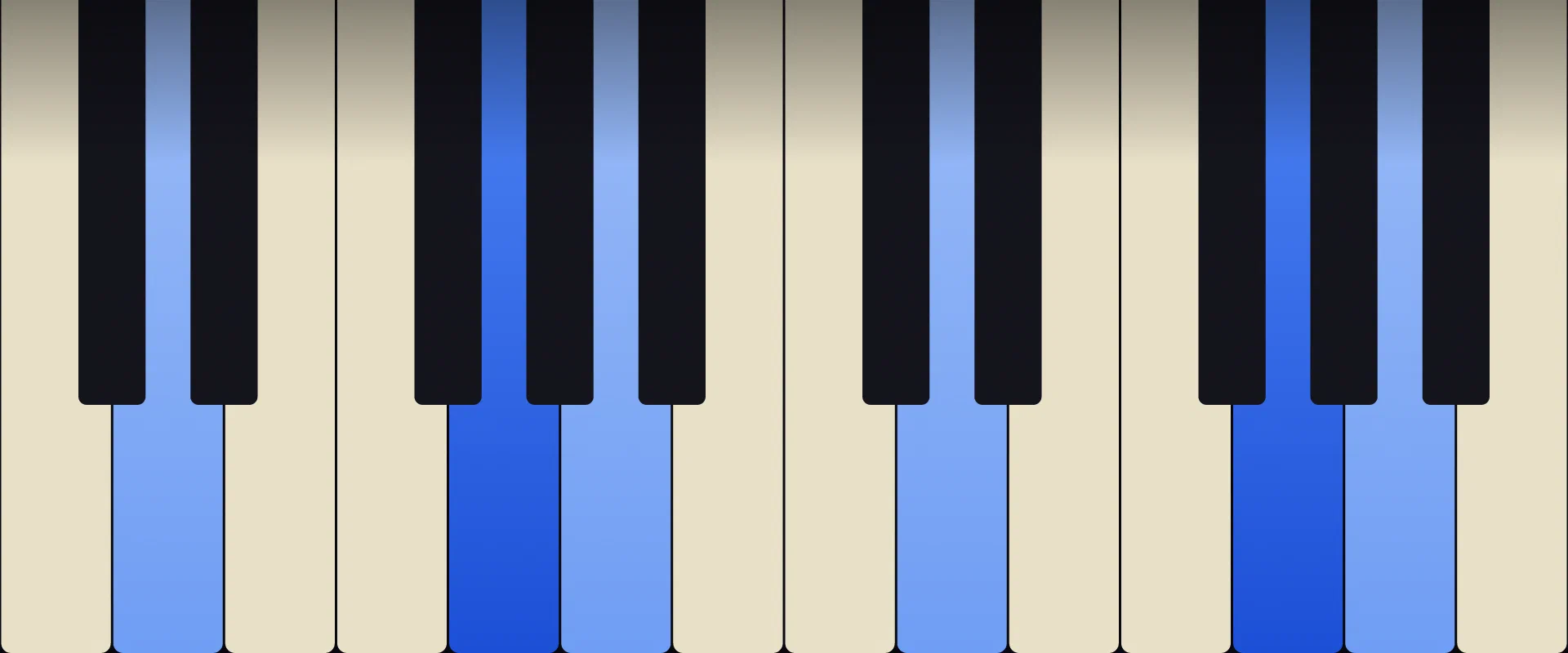
Play the open G that every guitarist learns in their first week, then lift the finger off the A string. B drops to the open A and the chord you are left holding is Gsus2. It costs nothing, it can be done mid strum, and it is the doorway into a family of shapes that share one hand position: G, Gsus2, Gsus4, Cadd9 and Dsus4 all live within a finger or two of each other, with the top two strings ringing the same D and G through every one of them.
That drone is not a trick, it is a huge amount of recorded music. Acoustic rock, folk pop and modern worship writing lean on it because a guitarist can change chords without ever silencing the top of the instrument. The three notes are G, A and D, all white keys, and there is not a third among them.
Try It: Gsus2 in the Chord Finder
The Notes of Gsus2
| Degree | Note | Interval from Root | Semitones |
|---|---|---|---|
| 1 (Root) | G | Perfect unison | 0 |
| 2 | A | Major 2nd | 2 |
| 5 | D | Perfect 5th | 7 |
Written Gsus2, sometimes Gadd9(no3) or G5add9 in guitar books. The perfect 5th is intact, so unlike most altered triads this one is entirely stable.
How Gsus2 Is Built
Start from G major, G B D, and replace the third with the second: B falls to A, one whole step down the white keys. The note that decides between major and minor has been removed rather than changed, so the chord is neither.
That single substitution is what separates it from its neighbour. Gsus4 moves the same B in the other direction, up a semitone to C, and the result strains towards resolution. Gsus2 does not. A sits a comfortable whole step above the root and a fourth below the fifth, and the chord will happily sit there for eight bars without asking to go anywhere.
Rearrange the notes and it gets clearer. G, D, A is two stacked perfect 5ths; A, D, G is two stacked perfect 4ths. Little else in common use has that property, which is why sus2 chords sound open and slightly ancient rather than sweet.
Gsus2 on the Piano
Three white keys, and yet the shape is stranger than it looks. G and A are next door to each other, so the thumb and second finger are bunched at the bottom of the hand while the little finger stretches a fourth up to D. Right hand 1, 2, 5. The left hand takes 5, 4, 1 and feels the same imbalance.
Compare Gsus4, G C D, where the crowding is at the top: the fourth comes first and C and D sit adjacent under fingers 4 and 5. Playing the pair back to back shows how much the position of one whole step changes the feel of a hand.
Down low, the whole step between G and A grinds. Below middle C it stops being harmony and starts being interference, so spread it: G in the left hand, D and A in the right, which puts the second where it belongs as a ninth and turns the chord into that stack of fifths.
The pianist’s version of the guitar drone is worth learning. Hold G and D as an outer shell and move only the note in between: A gives Gsus2, B gives G major, C gives Gsus4, then back down through B to A. One finger walking while the frame stays put is the whole of the suspended sound on a keyboard.
Gsus2 on the Guitar
No chart lists an open Gsus2 because the standard suspended shapes belong to the A, E and D forms. The guitar has one here anyway, by accident of tuning. Fret 3 0 0 0 3 3 and every string rings: G, A, D, G, D, G, with three open strings doing the work.
Finger it with the middle on the 6th string at the 3rd fret and the ring and little fingers on the top two strings, also at the 3rd fret. Now look at what is reachable without disturbing them:
| Chord | Frets | Change from Gsus2 |
|---|---|---|
| Gsus2 | 3 0 0 0 3 3 | starting point |
| G | 3 2 0 0 3 3 | add the 5th string, 2nd fret |
| Gsus4 | 3 3 0 0 3 3 | 5th string up to the 3rd fret |
| Cadd9 | x 3 2 0 3 3 | drop the 6th string, shift down |
| Dsus4 | x x 0 2 3 3 | one finger, 3rd string, 2nd fret |
| Em7 | 0 2 2 0 3 3 | open 6th, two fingers at the 2nd fret |
The top two strings never move. They sound D and G, the 5th and the root of G, and those two notes fit every chord in the row: against C they are the 9th and the 5th, against D they are the root and the suspended 4th, against Em they are the 7th and the minor 3rd. A whole progression can be played without the ringing top of the guitar ever changing pitch, which is why a strummed part in this key sounds like one continuous instrument rather than a sequence of separate chords.
Try this and listen to the top two strings sit still: G, Gsus2, Cadd9, Dsus4, one bar each, then back to G.
Movable forms exist and are mostly unnecessary here. The E shape sus2 barred at the 3rd fret is the loudest version, and the A shape lands at the 10th, where the frets are cramped and the voicing loses its bottom. Neither buys much over the open form.
Inversions
| Inversion | Notes | Bass | Symbol |
|---|---|---|---|
| Root position | G A D | G | Gsus2 |
| 1st inversion | A D G | A | Gsus2/A |
| 2nd inversion | D G A | D | Gsus2/D |
The second inversion has its own name. D, G, A is Dsus4, the same three notes measured from the fifth, so Gsus2 and Dsus4 are one chord with two identities and the bass note picks between them. The guitar shape x x 0 2 3 3 is exactly this ambiguity: call it Dsus4 in the key of D and Gsus2 with a D underneath in the key of G.
The first inversion, A D G, is the quartal voicing that jazz pianists build fourths from. Over an A bass it reads as A7sus4 without its fifth.
Voicings
Doubling changes the character more than inversion does. The open guitar form 3 0 0 0 3 3 gives three Gs, two Ds and one lonely A, so the second floats as a colour over a heavy foundation. Move the A into the middle of the texture and the chord turns noticeably tarter.
On piano, keep the second away from the root by an octave wherever possible. G and D in the left hand with A on top of the right hand is bright and open; G and A next to each other in the left hand is mud. Add B back on top and you have Gadd9, which is what this chord becomes the moment somebody plays a third over it.
Which Keys Contain Gsus2
Having no third makes this chord promiscuous. It belongs to major and minor keys alike, because the note that would exclude it from one or the other is simply not there:
- I of G major
- I of G natural minor
- I of G mixolydian
- V of C major
- IV of D major
- III of E natural minor
The first two are the interesting pair. The same chord is the tonic of G major and of G minor, and a song that slides between the two can leave the guitar exactly where it is. It also sits inside both the G major pentatonic and the E minor pentatonic scales, so any lick from either one will fit over it.
Where Gsus2 Shows Up
| Progression | Chords | Typical use |
|---|---|---|
| I, IV, V in G, open on top | Gsus2, Cadd9, Dsus4 | Acoustic rock, folk pop |
| I, V, vi, IV in G | G, Dsus4, Em7, Cadd9 | Worship, singer songwriter |
| Isus2 into I | Gsus2, G | Intros before the band enters |
| V of C with the third removed | C, Gsus2, G, C | Hymn and gospel cadences |
| i, III in E minor | Em7, Gsus2 | Modal vamps, ambient guitar |
| Vamp on one chord | Gsus2, Cadd9 | Two chord loops in G |
The intro row is where the missing third earns its place. Strum Gsus2 alone and the key is undecided, so the vocal entry settles it: a B in the melody makes the moment major, a B♭ makes it minor, and the guitar has not moved. Writers who want a verse that stays ambiguous until the chorus keep the guitar on this chord for as long as they can.
Two tunings make the same point louder. DADGAD, the tuning most Celtic and fingerstyle guitarists reach for, sounds D, A, D, G, A, D across its open strings, which is these three notes and nothing else. It is usually described as Dsus4 tuning, and Gsus2 is the other name for the same six strings. Meanwhile the lowest three open strings of a violin or a mandolin sound G, D and A, so a fiddler bowing across them is playing this chord without fingering anything at all. The instruments that carry folk and acoustic music are tuned into this chord, which is a large part of why the key of G is where they all seem to end up.
Related Chords
- G Major Chord, the same shape with the third restored
- G Minor Chord, the other chord Gsus2 can resolve into
- G Augmented Chord, which keeps the third and alters the fifth instead
- Gsus4, G C D, the same suspension moving upward instead of down
- Suspended Chords: Sus2, Sus4 and Tension
- The G Major Scale
- The G Major Pentatonic Scale
- The G Mixolydian Scale
- Guitar Chord Shapes: The CAGED System
Learn More
Practice Chords
Drill chord recognition with a metronome, MIDI support, and score tracking.
Start Practicing