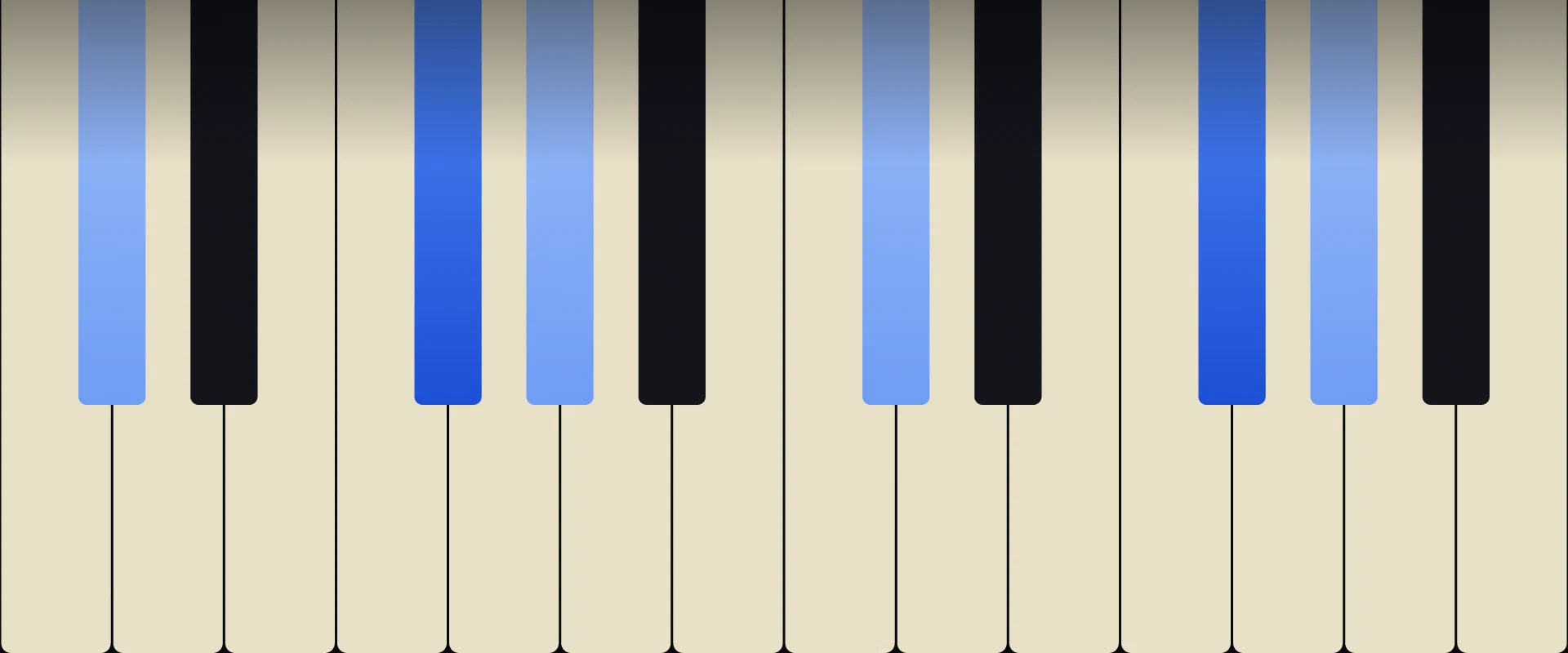
In the key of E major the chord on F♯ is minor. In A major it is minor again. In B major it is the major dominant. F♯sus2 works in all three without altering a note, because it has no third to contradict anyone: F♯, G♯ and C♯, with nothing in the middle to commit it.
E, A and B are the three keys guitar music returns to most often, which drops this sus2 into the centre of an enormous amount of repertoire. Pianists get an easier deal still: all three notes are black keys.
Try It: F♯sus2 in the Chord Finder
The Notes of F♯sus2
F♯sus2 contains three notes.
F♯, G♯, C♯
| Degree | Note | Interval from root | Semitones |
|---|---|---|---|
| 1 | F♯ | Root | 0 |
| 2 | G♯ | Major 2nd | 2 |
| 5 | C♯ | Perfect 5th | 7 |
Three sharps, three black keys, no awkwardness anywhere. The same key spelled as G♭ is not always so obliging: an augmented triad on it has to be written G♭, B♭ and D to dodge a double sharp, which is why the site files that chord as G♭aug and this one as F♯sus2. What is built above the key decides which name it gets.
How F♯sus2 Is Built
Start from F♯ major, F♯, A♯ and C♯, and let the A♯ fall three semitones to G♯. Or start from F♯ minor and let the A fall two semitones to the same G♯. Both parents are one short move away and both are chords almost every guitarist already owns, so the suspension is usually heard as a departure from one of them.
The outer frame stays a perfect fifth, so the chord occupies the same width as F♯ major. All the change happens inside: a whole tone at the bottom instead of a major third, which leaves the two lowest notes close enough to rub gently against each other.
Turn the chord over and the same three notes read C♯, F♯, G♯, which is C♯sus4. Every sus2 is the sus4 of its own fifth, and this pair is a clean example, since neither spelling needs an accidental the other does not already have.
F♯sus2 on the Piano
The five black keys are the F♯ major pentatonic scale, and this chord is three of those five. That is worth more than any fingering: hold F♯sus2 in the left hand, improvise anywhere on the black keys with the right, and nothing you land on can clash. The black-key group is where beginners are sent to make something up, and F♯sus2 is the harmony under that experiment.
For the chord itself, take 1 on F♯, 2 on G♯ and 5 on C♯ in the right hand. Thumb and index sit a whole tone apart and it feels cramped, because black keys are narrow and a short thumb slips into the gap between them. Keep the wrist high. Nothing asks the hand to reach around a white key, so the shape lives at the back of the keyboard.
Most pianists eventually abandon close position here. Send G♯ up an octave and the chord becomes F♯, C♯, G♯, two perfect fifths stacked, with the second no longer grinding against the root. The rub turns into open air.
F♯sus2 on the Guitar
No open form exists. Not one of the six open strings, E, A, D, G, B and E, appears in this chord, so nothing rings for free and the whole thing has to be fretted, capoed or muted.
That matters more than usual for a suspended chord, because in open position a sus2 is normally a subtraction. Asus2 and Dsus2 are made by lifting a finger off a chord you are already holding. Try the same trick on the F♯m barre at the 2nd fret and it fails: the G♯ you want sits on the 3rd string at the 1st fret, behind the barre, where no finger can reach it. The suspension that is free lower down costs an entirely new grip here.
Two grips do the job. The A shape barres at the 9th fret, x 9 11 11 9 9, index flat across the 9th and two fingers at the 11th: cramped, high up, and the more reliable of the two. The E shape barres at the 2nd fret, 2 4 6 6 2 2, a barre near the nut plus a reach out to the 6th, a genuine stretch for a small hand.
The third route is the one most records take. Put a capo at the 2nd fret and play the open Esus2 shape, or a capo at the 4th and play the Dsus2 shape, and F♯sus2 arrives with strings ringing openly behind it, which is why the chord turns up constantly in acoustic music despite having no open form.
Inversions
| Inversion | Notes | Bass note |
|---|---|---|
| Root position | F♯ G♯ C♯ | F♯ |
| 1st inversion | G♯ C♯ F♯ | G♯ |
| 2nd inversion | C♯ F♯ G♯ | C♯ |
The 1st inversion is two perfect fourths stacked on top of each other, G♯ to C♯ and C♯ to F♯, a shape jazz and film writers reach for when they want harmony without a stated quality. The 2nd inversion is C♯sus4 in root position, note for note. Which of the two names a listener hears depends entirely on the bass and on what follows. Chord Inversions and Voice Leading covers how that choice is made.
Voicings
Keep the 2nd off the bottom. F♯ and G♯ next to each other low down turns muddy fast, so put F♯ and C♯ in the left hand and let G♯ sit above them in the right, where it reads as colour.
On guitar, x x 4 6 7 4 is the compact version on the top four strings. Fingerpickers tend to keep the top two strings of a capoed shape droning and move everything else underneath them.
Which Keys Contain F♯sus2
The full list runs much longer, because a chord with no third fits almost anywhere. What the six above have in common is that they all spell it with sharps. The same three keys are just as diatonic to D♭ major, where they are written G♭, A♭ and D♭ and the chord is called G♭sus2. Same sound, same fingering, different page of the score.
Where F♯sus2 Shows Up
A, E, F♯sus2, D in A major. The familiar I, V, vi, IV loop with the vi opened out. F♯m states the sad turn plainly and F♯sus2 declines to, which is exactly why capo-driven acoustic pop uses it: the progression keeps its shape but stops announcing the emotion at the third chord.
F♯sus2, F♯, B in B major. Here the chord is the dominant with its third withheld, and the G♯ lifts to A♯ on the way into F♯ before the tonic lands. Worship writing and pop ballads lean on this hard, and the delay is the whole effect.
F♯sus2 held as a tonic. Drop the chord under a melody in F♯ minor and leave it there. With no third, nothing resolves and nothing darkens, so the harmony simply hangs. Ambient, post-rock and film cues use suspended tonics for anything that must stay unsettled.
Singers are the other reason this chord travels. A guitarist capos up to it from E or D shapes rather than reading six sharps, and a pianist reaching for the same sound finds the easiest handful of keys on the instrument. Both arrive from opposite directions. For moving a song into or out of it, see How to Transpose a Song to Any Key.
Related Chords
- F♯ Major Chord, the parent triad, one small move away
- F♯ Minor Chord, the other parent, and the chord F♯sus2 most often stands in for
- G♭ Augmented Chord, the same root under its flat name, which that chord needs and this one does not
- Guitar Chord Shapes: The CAGED System for the shapes behind the 2nd and 9th fret barres
Learn More
- Suspended Chords: sus2, sus4 and Tension, what suspension does, and where F♯sus4 and C♯sus4 fit alongside this chord
- What Are Intervals and How to Identify Them, for the major 2nd that replaces the third here
- The F♯ Major Scale, the home key, six sharps, one of which (E♯) is played on a white key
Practice Chords
Drill chord recognition with a metronome, MIDI support, and score tracking.
Start Practicing