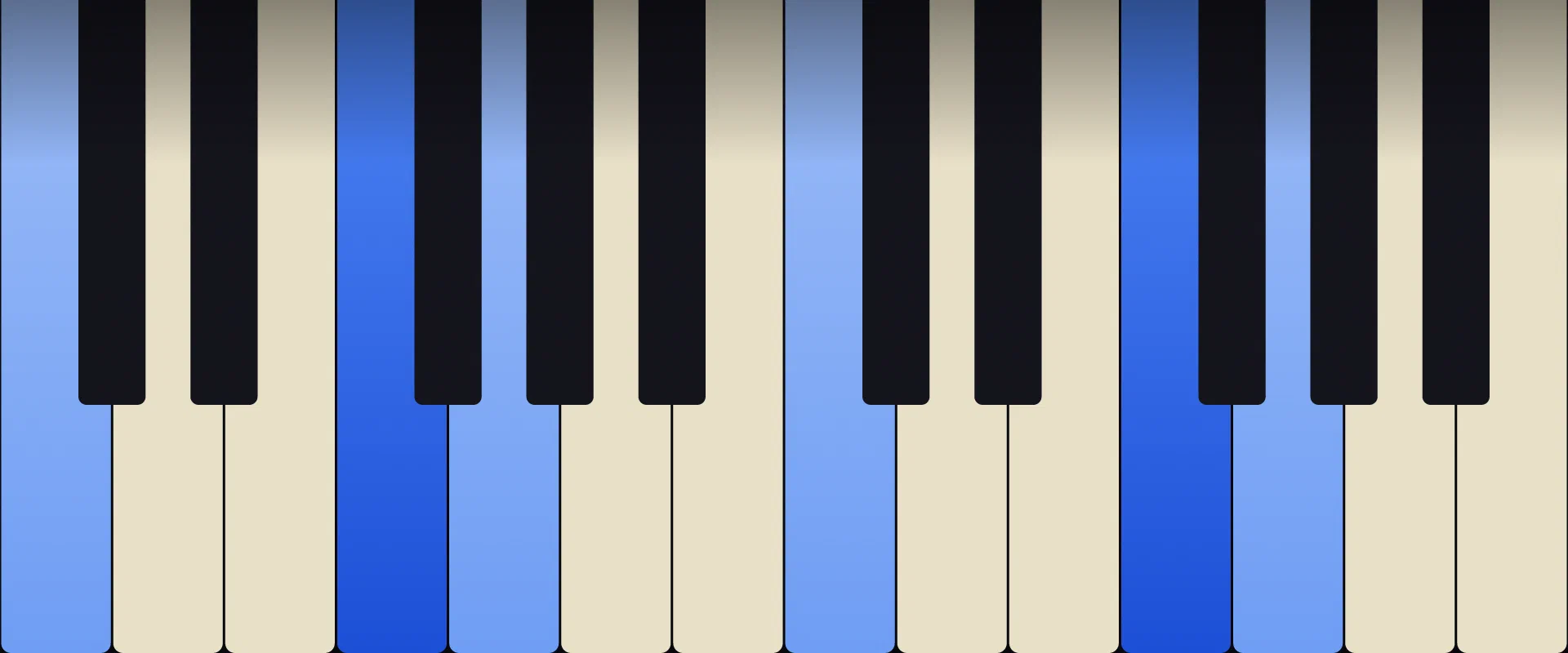
F, G and C are also C, F and G. Read the three notes upwards from F and you have a suspended 2nd. Rotate them so C is lowest and you have a suspended 4th. Nothing in the sound tells you which is meant, yet the two names describe opposite behaviour, because one is a genuine suspension and the other, in modern use, almost never is.
A suspension in the old sense is voice leading, not a chord. A note is held over from the previous harmony, turns dissonant as the bass moves under it, then falls one step. Read these notes on C and that is what happens: the F hangs on, drops to E, and C major arrives. It is a 4 to 3 suspension, in use long before chord symbols existed.
Read the same notes on F and the mechanism fails. For the G to fall one step it would land on the root, leaving a bare fifth. So players lift it the other way, to A, which gives F major and is not a suspension at all. Pop keeps the G and resolves nothing. The name is a fossil attached to a sound that has stopped doing the thing it is named after.
Try It: Fsus2 in the Chord Finder
Set F as the root and compare the sus2 with F major and F minor. The note separating those two is missing here.
The Notes of Fsus2
| Degree | Note | Interval from Root | Semitones |
|---|---|---|---|
| 1 (Root) | F | Perfect unison | 0 |
| 2 | G | Major 2nd | 2 |
| 5 | C | Perfect 5th | 7 |
Two semitones, then five. The outer interval is an ordinary perfect 5th, so the chord is stable at the edges and crowded at the base.
How Fsus2 Is Built
Take F major, F, A and C, remove the A and put G in its place. The 3rd decides whether a triad is major or minor, so taking it out leaves a chord with no quality at all: F major and F minor both accept these three notes, because the note they disagree about is the one this chord declines to play.
Turn it over once and something else appears. G, C, F is a perfect 4th stacked on a perfect 4th, five semitones and then five more. Quartal harmony sounds open and rootless for that reason, which is why a sus2 can sit under a melody for eight bars without ever seeming to need to move.
Fsus2 on the Piano
Three white keys and nothing else. Five of the twelve sus2 chords manage that, so it is no rarity, but it does make this a good place to learn the shape.
Under the hand it feels wrong at first. Thumb on F, index finger on G, little finger on C, a 1, 2, 5 grip with two fingers pressed against each other at the bottom and a gap of a 4th at the top. F major sits evenly as 1, 3, 5. This chord bunches. The cure is to lift the G an octave and play F, C, G, so the 2nd sounds as a 9th well above the 5th. Most chart voicings are spread that way rather than played close.
Then try both resolutions. Move the index finger one white key right onto A for F major, which is what everybody plays, then one white key left onto F for a bare fifth, which is what the theory books describe. Hearing them side by side shows why the second fell out of use.
Fsus2 on the Guitar
F is the root that punishes guitarists, and no open form exists here either: F sits one fret above the open 6th string.
One saving grace is worth knowing: the open 3rd string is a G, this chord’s 2nd. Ring finger on the 4th string at fret 3 for F, the 3rd string open, index across the 2nd and 1st strings at fret 1 for C and F. Written out, x x 3 0 1 1. The open string rings through the middle of the voicing, which is the sound most players are after.
The obvious shortcut does not work. In the standard F barre, 1 3 3 2 1 1, the 3rd string at fret 2 is the A, and lifting that finger does not open the string, it drops it onto the barre at fret 1, sounding A♭. Lift your middle finger off an F barre and you get F minor, not F sus2.
Higher up, the A shape barred at fret 8 works well: x 8 10 10 8 8, index across the 5th, 2nd and 1st strings, ring and little fingers two frets above. The E shape at fret 1 wants a first fret barre plus a reach out to the 5th, in the tightest stretch of neck, and buys nothing x x 3 0 1 1 does not.
Inversions
| Inversion | Notes | Bass Note | Symbol |
|---|---|---|---|
| Root position | F, G, C | F | Fsus2 |
| 1st inversion | G, C, F | G | Fsus2/G |
| 2nd inversion | C, F, G | C | Fsus2/C |
The second inversion is the interesting one, because C, F, G with C at the bottom is not usually called an inversion of anything. A chart will call it C sus4. That leaves G, C, F as the only rotation that stays anonymous, the stack of fourths, useful because no letter name in it feels like a root.
Voicings
Give the 2nd some air. Held tight against the root it reads as a rub rather than a colour, so lift the G an octave, or leave the root to the bass and voice the upper parts as C and G.
For tension and resolution at once, add the A back without removing the G. F, G, A and C is Fadd9, where the 2nd and the 3rd sound together instead of one replacing the other.
| Shape | Frets, low to high | Sounding notes |
|---|---|---|
| Four strings, open 3rd | x x 3 0 1 1 | F, G, C, F |
| A shape, barred at fret 8 | x 8 10 10 8 8 | F, C, F, G, C |
| E shape, barred at fret 1 | 1 3 5 5 1 1 | F, C, G, C, C, F |
| Fadd9, upper strings | x x 3 2 1 3 | F, A, C, G |
Which Keys Contain Fsus2
- I of F major
- I of F natural minor
- IV of C major
- V of B♭ major
- VI of A natural minor
- Contained in F major pentatonic
Look at the first two lines. F major and F natural minor have different signatures, and this chord belongs to both unaltered, because A against A♭ is the argument between them and this chord stays out of it. That is why the site’s full list runs to nearly fifty scales rather than the handful a major or minor triad gets. It also fits inside F major pentatonic, five notes with no semitone clashes anywhere, which goes some way to explaining why it sounds untroubled.
Where Fsus2 Shows Up
The most common reason a guitarist plays this chord is not a musical one. In the key of C the IV chord is F major, the barre that stops beginners, while x x 3 0 1 1 falls under the same hand as C and Am. Acoustic songwriting in C leans on the sus2 as its IV chord for that reason alone, and the unfinished quality that results has become part of the style.
| Progression | Chords | Where it lives |
|---|---|---|
| I, IV, vi, V | C, Fsus2, Am, G | Acoustic guitar in C |
| I, Isus2, IV, V | F, Fsus2, B♭, C | Folk and rock strumming |
| i, isus2, VI, VII | Fm, Fsus2, D♭, E♭ | Modal minor vamps |
The third line shows what the missing 3rd buys you. Fm is F, A♭ and C, and sliding to F, G and C removes the A♭ without replacing it, so the harmony brightens for a bar without going major. Film and ambient writing leans on that move over an F pedal, where a chord that refuses to declare itself can carry a long stretch.
Read from the other end, these notes make the classic dominant suspension in this page’s own key. C is the V chord of F, and a sus4 held over a C bass then dropped to the 3rd is a cadence formula centuries old. Guitarists reach for it to dodge a barre and pianists to delay a cadence.
Related Chords
- F Major Chord is what lifting the G to A gives you.
- F Minor Chord is the other neighbour, and this chord sits beside it as comfortably.
- F Augmented Chord alters the 5th instead of the 3rd.
- Suspended Chords: Sus2, Sus4 and Tension covers both suspensions and how they resolve.
- Chord Inversions and Voice Leading explains the rotation that turns this chord into C sus4.
Learn More
F sits one step anticlockwise from C on the circle of fifths, which is why these three notes are a tonic sus here and a subdominant sus there. For the 9th chords that keep the 2nd and the 3rd sounding together, see Extended Chords and Jazz Harmony. For every scale containing this chord, see Scales for Piano and Guitar: The Complete Reference Guide.
Practice Chords
Drill chord recognition with a metronome, MIDI support, and score tracking.
Start Practicing