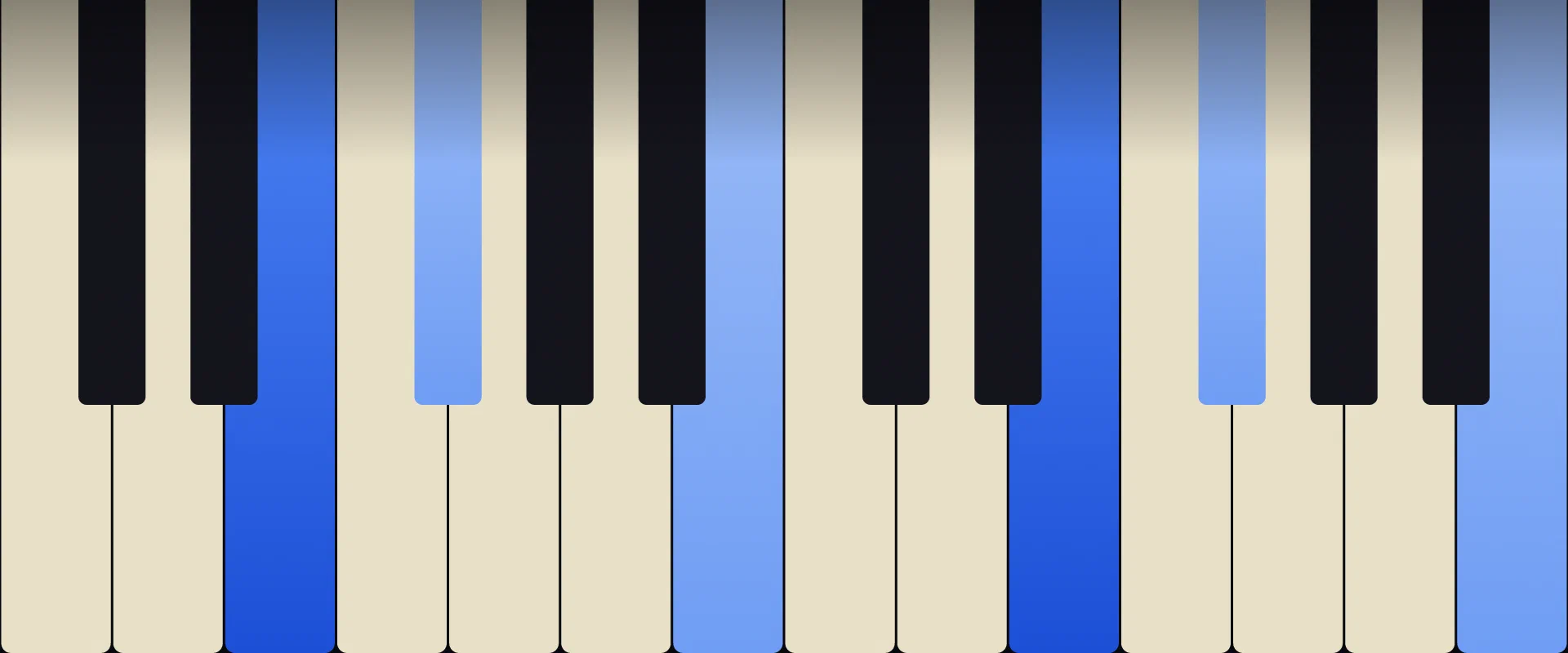
Here is a reversal worth knowing about. E major is the easiest full chord on a guitar, six ringing strings and three fingers inside the second fret, and every barre chord is modelled on it. Swap its third for the second and the convenience evaporates. Esus2 is E, F♯ and B, and the standard grip, 0 2 4 4 0 0, wants a two fret spread in the part of the neck where the frets are physically widest. Plenty of players quietly substitute something else. On a piano the same three notes are a shrug: one black key, two white, nothing to think about.
Try It: Esus2 in the Chord Finder
Select E as the root and E major or E Dorian as the scale. The chord sits on the first degree of both, because it has no third to disagree about.
The Notes of Esus2
E sus2 takes the root, major 2nd and perfect 5th:
E, F♯ and B
| Degree | Note | Interval from Root |
|---|---|---|
| 1 (Root) | E | Perfect unison |
| 2 | F♯ | Major 2nd |
| 5 | B | Perfect 5th |
F♯ is the only accidental and lands on the black key between F and G, so nothing about the layout is counterintuitive. Reorder the notes as E, B, F♯ and they are two perfect fifths stacked: no third, no argument between major and minor, just an open frame.
How Esus2 Is Built
Take E major, E, G♯ and B, and pull the G♯ down two semitones to F♯. The third is gone and the second stands in its place, which is what “suspended” means here. The chord is neither major nor minor, so it will sit over an E major passage and an E minor passage without arguing with either.
Its twin is Bsus4: B, E and F♯ are the same three pitches with B taken as root and E as the suspended fourth. Which one you are hearing is decided by the bass note and by what happens next. Keep the G♯ and add the F♯ beside it rather than in its place and you get Eadd9, which guitar tab books confuse with this chord constantly.
Esus2 on the Piano
One black key and two white ones, arranged so the hand narrows at the bottom and opens at the top. E and F♯ are a whole step apart, close enough that thumb and second finger almost touch, and then B is a perfect fourth further up.
Right hand: thumb on E, second finger on F♯, fifth finger on B.
Left hand: fifth finger on E, fourth finger on F♯, thumb on B.
The second finger reaches a little further in to catch the black F♯ while the outer fingers stay forward on white keys, and that is the only adjustment the shape asks for. In E major the black key sits in the middle of the span. Here it is crowded against the root, which is what gives the chord its faint clang when the two notes are close together.
Manage that clang by spreading the chord: E low in the left hand, F♯ and B up in the right, or the F♯ lifted an octave so the second sounds as a ninth. Held tight in the middle of the keyboard it reads as a deliberate crunch rather than as an open sound.
Esus2 on the Guitar
The standard form is 0 2 4 4 0 0, sounding E, B, F♯, B, B, E from the bottom up. Four strings ring open, which sounds promising until you look at what the fretting hand has to do: index at the 2nd fret of the fifth string, then ring and little fingers together at the 4th fret of the fourth and third strings. Two frets of spread at the widest end of the neck, with nothing to brace against.
Compare that with E major, 0 2 2 1 0 0, which never leaves the 2nd fret, or with Esus4, 0 2 2 2 0 0, which is E major plus one finger. Suspensions on this root are lopsided: the fourth is nearly free and the second is not. Guitar music in E consequently uses Esus4 far more than it uses Esus2, and it is a fingering accident rather than a musical judgement.
Four substitutes get used in practice:
x 2 4 4 0 0 drops the low E and gives Esus2/B. Same fingers, same stretch, but the fifth in the bass makes the chord float, and it is often what a recording actually contains when the chart says Esus2.
x x 4 4 0 0 is the two finger version, sounding F♯, B, B, E. All three notes are present with F♯ in the bass, so it works as a colour above a bass player and costs nothing.
x 7 9 9 7 7 is the Asus2 shape barred at the 7th fret. The frets are narrower there, the stretch stops being a stretch, and the chord gains a compact voice that suits a busy arrangement better than the open form does.
One more is 0 x 4 4 0 0, which keeps the low E and loses the stretch by muting the fifth string with the underside of a finger, if you can deaden a string mid voicing.
Inversions
| Voicing | Notes | Bass note |
|---|---|---|
| Root position | E F♯ B | E |
| 1st inversion | F♯ B E | F♯ |
| 2nd inversion | B E F♯ | B |
Inversion does more here than it does to a triad with a third, because moving the bass can rename the chord outright: with B underneath, the second inversion is indistinguishable from a root position Bsus4, and the ear takes whichever the surrounding music supports. First inversion, F♯ in the bass, is the least settled and the most useful under a moving bass line, since F♯ can walk down to E or up to G♯ while the upper voices sit still.
Voicings
- Open form, 0 2 4 4 0 0, the full six strings and the widest sound.
- Two finger partial, x x 4 4 0 0, sounding F♯, B and E over someone else’s bass.
- Slash voicing, x 2 4 4 0 0, Esus2 over B, which floats rather than lands.
- Barred, x 7 9 9 7 7 at the 7th fret, compact and easy to voice-lead from.
- Piano spread, low E in the left hand with B and F♯ high in the right, the second sounding as a ninth.
Avoid doubling the F♯ next to the E in the middle register. One second opens the chord up; two of them a tone apart muddy it.
Which Keys Contain Esus2
Having no third, this chord belongs to major and minor keys alike, which is why the list is so long. Six that earn their place:
- degree 1 (I) of E major
- degree 5 (V) of A major
- degree 2 (II) of D major
- degree 1 (I) of E natural minor
- degree 1 (I) of E dorian
- degree 1 (I) of E mixolydian
The four E rooted entries make the point. E major, E natural minor, E Dorian and E Mixolydian disagree about the third and the seventh, yet this chord sits on the tonic of all four without changing a note. Hence its value as an opening chord: it fixes a root and commits to nothing else.
Where Esus2 Shows Up
As the tonic of a modal E vamp. Folk, Celtic and British rock repertoire lives in E Dorian and E Mixolydian, and a sus2 on the tonic keeps the mode undeclared until the melody gives it away. Loop Esus2 and D and the bed accepts an E Dorian fiddle line and an E Mixolydian one equally. The open B and E strings carry most of that sound, which is how it survives on an instrument that makes the grip awkward.
As the ii of D major, minus its third. D, Esus2, A, D. The ii chord in D major is Em, and swapping its G for F♯ removes the minor quality without leaving the key. Folk and country guitar in D leans on this, since D and A are both generous open shapes and the sus2 keeps the middle of the progression from turning gloomy.
As Bsus4 in disguise, in the key of E. Bsus4, B, E is the standard suspended dominant into the tonic, and the first chord of it is these three notes with B in the bass. A guitarist who fingers x 2 4 4 0 0 in the key of E is playing a dominant, not a tonic, even though the notes are identical to Esus2. The label follows the function.
For all that, it is rarely a chord to hold for a whole bar. It works as an approach, a release, or a drone under a melody. Leave it too long with no third arriving anywhere and the music sounds like it is waiting on a decision nobody is making.
Related Chords
- E Major Chord: Notes, Voicings, and How to Play It is the chord this one suspends, and the shape that makes the comparison unflattering.
- E Minor Chord: Notes, Voicings, and How to Play It is the other resolution the second can fall into.
- E Augmented Chord: Notes, Voicings, and How to Play It alters the fifth instead of the third.
- Suspended Chords: Sus2, Sus4, and the Art of Tension is the family this chord belongs to, Esus4 included.
Learn More
- Diatonic Chords: A Beginner’s Guide to Building Chords from Scales explains the third this chord leaves out.
- Chord Inversions and Voice Leading on why the bass note decides between Esus2 and Bsus4.
- The Circle of Fifths Explained places D major, A major and E major in a row.
- E Dorian Scale: Notes, Chords, and How to Play It is the mode this chord suits best.
Practice Chords
Drill chord recognition with a metronome, MIDI support, and score tracking.
Start Practicing