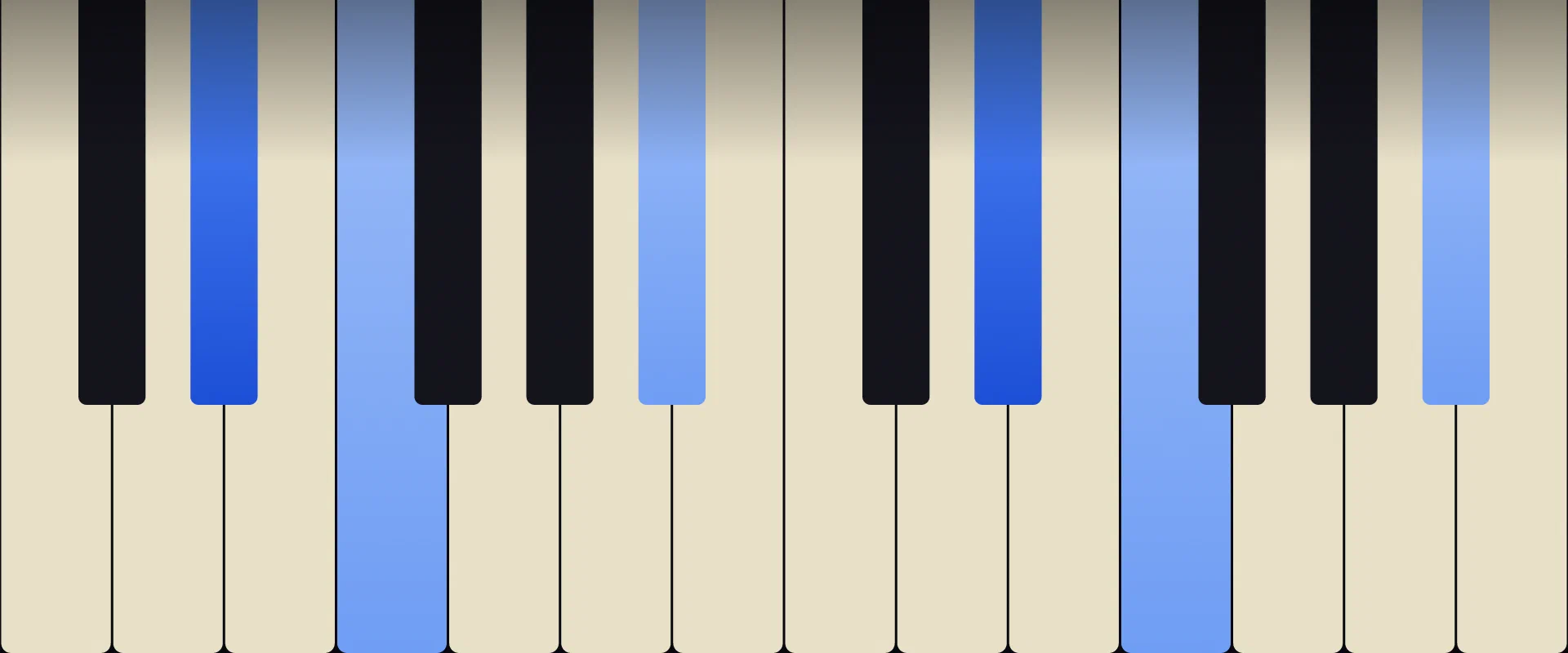
Few chords divide the two main instruments this sharply. At a keyboard, E♭ F B♭ is about as comfortable as three notes get: two raised keys with one white key beside them, the hand sitting back where it has room and the thumb never once squeezed between black keys. On a guitar the same chord has no open form at all and starts life as a barre at the 6th fret. Which is much of why you hear it in music that grew up around keyboards and rarely in music that grew up around six strings.
Try It: E♭sus2 in the Chord Finder
The Notes of E♭sus2
The chord contains three notes: E♭, F and B♭.
| Degree | Note | Interval from root | Semitones |
|---|---|---|---|
| 1 | E♭ | Root | 0 |
| 2 | F | Major 2nd | 2 |
| 5 | B♭ | Perfect 5th | 7 |
Written E♭sus2, occasionally E♭2 on lead sheets, and E♭(add9) by writers who want the third kept as well. That last one is a different chord, four notes rather than three.
How E♭sus2 Is Built
Start from E♭ major, E♭ G B♭, and pull the G down to F. The third is gone and a second stands in its place, which is what suspended means here. With no third the chord is neither major nor minor, so it sits happily inside an E♭ major passage and inside a C minor one without changing a note.
The spacing that results is lopsided: a major 2nd at the bottom, E♭ to F, then a perfect 4th above it, F to B♭. The lower pair rubs while the top stays wide open, which is the whole sound of sus2.
E♭sus2 on the Piano
Two black keys and one white, and the geography is friendly. E♭ is the right hand key of the group of two, B♭ the right hand key of the group of three, and F the white key immediately to the right of E♭, at the near edge where there is plenty of room.
Right hand fingering is 1 on E♭, 2 on F, 5 on B♭; the left hand takes 5, 4, 1. Note what the thumb and index finger do: they land on two keys physically side by side but on different planes, one raised and set back, one flat and forward. A whole tone in sound, almost no distance in space, so the pair falls under the hand rather than being reached for. Chords whose second sits between two black keys force the thumb into a slot. This one never does.
The wide gap between F and B♭ leaves the middle of the chord empty, which is where the fun is. Add G above for E♭add9, the major third restored without losing the open quality. Add G♭ and it turns minor. Leave both out and the ambiguity is the point.
There is a second reason this chord repays a keyboard, and one move demonstrates it. Hold E♭, F and B♭ in the right hand and play E♭ in the left: E♭sus2, at rest. Now move the left hand alone down to B♭. Nothing in the right hand has changed, but the chord is now B♭sus4, a suspension that badly wants its E♭ to fall to D. Three pitches, two opposite jobs, decided entirely by the bass note.
E♭sus2 on the Guitar
There is no open E♭sus2. The standard grip is the Asus2 shape barred at the 6th fret, x 6 8 8 6 6: index across the 6th fret, ring and little fingers at the 8th on the D and G strings, root on the 5th string. A full barre, but it falls in the middle of the neck where the strings are slackest and the frets are still wide enough to see, so it is one of the easier ones to hold for a whole bar.
The Esus2 shape barred at the 11th fret, 11 13 15 15 11 11, gives a low E♭ and costs a great deal more. The barre is up where the frets crowd, the reach to the 15th is four frets beyond it, and on most acoustics the neck joint is fighting your thumb by then. Use it for that bass note or not at all.
The cheap way out is the D shape moved up one fret: x x 1 3 4 1. Four notes, first position, only a two string index barre. It sounds E♭, B♭, E♭ and F from the 4th string up, high and thin, which is right when a piano or organ already covers the bottom.
Guitarists tuned down a semitone to E♭ standard get all of this for nothing. Every open shape drops a semitone, so the open Esus2 grip, 0 2 4 4 0 0, sounds E♭sus2 with its open strings ringing. If you have wondered how a band gets that much open string resonance in a flat key, this is usually the answer.
Inversions
| Inversion | Notes | Lowest note |
|---|---|---|
| Root position | E♭ F B♭ | E♭ |
| 1st inversion | F B♭ E♭ | F |
| 2nd inversion | B♭ E♭ F | B♭ |
First inversion, F B♭ E♭, is two perfect fourths stacked, the quartal shape modal jazz pianists reach for by reflex. It barely sounds like a chord of E♭ at all.
Second inversion is the twin mentioned above. Set out as B♭ E♭ F it is a textbook B♭sus4, and any harmony teacher marking suspensions would call it one. That is no quirk of notation: sus2 and sus4 a fifth apart are the same three pitches, and only the root the music picks separates them.
Voicings
Open the chord out and it improves. Put E♭ low in the left hand, then F and B♭ in the right with an octave of daylight between the hands, and the second at the top rings rather than beats. Squashed into the middle of the keyboard, E♭ and F buzz against each other.
For a fuller pad, stack it in fourths: B♭, E♭, F upwards, with a low E♭ underneath. This suits electric piano and drawbar organ, where a third in the middle register turns muddy fast.
Guitar wants the opposite. The three note fragment x 6 8 8 x x gives root, fifth and second without doubling anything, keeping the chord out of the singer’s way. The full barre doubles root and fifth and can swamp a quiet arrangement.
Which Keys Contain E♭sus2
- I of E♭ major
- II of D♭ major
- IV of B♭ major
- V of A♭ major
- III of C natural minor
- Contained in E♭ major pentatonic
All three notes also live inside C minor pentatonic, so this chord cannot clash with a blues solo in C minor however the soloist moves. A chord with no third has little it can argue with.
Where E♭sus2 Shows Up
Isus2 as home: E♭sus2, A♭/E♭, E♭sus2. In gospel and soul this chord is not waiting for anything. It is the tonic with the third rubbed off, a softer landing than the plain triad, and the progression can loop through it forever without resolving the F to a G. Sus2 as a destination rather than a delay is the biggest gap between how these genres use it and how a harmony course teaches it.
Isus2, IV, V: E♭sus2, A♭, B♭. The ordinary three chord frame with the tonic left slightly open. Since F is the fifth of B♭, the top of the chord already contains a piece of the dominant, and the progression feels joined up before it has gone anywhere.
vi, IV, Isus2, V: Cm, A♭, E♭sus2, B♭. The modern pop loop, in the key where soul records tend to sit. Arriving at E♭sus2 rather than E♭ stops the loop settling, which is what you want from a chord due round again in two bars.
B♭sus4, B♭, E♭. Play this against the first example. The notes are identical to E♭sus2 and the effect is opposite: here E♭ is a genuine suspension, it must fall to D, and the ear waits for it.
Why flat keys, and why keyboards. Soul, gospel and Motown grew up in rooms with horn sections, and horns read comfortably in E♭, A♭ and B♭, so the piano, the Wurlitzer and the Hammond followed them there. Three flats cost those instruments nothing, while the guitarist in the same band is capoing or barring all night. The repertoire that resulted is built on keyboard friendly chords in keyboard friendly keys, and E♭sus2 sits near the middle of it.
Related Chords
- E♭ Major Chord
- E♭ Minor Chord
- E♭ Augmented Chord
- Suspended Chords: Sus2 and Sus4
- Guitar Chord Shapes: The CAGED System
Learn More
Practice Chords
Drill chord recognition with a metronome, MIDI support, and score tracking.
Start Practicing