Finger an open D chord, x x 0 2 3 2, then take your middle finger off the top string. The open E rings instead of F♯ and you are playing Dsus2. That is the whole cost of this chord on a guitar: one finger, lifted, no reposition. Put a different finger down on the 3rd fret of that same string instead and you get Dsus4. Three chords live under one hand position, and the first string decides which of them you are playing.
That accident of the tuning is a large part of why suspended chords entered rock at all. Nobody had to learn a shape. The E is simply what the top string already does when you stop pressing it, and generations of players found the sound by accident before they found the name for it.
Try It: Dsus2 in the Chord Finder
The Notes of Dsus2
Dsus2 is three notes: D, E and A.
| Degree | Note | Interval from Root | Semitones |
|---|---|---|---|
| 1 (Root) | D | Perfect unison | 0 |
| 2 | E | Major 2nd | 2 |
| 5 | A | Perfect 5th | 7 |
Written Dsus2, occasionally D2 or Dadd9(no 3) by writers who want to be exact at the cost of being readable. The two is a replacement, not an addition: there is no F♯ in this chord anywhere.
How Dsus2 Is Built
Take D major, D F♯ A, and move the F♯ down to E. The third is gone and a second stands in its place, which is why the chord is neither major nor minor. It has no opinion about the key it is in, only about the root.
A second identity is hiding in those notes. Rearranged as E, A, D they are two perfect fourths stacked up. Read from A they are A, D, E, which is Asus4. Dsus2 and Asus4 hold the same pitches with a different note claiming the bottom, so choosing between the names is a question about the bass, not about the chord.
Dsus2 on the Piano
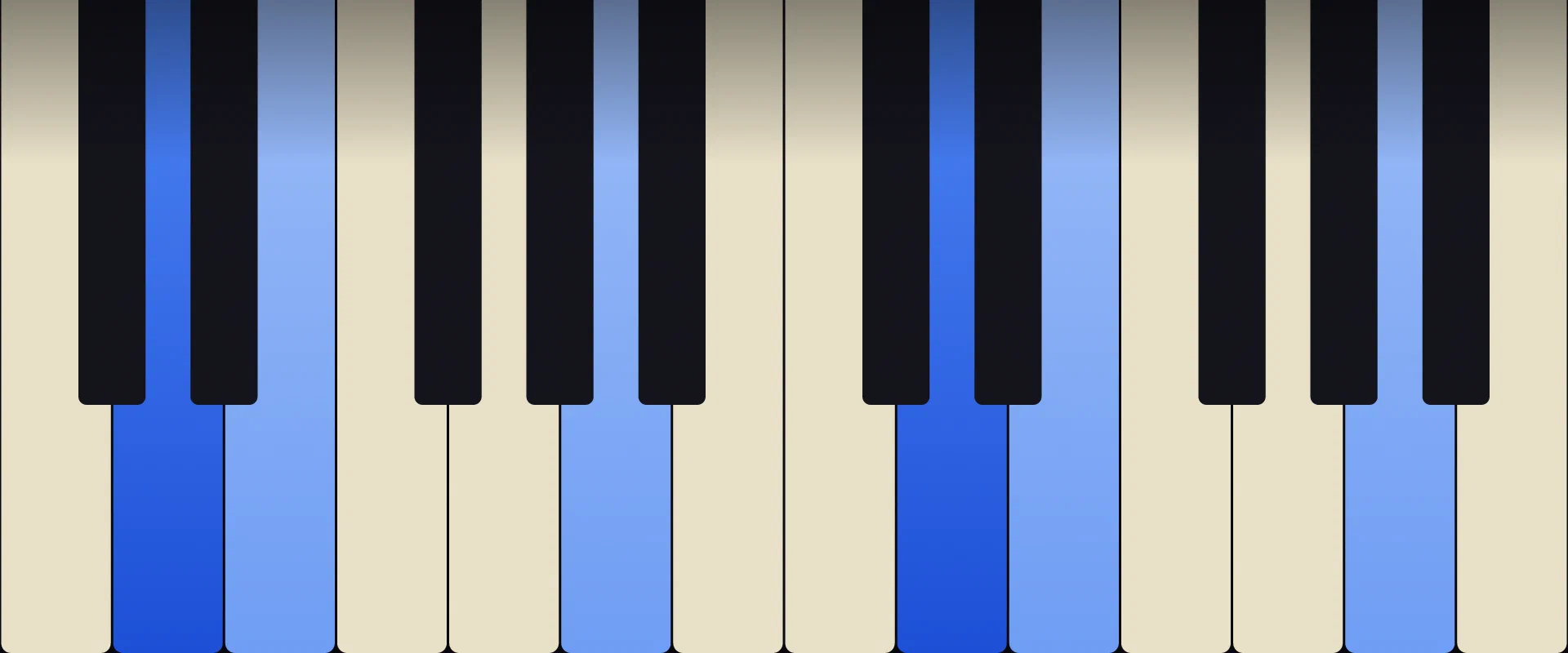
All three notes are white, and this is one of the few chords where that is not a convenience. D and E are neighbours, so the hand starts with two fingers jammed side by side on adjacent keys and then has to jump a fifth to reach A. Right hand 1, 2, 5 works but crowds the thumb; 1, 3, 5 keeps the fingers apart at the cost of a stretch, and most pianists pick between the two according to how fast the passage moves.
Spreading the chord solves that completely, and it is what the sound wants anyway. Put D low in the left hand and E with A together in the right. The major second stops being a cluster under two fingers and becomes a fourth from E up to A with a root a long way below, and the chord opens out into the wide, ringing thing it is meant to be.
Landmarks help. D is the white key wedged between the two black keys of the group of two, so the thumb finds its notch without looking, and E sits right beside it at the edge of that group. The A takes a small leap over the group of three, landing between its second and third black keys. Left hand 5, 4, 1 puts the little finger on D and the thumb on A, which drops the awkward D and E pairing onto the strongest fingers.
Dsus2 on the Guitar
The open form is x x 0 2 3 0 and it is the reason this chord is so common in guitar music. Open D string for the root, index at the 2nd fret of the G string for the A, ring finger at the 3rd fret of the B string for the D, and the top string open for the E. Four strings, two fingers, nothing muted except the two lowest strings.
Play the three chord sequence to feel what is going on. Hold the index and ring fingers still and use only the first string:
| Chord | Shape | Top note |
|---|---|---|
| Dsus2 | x x 0 2 3 0 | E (open) |
| D | x x 0 2 3 2 | F♯ (2nd fret) |
| Dsus4 | x x 0 2 3 3 | G (3rd fret) |
One finger drops onto the 2nd fret, shifts to the 3rd, comes off again. Rock rhythm guitar is built on that wobble, and it is why the D shape is the one beginners are taught to decorate first.
Higher up, the Asus2 shape barres at the 5th fret for a fuller Dsus2 with a fretted A in the bass. The Esus2 shape barred at the 10th fret works too, but the frets are cramped there and it asks a lot of the hand for a chord available free at the nut. Almost nobody bothers.
Inversions
| Inversion | Bass Note | Notes | Symbol |
|---|---|---|---|
| Root position | D | D, E, A | Dsus2 |
| 1st inversion | E | E, A, D | Dsus2/E |
| 2nd inversion | A | A, D, E | Dsus2/A |
Second inversion is where the ambiguity bites. Most listeners hear A, D, E as Asus4, so a guitarist strumming open Dsus2 over a bass player sitting on A has written Asus4 whether that was the plan or not. First inversion is subtler: E, A, D is a pair of stacked fourths, a modal colour rather than a suspension awaiting resolution.
Voicings
Guitar, open (x x 0 2 3 0). The default, and the version almost every recording uses.
Guitar, barre at fret 5 (Asus2 shape). Bigger and rounder, with the fifth in the bass.
Piano, spread (D low, E and A above). The best sounding option by a distance.
Piano, close (D, E and A in one hand). Tight and slightly clangy. Useful as an inner voice under a melody, less good on its own.
Which Keys Contain Dsus2
Dsus2 is diatonic to a long list, because a chord without a third fits anywhere the root, second and fifth all survive:
Read the first entry and the fifth together. The same chord is the tonic of D major and the tonic of D minor, because the note that would tell them apart is not there. That is not true of any triad with a third in it, and it is the practical reason songwriters reach for a sus2 when they want to delay committing to a mood.
Where Dsus2 Shows Up
The modal jazz voicing. Stack E, A, D, G and B and you have the chord Bill Evans plays on “So What”, the piece that opens Miles Davis’s “Kind of Blue”. That tune sits in D Dorian, and the bottom three notes of the famous voicing are exactly Dsus2 in first inversion. The whole point of that sound is the absence of thirds: fourths stacked instead, so nothing declares a key and the soloist is free. Dsus2 is the smallest version of the same idea.
The Beatles’ “Here Comes the Sun”. With a capo at the 7th fret, George Harrison’s opening figure is the D shape with the first string coming on and off, so Dsus2 and Dsus4 appear as decorations of a D chord rather than as chords in their own right. This is the sus family in its most common role in pop: not harmony, ornament.
Folk and drone playing in D. The open D and A strings of a guitar are a fifth apart, and D is the key most open tunings aim at. Add an E to that fifth and you have Dsus2, a chord that keeps the drone intact while adding a note that will not fight it. Fiddle tunes, sea shanties and anything with a bagpipe influence live in this sound, since the tune moves and the accompaniment refuses to resolve.
Where you will not hear it is in strict functional harmony. Dsus2 has no third, so it cannot act as a dominant and it cannot cadence in the usual way. It sits, it rings, and something else has to supply the direction. Its natural partner is Dsus4, three frets higher on the same string, which does want to resolve and normally falls back onto the F♯ that Dsus2 left out.
Related Chords
- D Major Chord, the chord one finger away on the top string.
- D Minor Chord, the other resolution Dsus2 keeps open.
- A Major Chord, whose sus4 is these same three notes.
- D Augmented Chord, the same root with the fifth pushed up instead.
- Suspended Chords: Sus2, Sus4 and Tension for the full family.
Learn More
Practice Chords
Drill chord recognition with a metronome, MIDI support, and score tracking.
Start Practicing