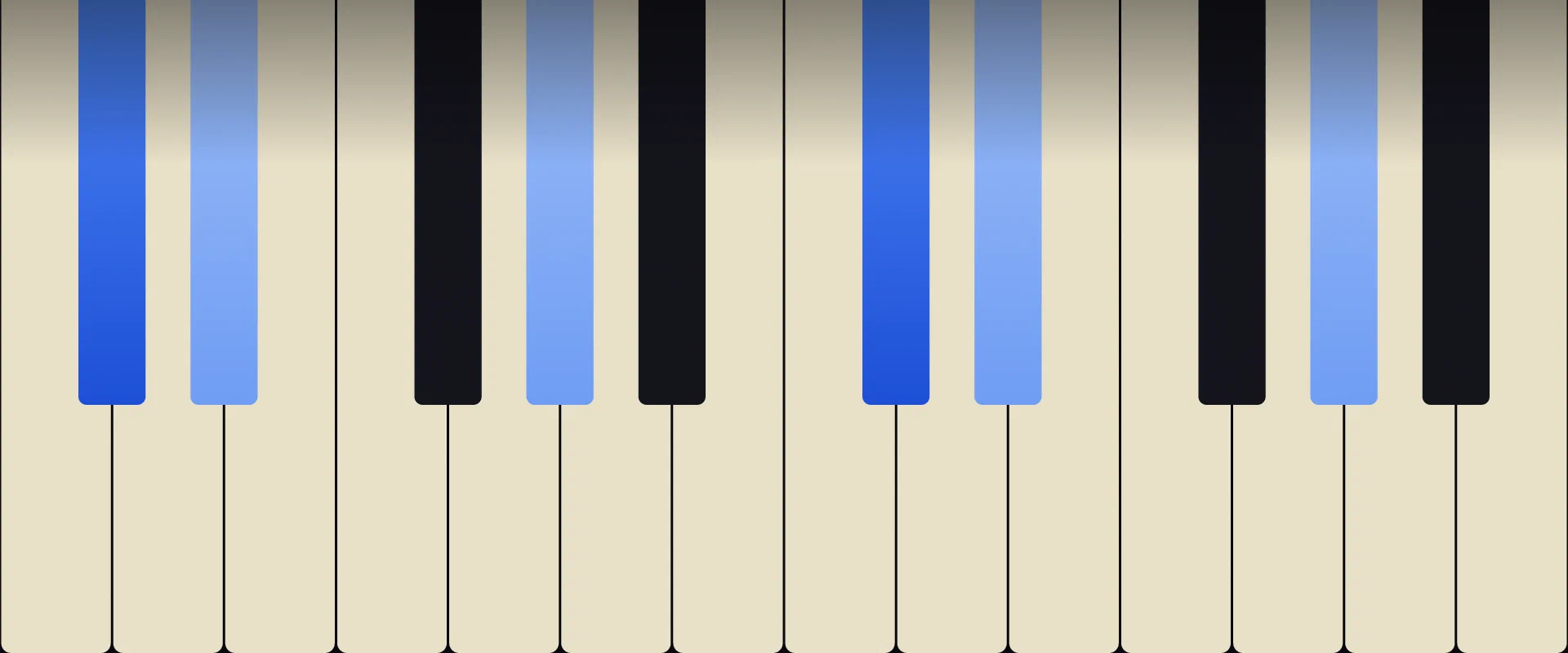
A pianist can find this chord in the dark. C♯, D♯ and G♯ are all black keys, raised and narrow and set back from the front edge, so the fingertips locate the shape by touch before the eyes are involved. Hand the same three notes to a guitarist and not one open string is available: standard tuning offers six naturals and this chord contains none of them, so it becomes a barre at the 4th fret with everything fretted. Few chords divide the two instruments this sharply.
Try It: C♯sus2 in the Chord Finder
The Notes of C♯sus2
| Degree | Note | Interval from root | Semitones |
|---|---|---|---|
| 1 | C♯ | Root | 0 |
| 2 | D♯ | Major 2nd | 2 |
| 5 | G♯ | Perfect 5th | 7 |
The spacing is lopsided: two semitones between the bottom pair, five between the top pair. That tight interval underneath is what gives a sus2 its rub, and why the chord sounds better spread out than crammed into one low octave.
How C♯sus2 Is Built
Start from C♯ major, C♯, E♯ and G♯, and take the third away. Put the second in its place and you have C♯, D♯, G♯. The third is the note that decides whether a chord is major or minor, so a chord without one is neither, and it will sit happily over a passage in C♯ major or C♯ minor without committing to either.
The substitution quietly solves a notation problem as well. E♯ is played on the white key F, and it catches readers out every time it appears. C♯sus2 contains no such note. All three members are plain sharps living on black keys.
Turn the chord over and something useful happens. Second inversion is G♯, C♯, D♯, and read from G♯ those are root, fourth and fifth: G♯sus4. Sus2 and sus4 are not two chord types but one set of intervals seen from two different notes, which is why the two symbols so often describe the same handful of keys. Put the third back and you get C♯add9, not plain C♯ major, because D♯ has claimed a place of its own.
C♯sus2 on the Piano
Three black keys, no white ones, and the hand never leaves the raised plane. There is no tilting, no pushing a finger back between two black keys, no wrist adjustment between one note and the next. Everything sits at the same height and the same depth.
The landmark is easy to see. C♯ and D♯ are the pair, and G♯ is the middle key of the group of three. Pair plus middle of the trio.
Right hand, root position: 1 on C♯, 2 on D♯, 5 on G♯. The thumb on a black key is the one genuine cost, since the thumb is short and the black keys sit further back, so carry the wrist a little higher than usual and let the thumb meet the key rather than reach up at it. Left hand takes 5, 4,
- To double the root an octave above, use 4 on G♯ instead and keep the little finger free.
Chopin started students on the B major scale rather than C major, because long fingers belong on black keys and short ones on white, and this chord is that argument in miniature. Play it, then play Csus2 a semitone below, C, D and G, all white: the white version is the one that feels vague, because nothing about the keyboard tells you where you are. These three notes are also three of the five black keys, so the chord falls straight out of black key noodling.
C♯sus2 on the Guitar
The shape to learn is the Asus2 form moved up: x 4 6 6 4 4. Barre the 4th fret from the A string across, then take the D and G strings at the 6th fret with the ring and little fingers. Low to high that gives C♯, G♯, C♯, D♯, G♯. It is a full, ringing voicing and a real grip: fret 4 is low enough that the string tension is still stiff, and with no open string in the chord there is nothing to disguise a buzzing barre.
Compare it to what it came from. Asus2 open, x 0 2 2 0 0, is a chord beginners play in their first week. Move it four frets and it becomes one of the harder shapes in that same vocabulary. The appeal of a sus2 on guitar is the half open shimmer of Dsus2, Asus2 and Esus2, and barring the shape removes exactly the quality you wanted it for.
The alternative, the E form barred at the 9th fret, is worse: five frets from the barre up to the highest note, in a region cramped enough that the stretch becomes a fight for a thinner sound.
Which is why, in practice, this chord means a capo. Clamp the 1st fret and play the open Csus2 shape, x 3 0 0 3 3, and you have C♯sus2 with two strings ringing open above the capo. Clamp the 4th fret and play open Asus2. Either one restores the shimmer, and it is why so many guitar records apparently in this key have a capo visible in the first frame of the video.
Inversions
| Inversion | Notes | Lowest note |
|---|---|---|
| Root position | C♯ D♯ G♯ | C♯ |
| 1st inversion | D♯ G♯ C♯ | D♯ |
| 2nd inversion | G♯ C♯ D♯ | G♯ |
First inversion is the one pianists actually use. D♯ to G♯ is a fourth, G♯ to C♯ is another fourth, so the chord becomes two stacked fourths, the open quartal sound modal jazz comping is built on. Root position keeps the tight second at the bottom and sounds more like a suspension waiting to move. Second inversion is G♯sus4 under another name.
Voicings
Split it wide. Left hand takes C♯ and G♯ as a bare fifth low down, right hand takes D♯, G♯ and C♯ above it. Emptying the middle suits this chord, because the major second is far easier on the ear an octave and a step apart than a step apart.
Adding notes changes its identity more than its sound. Put E natural in and you have C♯m(add9), the chord half of ambient and indie guitar music is made of. Put E♯ in instead and it is C♯add9.
The better trick is to leave the three notes alone and change what is underneath. Play C♯, D♯ and G♯ over an F♯ bass and the result is F♯6/9 with no third. Play the same three over a B bass and it is B6/9, again with no third. One shape, three keys, and in each case the missing third is what keeps it open.
Which Keys Contain C♯sus2
- I of D♭ major
- V of F♯ major
- II of B major
- IV of A♭ major
- I of C♯ natural minor
- degree 5 of E♭ minor pentatonic
That list could have run to fifty entries. A chord with no third fits any scale supplying its root, its second and its fifth, and most scales do, which is why sus2 shapes travel so freely.
Two entries deserve a second look. The key in which this chord is the tonic gets written D♭ major, five flats, so on the page it becomes D♭sus2 with D♭, E♭ and A♭: same keys under the fingers, different letters, chosen because the surrounding key is flat. And E♭ minor pentatonic is the black key scale itself, all five of them.
Where C♯sus2 Shows Up
| Progression | Chords | Turns up in |
|---|---|---|
| i, isus2, i in C♯ minor | C♯m, C♯sus2, C♯m | Ambient, post rock, film cues |
| Vsus2, V, I in F♯ major | C♯sus2, C♯, F♯ | Delayed cadences, worship music |
| Isus2, IV, V in D♭ major | D♭sus2, G♭, A♭ | Pop written at the piano |
| ii, V, I in B major | C♯sus2, F♯, B | Capo guitar pop |
Row one is texture rather than function. Holding a minor chord and lifting the third to the second and back, over and over, keeps a static harmony alive, and on this root it costs one finger moving between two adjacent black keys.
Row four is where most listeners actually meet the chord. B major sits well on guitar with a capo at the 4th fret, where the whole key reads as G shapes, and the ii chord in that arrangement is this one, fingered as an open Asus2. Nobody involved is thinking about sharps.
The instrument split runs through all of it. Gospel and neo soul keyboard players live on black key sus voicings because the hand position is so secure, while guitarists get here through a capo or not at all. The sus4 chord on this root, C♯ with F♯ and G♯, is the commoner of the two suspensions on guitar, since it is built by adding a finger to a barre rather than rearranging one.
Related Chords
- C♯ Major Chord, which puts E♯ where this chord puts D♯
- C♯ Minor Chord, the other chord this one refuses to commit to
- D♭ Augmented Chord, the same root spelled the other way round, and the page explaining why
- Suspended Chords: Sus2, Sus4 and Tension
- Guitar Chord Shapes: The CAGED System for moving the A and E forms up the neck
Learn More
Practice Chords
Drill chord recognition with a metronome, MIDI support, and score tracking.
Start Practicing