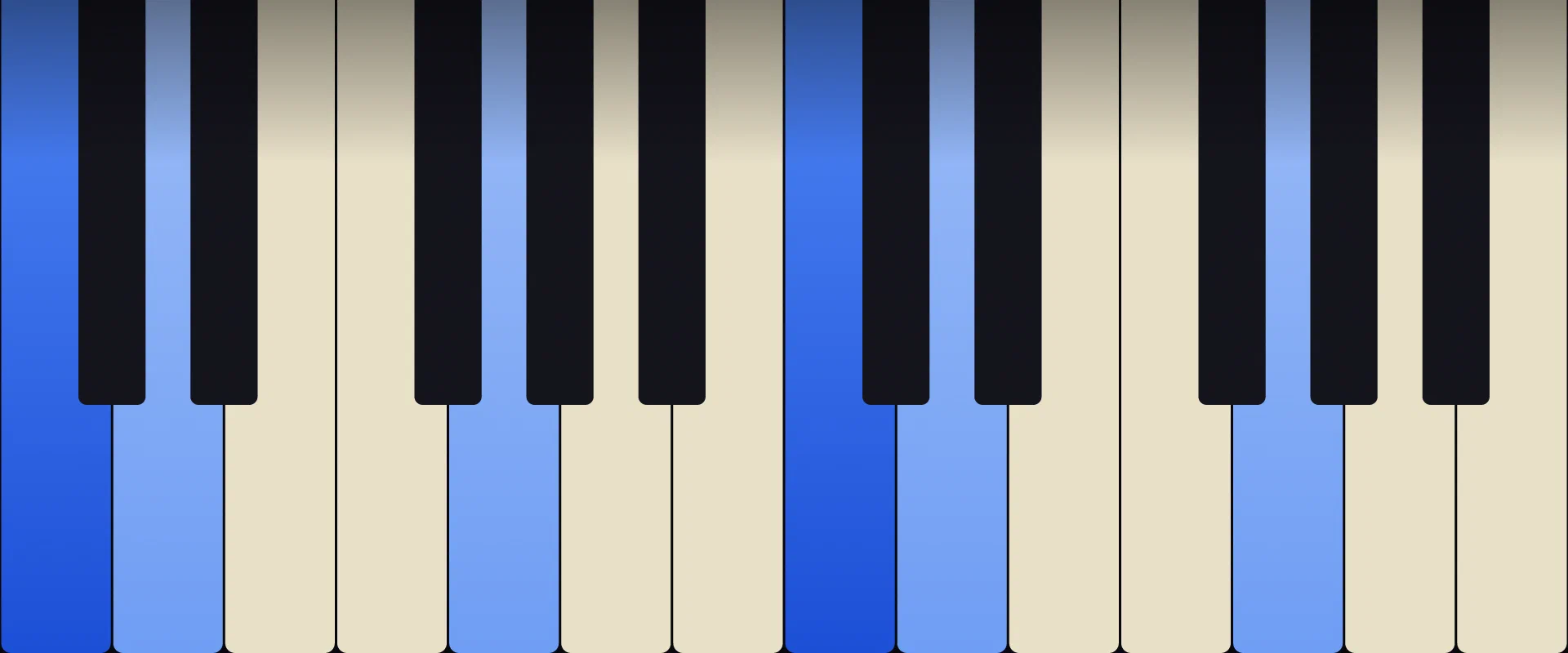
Three white keys and nothing else, and yet this is one of the few common C chords a guitarist cannot play in open position. Csus2 is C, D and G. On a piano it takes two seconds to find; on a guitar every version of it is a compromise, and that split between the two instruments explains most of where the chord turns up and where it does not.
What makes it a sus chord is the note that is not there. The E in the middle of C major is the only note that says major. Replace it with the D a step above C and the chord stops committing. It is not C major and it is not C minor, and it will sit happily on top of either.
Try It: Csus2 in the Chord Finder
Set the root to C and look for the gap where the 3rd should be.
The Notes of Csus2
| Degree | Note | Interval from root | Semitones |
|---|---|---|---|
| 1 (root) | C | Perfect unison | 0 |
| 2 | D | Major 2nd | 2 |
| 5 | G | Perfect 5th | 7 |
Written out: C, D, G. No accidentals, and no enharmonic decision to make anywhere in the chord.
How Csus2 Is Built
Start from C major, C, E and G, and move the E down two semitones to D. The perfect 5th survives, which is why Csus2 still sounds anchored on C rather than adrift the way a chord with an altered 5th does. What is gone is the quality.
Now reorder those three notes as G, C, D: a root, a 4th and a 5th, which is the recipe for Gsus4. Csus2 and Gsus4 are the same three pitch classes, and the rule generalises. A sus2 chord is the sus4 chord built on its own 5th, and running it the other way, Csus4 (C, F, G) is the same set as Fsus2. There is one suspended sound with two names, and which name applies depends on the bass note and on what the chord does next.
Stack the same set as D, G, C and you get two perfect 4ths piled on each other, the quartal voicing modal jazz built a vocabulary from. One collection, three uses. For the tension side of the family, see Suspended Chords: sus2 and sus4.
Csus2 on the Piano
Three white keys, but the shape is lopsided rather than even. C and D are neighbours, touching, and then there is a gap of a perfect 4th up to G. Right hand takes thumb on C, second finger on D and fifth on G; thumb and index sit almost on top of each other while the little finger stretches away, so the hand fans rather than curls.
That crowding matters lower down. A major 2nd in the bass register turns to mud below the C an octave under middle C, so pianists rarely play Csus2 in root position with the left hand. The standard fix is to put C alone underneath and take D and G in the right hand, which converts the cramped 2nd into a spacious 9th and is where the chord gets its wide, open sound from.
Coming from C major the change is one finger. Thumb and little finger stay on C and G while the middle voice slides down from E to D. Slide it up to F instead and you have Csus4, so the two suspensions sit either side of the 3rd and one finger walks between all three chords. Practise that D, E, F movement over a held C and G as a unit: it is the whole sus vocabulary in one gesture.
One more quirk belongs to this root rather than to the shape. Csus2 is the tonic chord of C major, C natural minor, C harmonic minor, C melodic minor, C Dorian, C Lydian and C Mixolydian alike, because it contains none of the notes those scales disagree about.
Csus2 on the Guitar
The guitar loves sus2 chords, just not this one. Dsus2, Asus2 and Esus2 are one finger lifts from the open shapes because D, A and E are open string roots. C is not, so every open Csus2 is a negotiation.
The two shapes in circulation are x 3 0 0 1 3 and x 3 0 0 3 3. Both take C from the 5th string at the 3rd fret and both let the open 4th and 3rd strings supply the D and the G for free. The first gives C, D, G, C, G, compact and easy. The second swaps the 2nd string C for a D at the 3rd fret, giving C, D, G, D, G, a brighter ring at the cost of a small barre on the top two strings. Both sound thinner than the open C they came from, because the 6th string is out of play.
Beware the near miss. x 3 2 0 3 3 is played constantly and looks similar, but the 4th string at the 2nd fret is an E. That is Cadd9, a full C major triad with a D on top, and it sounds nothing like a suspension. Songbooks write the two interchangeably and they are not the same chord.
For movable versions, the Asus2 shape barred at the 3rd fret gives x 3 5 5 3 3, the most reliable Csus2 on the instrument. The Esus2 shape barred at the 8th fret gives 8 10 12 12 8 8, a four fret stretch above the barre worth the effort only when you need the low C in the bass.
Inversions
| Inversion | Notes | Bass | Symbol |
|---|---|---|---|
| Root position | C D G | C | Csus2 |
| 1st inversion | D G C | D | Csus2/D |
| 2nd inversion | G C D | G | Csus2/G |
The 2nd inversion is the interesting one, because G, C, D with G in the bass simply is Gsus4. A suspended chord in inversion does not sound like a version of itself, it sounds like the other suspension. Guitarists exploit this without noticing: hold the shape, drop the bass note to G, and a sus2 becomes a sus4 pull into G major.
Voicings
Spread it. The appeal of a sus2 is space, and root position wastes that by putting the two closest notes at the bottom. C in the bass, then G and D, then another C on top is the sound ambient and post rock guitar records are built on.
Added notes give the chord an opinion again, so add carefully. Plus a B it is Cmaj9 with no 3rd, softer but still ambiguous; plus a B♭ it points at F. A new bass note reframes it entirely: C, D and G over A is Am11 without the 5th, which is why a held Csus2 works so well over a moving bass line.
| Shape | Frets | Result |
|---|---|---|
| Csus2 | x 3 0 0 1 3 | Compact, open strings |
| Csus2 | x 3 0 0 3 3 | Brighter, wider |
| Csus2 | x 3 5 5 3 3 | A shape at the 3rd fret |
| Cadd9 | x 3 2 0 3 3 | Not a sus chord, the 3rd is there |
Which Keys Contain Csus2
Because it has no 3rd, Csus2 fits an unusual number of keys. Six that matter in practice:
- I of C major
- IV of G major
- V of F major
- I of C natural minor
- I of C Dorian
- III of A natural minor
The first and fourth entries are the point. The same three notes are the tonic chord of C major and of C minor, and a listener hearing Csus2 cold cannot tell you which key they are in.
Where Csus2 Shows Up
| Progression | Chords | Context |
|---|---|---|
| I, Isus2, I (C major) | C, Csus2, C | Decorating a held tonic |
| Isus2, V, vi, IV (C major) | Csus2, G, Am, F | Ambiguous pop opening |
| IVsus2, I, V (G major) | Csus2, G, D | C as a ringing subdominant |
| Isus2, ♭VII, ♭VI (C minor) | Csus2, B♭, A♭ | Same chord, minor context |
Sus2 became the default open chord of guitar pop and post rock for a reason about arrangement rather than theory. Thirds are the notes that clash when two parts overlap, and a record with two guitars, a bass and a keyboard has plenty of people willing to supply one, so the rhythm part is free to drop it. Csus2 at x 3 5 5 3 3 is exactly that part.
Keyboard players use it differently. Csus2 opens piano ballads in C because it delays the moment the key declares itself, and because the D stepping up to E under a held C and G is a resolution listeners hear without being able to name. Screen cues in C use the same trick to hold a scene unresolved for a few extra bars.
C also lands well on both instruments at once: low enough on a piano to spread across two hands without booming, and on guitar the 3rd fret version sits under a singer rather than over one. For the wider picture, see Chord Progressions Every Musician Should Know.
Related Chords
- C Major Chord and C Minor Chord, the two chords Csus2 refuses to choose between
- C Augmented Chord, the opposite case: an altered 5th and an intact 3rd
- Suspended Chords: sus2 and sus4 for how suspensions resolve
- Extended Chords and Jazz Harmony for C9, C11 and the quartal voicings
Learn More
Practice Chords
Drill chord recognition with a metronome, MIDI support, and score tracking.
Start PracticingRelated Articles
A Augmented Chord: Notes, Voicings, and How to Play It
Aug 23, 2026 · 8 min
A♭ Augmented Chord: Notes, Voicings, and How to Play It
Aug 23, 2026 · 7 min
B Augmented Chord: Notes, Voicings, and How to Play It
Aug 23, 2026 · 8 min