Press B, D♯ and G on a keyboard and you have sounded a B augmented triad. Write it down that way and you have spelled it wrong. The top note is F𝄪, F double sharp.
So, in plain language and before anything else: F𝄪 sounds exactly like G. Same key, same pitch, same fret. If you are reading Baug off a page and hunting for F𝄪 on the keyboard, play the white key marked G and you are correct.
The spelling is not stubbornness. The 5th of any chord built on B has to be some form of F, because a fifth spans five letter names and B, C, D, E, F does that. F♯ is the perfect 5th. Augmented means that fifth widened by a semitone, so you raise the F♯ again, and F♯ raised is F double sharp. Call it G and the chord spans six letters, which is a sixth, not a fifth.
Three chords in this whole reference keep a double accidental, and this is the one where the reason is easiest to see. The spelling rules exist to keep the interval visible on the page, and here they cost a glyph most musicians meet twice a year.
Try It: Baug in the Chord Finder
The Notes of Baug
| Degree | Note | Interval from Root | Semitones |
|---|---|---|---|
| 1 (Root) | B | Perfect unison | 0 |
| 3 | D♯ | Major 3rd | 4 |
| ♯5 | F𝄪 | Augmented 5th | 8 |
Four semitones, then four more. Both thirds are major, which no other triad manages, and it is that evenness that makes the chord sound unanchored.
How Baug Is Built
Start from B major, B D♯ F♯, and push the top note up one semitone. Nothing else moves. The letter stays F, because raising a note never changes its letter name, it only adds to the accidental. F♯ becomes F𝄪.
Of all the single-note alterations of a B triad, this is the only one that touches the fifth. Moving the D♯ instead gives B minor or one of the two B suspended chords, and all of those leave the F♯ alone.
Because the two thirds are equal, the notes divide the octave into three exact parts. B, D♯ and F𝄪 sound the same as E♭, G, B and as G, B, D♯: one sonority, three names, depending on which note you call the root.
Baug on the Piano
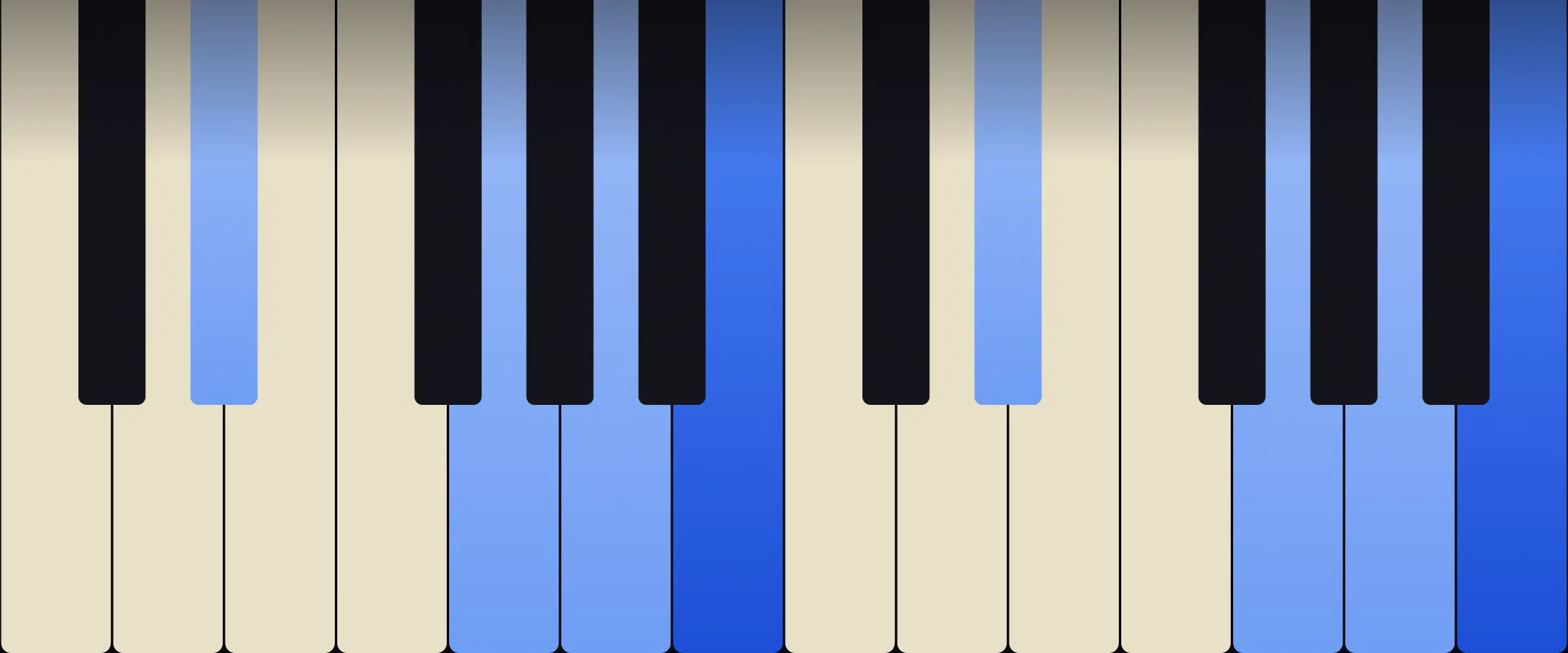
One black key and two white ones, the opposite of what the name suggests. B major sits on white, black, black: B, then D♯ and F♯ both behind. Raising the fifth walks that top finger off the black F♯ onto the white G next door, so the chord with a double sharp in its name is the one with fewer black keys under the hand.
Right hand, put 1 on B, 3 on D♯ and 5 on G. Left hand, 5, 3, 1. Thumb and little finger sit forward on white keys while the middle finger reaches back between D and E, so the hand tilts rather than sitting flat. B to G is eight semitones, one wider than a major triad, so the little finger stretches a fraction further than it does in B major.
Here is the exercise that makes the spelling make sense. Hold B and D♯ down and move only the top note: F♯, then G, then G♯. That is B major, then Baug, then G♯ minor over a B bass. The top voice has climbed by semitones, and on the page it reads F♯, F𝄪, G♯. The letter changes only when the chord arrives somewhere new. Spell the middle note G and the line reads F♯, G, G♯, a wobble instead of a climb.
Baug on the Guitar
There is no standard open shape, but two of the three notes are open strings already: the third string is G, which is the F𝄪, and the second string is B. Play x2100x, with B at fret 2 on the fifth string and D♯ at fret 1 on the fourth above the two open strings. Two fingers, root position, no barre.
The movable grip lives on the top four strings. xx9887 puts B at fret 9 on the fourth string, D♯ at fret 8 on the third, F𝄪 at fret 8 on the second and B again at fret 7 on the first.
Sliding it is where augmented chords get interesting. Because the octave splits into three equal parts, the same grip moved four frets holds the same three pitches: xx5443 is xx9887 inverted, not transposed. Learn Baug and you have learned D♯aug and Gaug for nothing, and four grips cover all twelve roots.
The full barres are the awkward ones. On the sixth string root, B is at fret 7 and the E shape with a raised fifth spreads four fingers across four frets above the barre. On the fifth string root, B is at fret 2, by the nut where the frets are widest and the tension is highest, and the A shape there wants a reach to fret 5 while the index holds fret 2. Neither is worth it when x2100x sits at the same fret.
Inversions
| Inversion | Notes | Bass Note |
|---|---|---|
| Root position | B D♯ F𝄪 | B |
| 1st inversion | D♯ F𝄪 B | D♯ |
| 2nd inversion | F𝄪 B D♯ | F𝄪 |
Every inversion of a major or minor triad has its own internal shape, which is how the ear picks the root out. This chord gives no such clue: stack the notes any way you like and you get two major thirds, so the bass decides the name. On the hand, root position puts the black key in the middle, first inversion at the bottom, second inversion on top. On the page the second inversion is the oddest thing in the set, F𝄪 below B, an interval that reads as a diminished fourth and sounds like a major third.
Voicings
At the keyboard, put B in the left hand and keep D♯ and F𝄪 together in the right. For a fourth voice double the root, since doubling the F𝄪 doubles the note that wants to move and gives parallel octaves when it does.
Adding a seventh gives the chord its practical form. B, D♯, F𝄪 and A is B7♯5, an altered dominant one finger from the open grip. x21005 adds the A at fret 5 on the first string while the open G and B keep ringing, and that shape turns up far more often than the bare triad.
Which Keys Contain Baug
- III of G♯ harmonic minor
- III of G♯ melodic minor
Two entries, and the shortness is the point. No major scale contains an augmented triad and neither does natural minor. The chord only turns up where a scale has a raised seventh, and then only on the third degree.
For the spelling B D♯ F𝄪, that means G♯ minor and nothing else, and that is where the double sharp comes from. G♯ minor already carries five sharps, so raising its seventh from F♯ gives F𝄪 in the key’s own terms. The chord is not importing an exotic accidental, it is inheriting one. A♭ minor holds the identical sounds and spells them C♭, E♭, G. The whole tone scale contains it too, three of its six notes being B, D♯ and F𝄪.
Where Baug Shows Up
| Progression | Numerals | Chords |
|---|---|---|
| Rising line in B major | I, I+, vi6 | B, Baug, G♯m/B |
| Augmented dominant | V+, I in E | Baug, E |
| Third degree of G♯ minor | i, III+, VI | G♯m, Baug, E |
| With a seventh | V7♯5, I in E | B7♯5, E |
The F𝄪 is the moving voice in all four. In the first row it sits halfway between the F♯ of B major and the G♯ of the chord after it, which is the notation’s whole argument for the double sharp: an F on its way up, caught mid-step. In the other rows it arrives, climbing to the G♯ that is the third of E major while the D♯ pushes up to E. An augmented dominant is a dominant with its fifth already leaning.
The G♯ minor row is the one place the chord appears without anyone reaching for it: build triads on G♯ harmonic minor and the third degree comes out augmented whether you wanted it or not.
Then there is the symmetry, which players use directly. Hold xx9887 and it is Baug, D♯aug and Gaug at once, so one grip is the augmented dominant of E, of C and of A♭. That evenness is also why the chord suits anything meant to feel unmoored: with no perfect fifth and no unequal third, nothing tells the ear which note is home.
Related Chords
- B Major Chord
- B Minor Chord
- B Diminished Chord
- G♯ Harmonic Minor Scale
- What Are Intervals and How to Identify Them by Ear
- Secondary Dominants and Borrowed Chords
Learn More
Practice Chords
Drill chord recognition with a metronome, MIDI support, and score tracking.
Start PracticingRelated Articles
A Augmented Chord: Notes, Voicings, and How to Play It
Aug 23, 2026 · 8 min
A♭ Augmented Chord: Notes, Voicings, and How to Play It
Aug 23, 2026 · 7 min
B♭ Augmented Chord: Notes, Voicings, and How to Play It
Aug 23, 2026 · 7 min