The top note of B♭ augmented is written F♯. A sharp, in a chord whose root carries a flat, usually in a piece with two or three flats in the key signature and not a sharp anywhere else on the page. Everyone meeting it assumes a misprint. The 5th of a B♭ chord has to be some form of the letter F, and the key signature gets no vote. The sound, two major thirds stacked with nothing to settle them, is the easy half of this chord.
Try It: B♭aug in the Chord Finder
Set the root to B♭ and listen to how far the top note has drifted from plain B♭ major.
The Notes of B♭aug
B♭ augmented is a three note triad: B♭, D and F♯.
| Degree | Note | Interval from B♭ | Semitones |
|---|---|---|---|
| 1 (root) | B♭ | Perfect unison | 0 |
| 3 | D | Major 3rd | 4 |
| ♯5 | F♯ | Augmented 5th | 8 |
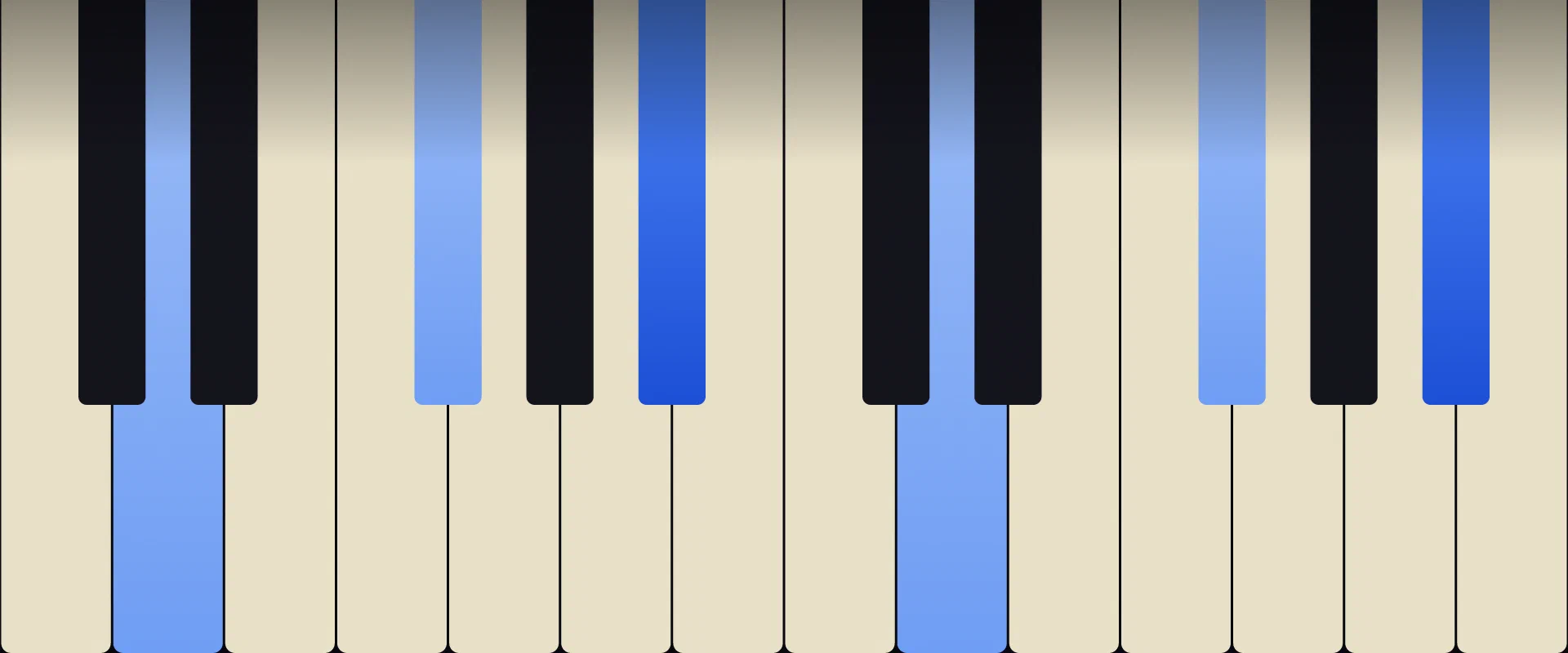
Written B♭aug, B♭+ or B♭(♯5): two black keys with one white key between them.
How B♭aug Is Built
Start from B♭ major, B♭ D F, and push the F up a semitone. Nothing else moves. The 3rd stays put, which is why the chord keeps a bright quality on top of its instability.
The letter cannot change with it. Count upwards from the root and you get B♭, C, D, E, F: F is the fifth letter, so the 5th of any B♭ chord is a form of F. Perfect gives you F, augmented gives you F♯, diminished gives you F♭. Write G♭ instead and the maths falls over: B♭ up to G♭ spans six letters, so it reads as a 6th, and the gap from D to G♭ reads as a fourth rather than a third. A triad is two thirds stacked, and only F♯ keeps both of them thirds. The working rule is to alter the letter you already have, never swap it for its neighbour.
None of this changes which keys you press. A piece in G♭ major calls the same three keys G♭aug, quite properly, because a different note is the root there.
B♭aug on the Piano
The two outer notes are black and the middle one is white, which makes the hand rock in and out as it sets. B♭ is the last black key in a group of three; D is the white key sitting between the pair of black keys above it; F♯ starts the next group of three.
Both gaps are four semitones, so nothing is stretched. Right hand, take 1 on B♭, 3 on D and 5 on F♯. The thumb on a black key pushes the hand forward, and the third finger then has to reach back down between the black keys for D. That backwards pull is the only real difficulty, and it goes once you stop looking for D and let the finger drop into the gap. Left hand, 5 on B♭, 3 on D and 1 on F♯, which suits a hand already sitting forward in E♭ or B♭.
Better still, play it as a change rather than a shape. Hold B♭ and D and walk the top note: F for B♭ major, F♯ for the augmented, G for B♭6, A♭ for B♭7. One finger, four chords, and the ear hears a line instead of a series of grips.
B♭aug on the Guitar
There is no open form, and the obvious barre is worse than it looks. The five string augmented grip guitarists know from Caug at frets 3, 2, 1, 1 would need two of its notes below the nut to make B♭. It runs out of neck.
What works from the fifth string is the Aaug shape moved up one fret: x 1 4 3 3 2, with B♭ on the A string at fret 1 and F♯ reaching to fret 4 on the D string. Four frets wide at the stiffest end of the fingerboard, where the string sits highest above the wood, so the first finger works hard while the little finger stretches away from it. Dropping the top string, x 1 4 3 3 x, loses only a doubled F♯ and is noticeably kinder.
The sixth string root lands at fret 6: 6 9 8 7 7 6, a full barre plus a reach to fret 9. Most players take the top four strings, x x 8 7 7 6.
The way out of the first fret is the symmetry. The augmented triad divides the octave into three equal thirds, so the same grip moved four frets sounds the same three pitches. Play x 5 8 7 7 6 at fret 5, or x 9 12 11 11 10 at fret 9, and you have B♭ augmented again with a different one of its notes underneath. Four augmented triads cover all twelve roots, so this grip accounts for a quarter of every augmented sound on the instrument.
Inversions
| Inversion | Notes | Bass note | Symbol |
|---|---|---|---|
| Root position | B♭ D F♯ | B♭ | B♭aug |
| 1st inversion | D F♯ B♭ | D | B♭aug/D |
| 2nd inversion | F♯ B♭ D | F♯ | B♭aug/F♯ |
Inverting an augmented triad does what no other triad does: it produces a root position augmented triad on a new root. D F♯ B♭ is Daug with one letter out of place, and F♯ B♭ D is G♭aug in disguise. The slash symbols above are honest about function, and arrangers who want D underneath often just write Daug instead. See Chord Inversions and Voice Leading for what that costs in the voice leading.
Voicings
Put F♯ where it can rise. An augmented 5th leans upwards, so give it to a top voice with somewhere to go rather than burying it in the middle.
Keep the bottom clean: B♭ low in the left hand, then D and F♯ above middle C. Two major thirds crammed into the bass octave turn into a rumble.
Adding the ♭7 gives B♭7♯5, B♭ D F♯ A♭, which in jazz is far more common than the bare triad and is the natural bridge to Extended Chords and Jazz Harmony.
Which Keys Contain B♭aug
Hardly any, and that is the point. No major scale produces an augmented triad from stacked thirds, so this chord is always an alteration or a borrowing. Two scales on this site generate it:
- III+ of G harmonic minor
- III+ of G melodic minor
Both work for the same reason. G minor raises its 7th degree to F♯ for a leading note, and thirds stacked from the third degree then give B♭, D and that F♯. The sharp in your two flat key signature is the leading note of G minor doing its usual job in an unusual chord.
Where B♭aug Shows Up
The commonest home for it is a rising inner line over a chord that never moves:
B♭ | B♭aug | B♭6 | B♭7
Underneath, B♭ and D hold still while one voice climbs F, F♯, G, A♭. Cabaret piano, spy film themes and big band introductions run on this figure, and it settles the spelling argument for good: a note passing upwards from F to G is written F♯. Call it G♭ and you have written a falling note into a rising line.
The other standard use is as an altered dominant:
E♭ | A♭ | B♭aug | E♭
That is I, IV, V+, I in E♭ major, with F♯ pulling up into G, the 3rd of the tonic chord. E♭ and B♭ are the home keys of the concert band and the big band, because the instruments are built there: trumpets and clarinets in B♭, alto saxes in E♭. So this cadence, not anything on a piano, is where most players first hear an augmented chord.
In minor, the same three notes arrive diatonically:
Gm | B♭aug | E♭ | D7
That is i, III+, VI, V in G minor, the augmented chord falling straight out of the harmonic minor scale rather than being borrowed. For more on chromatic chords arriving from outside the key, see Secondary Dominants and Borrowed Chords.
Related Chords
- B♭ Major Chord, the chord this one alters, with F in place of F♯.
- B♭ Diminished Chord, where the same 5th moves the other way, to F♭.
- B♭ Minor Chord, for the 3rd lowered instead of the 5th raised.
- Diatonic Chords: A Beginner’s Guide, on why no major key contains this chord.
Learn More
Practice Chords
Drill chord recognition with a metronome, MIDI support, and score tracking.
Start PracticingRelated Articles
A Augmented Chord: Notes, Voicings, and How to Play It
Aug 23, 2026 · 8 min
A♭ Augmented Chord: Notes, Voicings, and How to Play It
Aug 23, 2026 · 7 min
B Augmented Chord: Notes, Voicings, and How to Play It
Aug 23, 2026 · 8 min