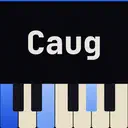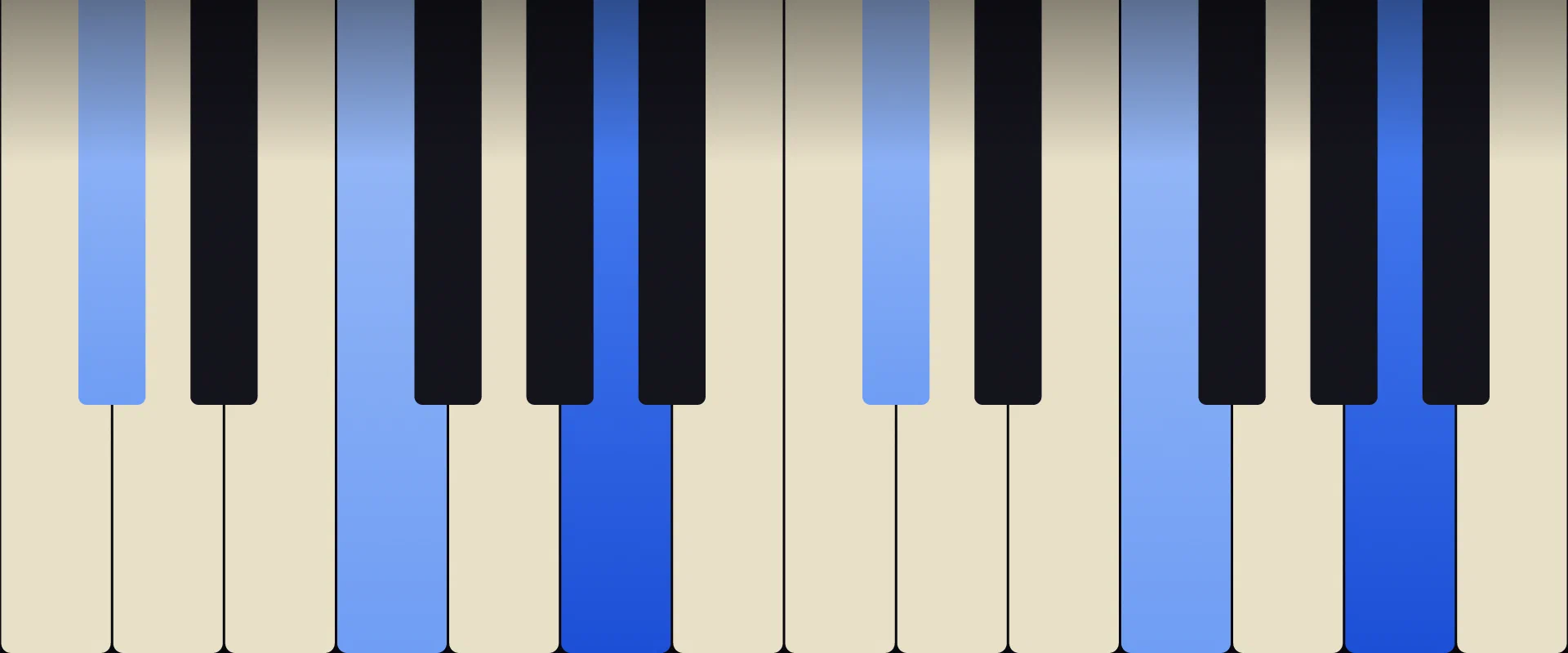
The top note of A augmented is written E♯ and played on the white key F. A reader who checks that against a keyboard, finds no black key there and concludes the page has a misprint is right about the keyboard and wrong about the notation. A augmented is A, C♯ and E♯, and the reason it cannot be written A, C♯ and F is the same reason the chord is worth knowing.
Try It: Aaug in the Chord Finder
Play A major first, then move the top note up one white key and hold it. The chord stops sitting still and starts leaning somewhere.
The Notes of Aaug
| Degree | Note | Interval from root | Semitones |
|---|---|---|---|
| 1 (root) | A | Perfect unison | 0 |
| 3 | C♯ | Major 3rd | 4 |
| ♯5 | E♯ | Augmented 5th | 8 |
Written out: A, C♯, E♯. Only one of the three, C♯, sits on a black key. That makes this one of the easier augmented triads to find under the hand and one of the more alarming ones to read, because the note carrying an accidental in the score is the note played on a white key.
How Aaug Is Built
Count letters upward from A and the fifth is decided before any accidental is chosen: A, B, C, D, E. The fifth of any chord rooted on A is some kind of E, and raising a perfect 5th by a semitone can only produce E♯. Write F instead and the interval becomes a sixth by letter name, so the chord no longer reads as a stack of thirds and stops behaving like a triad on the page.
The sounding equivalent is the simple part. In equal temperament E♯ is the same pitch as F, so you press F on a piano, fret the note you would call F on a guitar, and a tuner reads F. The spelling is a claim about what the note does next, not about which key you press.
Everything else follows from A major. Raise the E a semitone and the perfect 5th that held the chord upright becomes an augmented 5th with nowhere stable to rest. A to C♯, C♯ to E♯ and E♯ back to A are then all major 3rds, which is why the same three sounds also spell C♯ augmented and F augmented. Only the key decides which of the three names is correct.
Aaug on the Piano
The change from A major costs nothing physically. Set right hand 1, 3 and 5 on A, C♯ and E, then slide the little finger one white key to the right onto F. No finger goes back into the keyboard, no thumb has to shuffle, and the hand keeps the same comfortable arch it had for the major chord. Very few chords add an accidental to the score and take work away from the hand at the same time.
That comfort is also the trap. Because the eye sees E♯ and the fingers feel a plain white key, students often write the chord back as A, C♯, F in their own notes and then cannot work out why the harmony analysis stops making sense. Say the letter names aloud while you play: A, C♯, E♯, with the finger sitting on F.
Interval symmetry is invisible here as well. The three gaps are identical in sound, yet A up to C♯ is white to black, C♯ up to E♯ is black to white and E♯ up to A is white to white. An evenly divided octave looks lopsided under the hand, so it has to be learned by feel.
Keep the E♯ on top when you voice it. That note is the one under tension and the one about to move, so burying it in the middle of a close chord wastes it, and doubling it forces two voices to resolve the same way.
Aaug on the Guitar
Guitarists rarely learn this as a grip. They arrive at it by moving one note inside a chord they are already holding.
Start from the open A major, x 0 2 2 2 0. That voicing contains two E’s, one on the fourth string at the 2nd fret and one on the open first string, and both of them are fifths. Push both up a semitone and you get x 0 3 2 2 1, which sounds A, E♯, A, C♯, E♯. Index on the first string at the 1st fret, middle on the third string, ring on the second string, little finger on the fourth string at the 3rd fret.
The open top string is the casualty, and it is a real loss. Much of the ring of an open A chord comes from that unfretted E, and here it must be stopped at the 1st fret, where the string sits highest above the board. Small hands usually drop it and play x 0 3 2 2 x instead, three fingers over an open fifth string.
Higher up the neck the chord is the E shape barred at the 5th fret, though the full six string version wants five fingers, so in practice the top strings are abandoned and only the middle of the shape survives.
One property does pay for the trouble. Since the octave is divided into three equal steps, any augmented grip moved four frets produces the same three pitches again, so there are only four distinct augmented triads anywhere on the neck. Learn one movable shape and you have covered every root there is.
Inversions
| Inversion | Notes | Bass | Symbol |
|---|---|---|---|
| Root position | A C♯ E♯ | A | Aaug |
| 1st inversion | C♯ E♯ A | C♯ | Aaug/C♯ |
| 2nd inversion | E♯ A C♯ | E♯ | Aaug/E♯ |
These do not sound like inversions. Because the three intervals are equal, each rotation is heard as another augmented triad in root position, so the ear cannot say whether it is hearing Aaug over C♯ or C♯ augmented. Only the bass line and the key settle it, and on paper the spelling shows the verdict: an E♯ rising to F♯ proves the chord was an A chord.
Voicings
| Voicing | How to play it |
|---|---|
| Guitar, from the open A shape | x 0 3 2 2 1, both E’s pushed up a fret |
| Guitar, trimmed | x 0 3 2 2 x, three fingers over the open fifth string |
| Guitar, movable | The same grip four frets higher gives the same three notes |
| Piano, root position | Right hand 1, 3 and 5 on A, C♯ and F, read as E♯ |
| Piano, spread | A2 in the left hand, C♯4 and E♯4 in the right |
| A7♯5 | Add G for the seventh chord version used in jazz |
Which Keys Contain Aaug
- III of F♯ harmonic minor
- III of F♯ melodic minor
Two entries, and that short list is the point. The augmented triad belongs to no major scale and no natural minor scale. It appears only once a minor key raises its seventh degree, after which stacking thirds from the mediant produces it. F♯ minor raises its seventh to E♯, so the chord on its third degree is A, C♯, E♯.
The neighbourhood is friendly. F♯ minor is the relative minor of A major, so both of this chord’s homes sit next door to the key most guitarists treat as home ground.
Where Aaug Shows Up
| Progression | In this key | Chords |
|---|---|---|
| I, IV, V+, I | D major | D, G, Aaug, D |
| V, V+, I | D major | A, Aaug, D |
| III+, VI | F♯ minor | Aaug, D |
| Rising inner line | D major | A, Aaug, A6, A7, D |
Every one of these does the same small thing. E♯ climbs a semitone to F♯: in D major that F♯ is the third of the tonic chord, and in F♯ minor it is the tonic itself. One note with one job, performed twice, and it is precisely why the note is spelled with a sharp. Leading notes go up, and the notation says so before the sound does.
D major is why this chord is far less exotic than its spelling suggests. On a guitar the D, G and A chords are all open shapes with open bass strings, so D is the default key of enormous amounts of folk, country and rock. The dominant of that key is A, and sharpening its fifth for a beat before it resolves is a stock gesture in doo wop and in Tin Pan Alley writing. Any guitarist who has slid one finger up while holding an A chord at the end of a chorus has played Aaug without reading a word about it.
The last row is worth playing slowly. Over a held A in the bass, an inner voice walks E, E♯, F♯, G, turning the chord into Aaug, then A6, then A7 before it drops onto D. Written with an F in the middle, that line reads E, F, F♯, G and the eye loses track; written E, E♯, F♯ it is plainly one voice rising by semitones inside a chord whose root never moved.
Jazz players meet the same chord with a seventh attached. A7♯5 is A, C♯, E♯ and G, an altered dominant resolving to D or to D minor.
Related Chords
- A Major Chord the chord this one raises
- A Diminished Chord the opposite alteration, with the fifth pushed down instead of up
- A Minor Chord
- Seventh Chords: The Complete Guide for A7♯5
- Secondary Dominants and Borrowed Chords
Learn More
Practice Chords
Drill chord recognition with a metronome, MIDI support, and score tracking.
Start PracticingRelated Articles
A♭ Augmented Chord: Notes, Voicings, and How to Play It
Aug 23, 2026 · 7 min
B Augmented Chord: Notes, Voicings, and How to Play It
Aug 23, 2026 · 8 min
B♭ Augmented Chord: Notes, Voicings, and How to Play It
Aug 23, 2026 · 7 min