Twelve note tuning holds only four different augmented triads, and this is one of three names for one of them. Nothing you can hear will tell you that the chord in front of you is A♭aug rather than one of its two aliases. What tells you is the bar after it. Written A♭ C E, this chord is on its way to D♭, and that single fact is what earns the spelling. A reader coming to the page cold would never guess the sound from the letters, which is the point: notation records function, not pitch.
Try It: A♭aug in the Chord Finder
The Notes of A♭aug
| Degree | Note | Interval from root |
|---|---|---|
| 1 | A♭ | Perfect unison |
| 3 | C | Major 3rd, 4 semitones |
| ♯5 | E | Augmented 5th, 8 semitones |
Written low to high in root position: A♭ C E.
One flat, two plain letters. The same pitches can also be spelled with one sharp, or with two sharps one of which is B♯, and only this version keeps its accidental on the root, where a player reading in a flat key already expects one. That is why A♭aug is the form you meet in soul, gospel and standards, and the other two belong to sharp keys.
How A♭aug Is Built
Take A♭ major, A♭ C E♭, and lift the fifth by a semitone. The E♭ becomes E natural. It does not become F♭, even though F♭ is the same key on the piano, because the note is still the fifth of the chord and the fifth of A♭ has to be some kind of E. Call it F♭ and you have written a sixth, the stack stops being three letters apart, and the chord symbol no longer matches the notes.
There is a musical reason as well as a clerical one. E is a semitone below F, and F is the third of D♭ major. Spelling the raised fifth as E says out loud that this note is going up. F♭ would tell a reader it is coming down, which is exactly wrong for a chord whose job is to push.
That upward pull is the whole character. A♭ and C alone sound settled. Add E, a semitone past where the ear expects the fifth, and the chord will not sit still.
A♭aug on the Piano
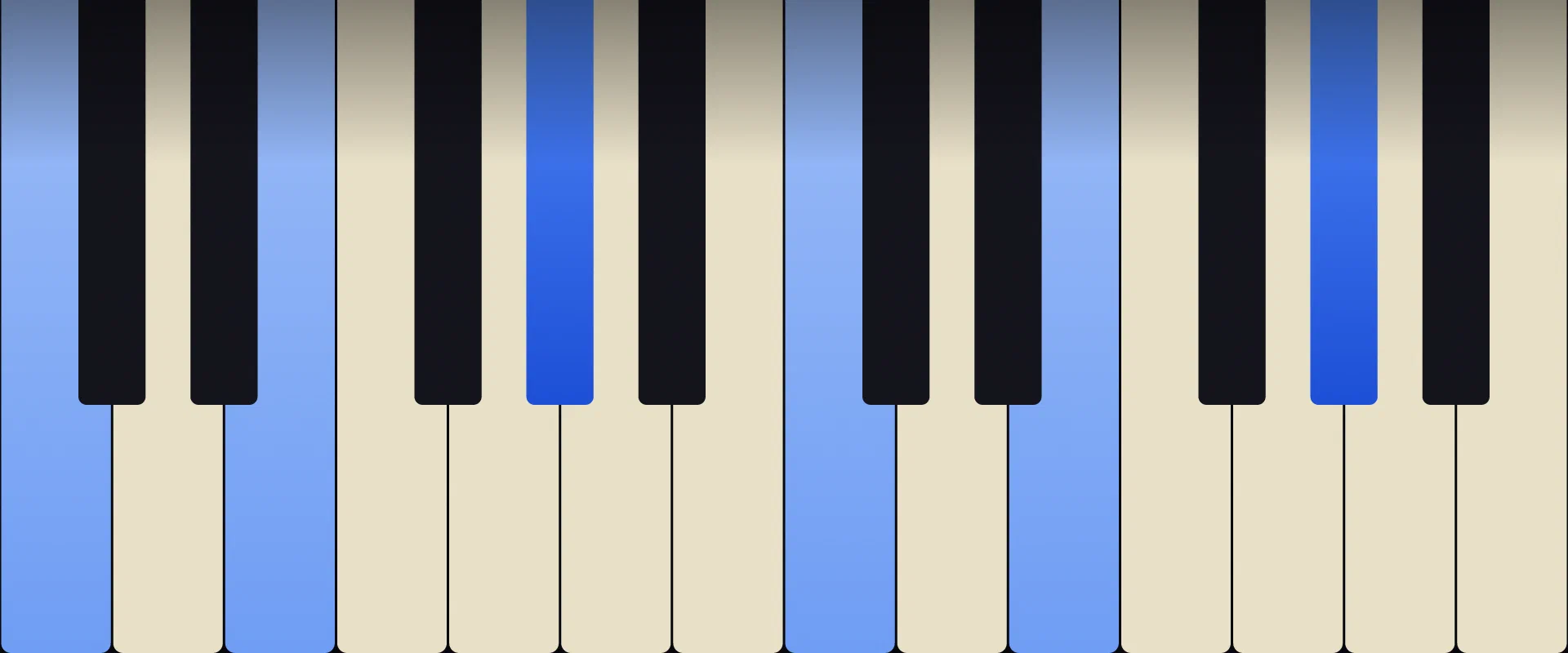
Only one black key here, the root, and the two notes above it are white. That makes A♭aug feel noticeably different under the hand from A♭ major, which has black keys at both ends and cradles the palm forward. Raising E♭ to E pulls the top of the chord back out among the white keys, so the hand flattens and the thumb is left alone up on A♭. Right hand root position is 1 on A♭, 3 on C, 5 on E; left hand is 5, 3, 1 on the same notes. Watch the wrist, because the temptation is to drop it as the fingers come back, and the thumb then loses the black key.
The equal spacing is a gift to practise. Both intervals are major thirds, so the gap from thumb to middle finger matches the gap from middle finger to little finger and the hand learns one measurement instead of two. Play A♭ C E, move every finger up a major third to C E A♭, then again to E A♭ C. The grip never changes and you are still holding the same chord.
The key colours do change as you climb: black, white, white becomes white, white, black and then white, black, white. Anyone who has memorised this chord by how it looks rather than how it measures loses it at the second step, so learn the span.
A♭aug on the Guitar
No open form exists for this root, and no open string belongs to the chord, so everything is stopped. The workable grip has the root on the 6th string at the 4th fret: 4 on the low E, 7 on the A, 6 on the D, 5 on the G, with the top two strings muted. Index, little finger, ring, middle. It is a compact four-string shape, and the 4th fret is a friendly place to hold it, well clear of the stiff string tension at the nut.
Higher up, the root sits at the 11th fret of the A string with C at the 10th on the D and E at the 9th on the G. The notes step down one fret per string, so it fingers more easily than it looks, but the frets are cramped that far along the neck.
The symmetry pays off here more than it does at the keyboard. Slide either grip four frets and the same three pitches come back. Take the low shape from fret 4 to fret 8 and on to fret 12 and you have moved twice without changing chord. Guitarists use that to keep an augmented sound climbing under a melody, and it means a four-fret misjudgement is not a wrong chord, which is true of no other shape on the instrument.
Inversions
| Inversion | Notes low to high | Bass note |
|---|---|---|
| Root position | A♭ C E | A♭ |
| 1st inversion | C E A♭ | C |
| 2nd inversion | E A♭ C | E |
Inversion is nearly a bookkeeping word here, since every one of the three has the same interval pattern and only the bass note differs. That note still does real work: put C at the bottom and the ear takes the chord as C rooted and heading somewhere else, so keep A♭ low when the chord is meant to land on D♭.
Voicings
The essential pair is A♭ and E. Drop the C and the augmented interval is still there, so a left hand shell of A♭ and E under a melody note states the chord in a busy arrangement.
Most of the time this chord is a dominant in disguise. Add G♭ and you get A♭7♯5, A♭ C E G♭, the altered dominant that resolves to D♭ and by far the most common context for these notes. Add G instead and you get A♭maj7♯5, rarer and dreamier and at home in film writing.
On guitar the three-note reduction is the top of the low shape, frets 7, 6 and 5 on the A, D and G strings, giving E A♭ C with no root underneath. Over an A♭ bass it sounds complete.
Which Keys Contain A♭aug
Augmented triads are not diatonic to any major key, so the list is short by nature. This one comes from the third degree of the minor scales that raise their leading note:
- III of F harmonic minor
- III of F melodic minor
In both cases the E is the leading note of F minor, borrowed into a chord built on A♭. That is worth remembering, because it means every time you see A♭aug in a piece in F minor, the top note is about to rise to F.
Where A♭aug Shows Up
| Progression | In letters | Where it lives |
|---|---|---|
| V+, I | A♭aug, D♭ | Gospel and soul, into D♭ |
| I, I+, I6, I7 | A♭, A♭aug, A♭6, A♭7 | Soul ballad, cabaret intro |
| i, III+, VI, V7 | Fm, A♭aug, D♭, C7 | F minor, classical and film |
The second row is the one most players meet first, and it is not really a chord progression at all. It is one moving line inside a held A♭ chord: E♭ rises to E, then to F, then to G♭, while A♭ and C stay put underneath. The augmented chord is simply the second step of that climb. Play it slowly on a piano with the sustain pedal down and you will recognise it instantly from a hundred recordings.
The first row explains why this spelling exists. A♭ is the dominant of D♭, and sharpening its fifth adds a second voice that leans into the tonic: C goes up to D♭ while E goes up to F. Two semitone steps arriving at once is a strong pull, and in gospel piano playing, where D♭ and A♭ are home territory, it is a reflex rather than a decision.
The third row is the classical route. In F minor, A♭aug arrives when the raised seventh degree is harmonised over the mediant, usually at a moment of hesitation before the harmony drops to the flat submediant.
Related Chords
- A♭ Major Chord the chord this one alters, sharing A♭ and C
- A♭ Minor Chord for what happens when the third moves instead of the fifth
- Secondary Dominants and Borrowed Chords for how A♭7♯5 functions on its way to D♭
- Guitar Chord Shapes: The CAGED System for why the movable shapes sit where they do
- F Harmonic Minor Scale the scale that produces this chord diatonically
Learn More
Practice Chords
Drill chord recognition with a metronome, MIDI support, and score tracking.
Start PracticingRelated Articles
A Augmented Chord: Notes, Voicings, and How to Play It
Aug 23, 2026 · 8 min
B Augmented Chord: Notes, Voicings, and How to Play It
Aug 23, 2026 · 8 min
B♭ Augmented Chord: Notes, Voicings, and How to Play It
Aug 23, 2026 · 7 min