Augmented triads are rare, and this is the one that is not. Gaug is the dominant of C major with its fifth shoved up a semitone, and C major is the key that method books, songwriting apps and half the pop repertoire default to. Statistically, if you have ever heard an augmented chord in a song, there is a good chance it was these three notes on their way to a C.
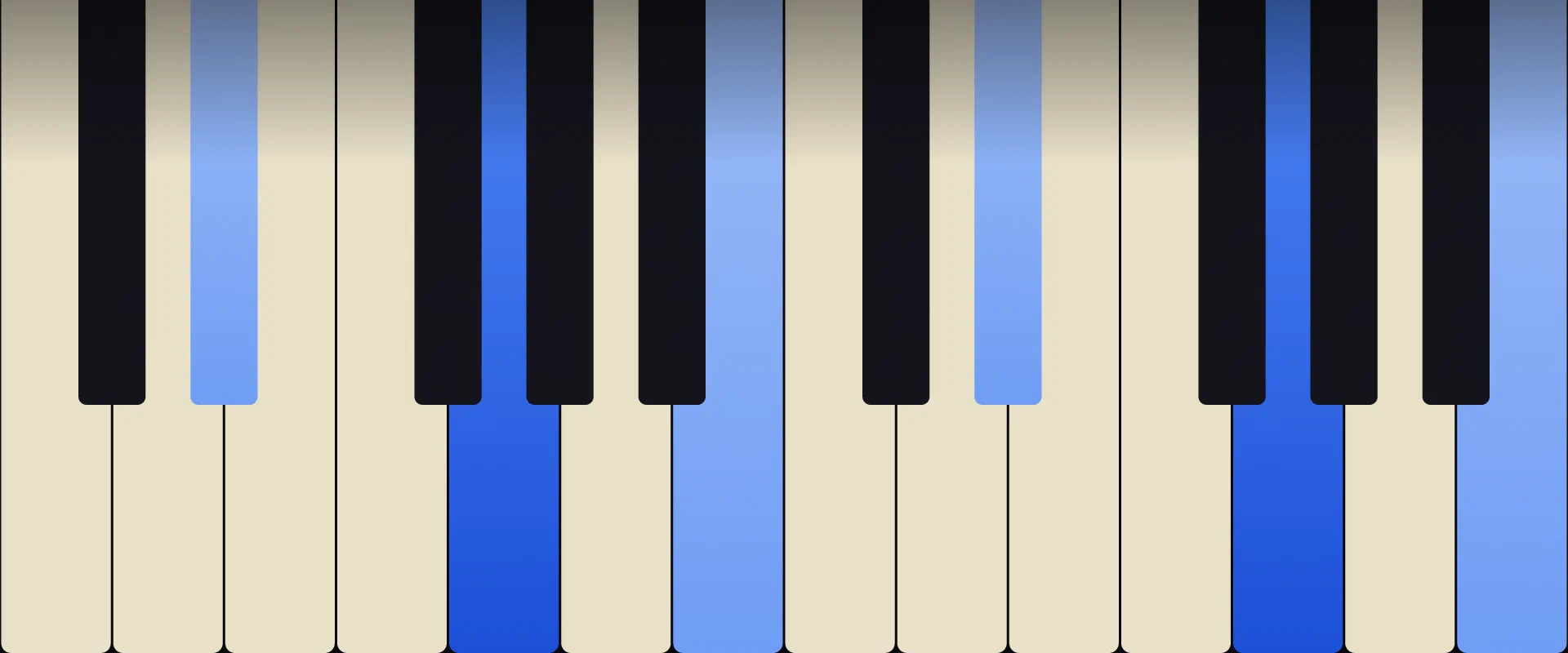
The notes are G, B and D♯, two white keys and one black one. That top note is written D♯ and never E♭, though your finger lands on the same key either way. Triads stack letters in thirds, so a G chord needs a B of some kind and then a D of some kind. Write G B E♭ and the eye reads an E♭ major triad standing on its third: same sound, no dominant function left on the page.
Try It: Gaug in the Chord Finder
The Notes of Gaug
| Degree | Note | Interval from Root | Semitones |
|---|---|---|---|
| 1 (Root) | G | Perfect unison | 0 |
| 3 | B | Major 3rd | 4 |
| ♯5 | D♯ | Augmented 5th | 8 |
Written Gaug, G+ or G(♯5). The outer interval spans eight semitones, which the ear also hears as a minor 6th, and that ambiguity is the character of the chord.
How Gaug Is Built
Two major 3rds, stacked. Four semitones from G to B, four more from B to D♯, with no perfect 5th anywhere to anchor the result.
The nearest simpler chord is plain G major. G B D becomes G B D♯ by raising one note one semitone and nothing else changes: same root, same third, with the roof pushed up. Add F and you get G7♯5, which is how jazz players usually meet the sound.
Because both intervals are identical, the same three keys can be named from any of them. Call the bottom note E♭ and you have E♭aug; start from B and you need a double sharp to spell it. Only four augmented sonorities exist, and they cover all twelve roots between them.
Gaug on the Piano
On paper the chord is perfectly even. Under the hand it is not. G to B is a flat reach across two white keys with A between them. B to D♯ then crosses C and D to land on a black key set back into the keyboard, which pulls the hand inward and lifts the wrist. Symmetry you can see in the notation is not symmetry you can feel.
Take the right hand as 1 on G, 2 on B and 4 on D♯, which looks unusual until you play the resolution. Slide 2 up to C and 4 up to E, keep the thumb where it is, and you have G C E, C major in second inversion, with two fingers moving a semitone each and one not moving at all. That is the whole reason this chord exists. The left hand mirrors it as 5 on G, 3 on B and 1 on D♯, with the thumb making the D♯ to E move.
Keep it out of the bass. Three notes four semitones apart, stacked below middle C, beat badly and turn to growl. Put G low and B and D♯ in the right hand, where the thirds have room.
One warning: inversions here do not sound like inversions. Every interval is the same size, so turning the chord over changes nothing the ear can catch. Only the bass note tells a listener which of the three possible names they are getting.
Gaug on the Guitar
There is no textbook open form, but on this root there hardly needs to be. Take the standard open G, 3 2 0 0 0 3, and put your index finger on the 1st fret of the D string. The open D becomes D♯ and the shape is now 3 2 1 0 0 3: G, B, D♯, G, B, G across all six strings. Middle finger on the 5th string, ring on the 6th, little finger on the 1st, index on the 4th. Anyone who already fingers G with the little finger has the index free and the chord costs one movement.
That is also the cleanest way to drill the progression this chord lives for. Strum G, drop the index on, strum Gaug, move to C. D climbs to D♯ and then to E, a chromatic line walking through the middle of the texture.
For a compact movable grip, use x x 5 4 4 3: G on the D string, B on the G string, D♯ on the B string and G on top. The full 6th string rooted shape sits barred at the 3rd fret, and the 5th string rooted version lands at the 10th, high enough that the frets are cramped and the voicing thins out.
You rarely need to go up there. Moving the shape four frets transposes it by a major 3rd, which lands on the same three pitches with a different note at the bottom: x x 9 8 8 7 is this chord again with B in the bass. Whichever region of the neck you are in, one of them is close.
Do not expect it to survive distortion. With no perfect 5th anywhere, none of the power chord physics applies.
Inversions
| Inversion | Notes | Bass | Symbol |
|---|---|---|---|
| Root position | G B D♯ | G | Gaug |
| 1st inversion | B D♯ G | B | Gaug/B |
| 2nd inversion | D♯ G B | D♯ | Gaug/D♯ |
Voice leading picks between them. G in the bass gives a root position C on the resolution; B underneath moves the bass up a semitone to C, which is as tight as a cadence gets.
Voicings
Doubling matters more than position. The six string form 3 2 1 0 0 3 gives three Gs and two Bs against a single D♯, and that imbalance is useful: the raised fifth is the strange note and one of it is plenty. The compact x x 5 4 4 3 doubles only the root and speaks more clearly in a busy arrangement.
On piano, G in the left hand with B and D♯ in the right is the reliable spread. If a bass player has the root, drop it and play B and D♯ alone: a bare major 3rd where the fifth should be tells the band everything it needs.
Which Keys Contain Gaug
Almost nowhere, and that is the point. No major key contains an augmented triad at all, so this chord is a visitor in most music rather than a resident. On this site it turns up in exactly two scales:
- III of E harmonic minor
- III of E melodic minor
Both are E minor with the 7th degree raised to D♯ so it can lead to E. Stack a triad on the third degree of either and that raised note lands on top, so Gaug arrives with no chromatic decision at all. E minor is its only native home.
It also sits inside the whole tone scale on G, G A B C♯ D♯ F, which is why the sound became film shorthand for dreaming and time travel.
Where Gaug Shows Up
| Progression | Chords | Typical use |
|---|---|---|
| V, V+, I in C | G, Gaug, C | Cadences, doo wop, hymn endings |
| I, I+, I6, I7, IV in G | G, Gaug, G6, G7, C | Ragtime, music hall, sixties pop |
| i line cliché in E minor | Em, Em(maj7), Em7, Em6 | Torch songs, spy themes |
| ii7, V7♯5, I in C | Dm7, G7♯5, Cmaj7 | Jazz turnaround |
| i, III+, iv, V7 in E minor | Em, Gaug, Am, B7 | Tango, minor key ballads |
The first row is worth drilling. G to Gaug to C walks D up to D♯ and then to E, so the middle of the chord climbs into the third of the tonic while the ear expects a plain dominant. Note which tonic it wants: a raised fifth points at a major third, so the chord leans to C major and sounds strained into C minor.
The line cliché row hides a nice identity. Em(maj7) is E, G, B and D♯, so take the E away and Gaug is what remains. Every minor chord with a major seventh on top is an augmented triad sitting on a bass note a major 3rd below, which is why the descending E, D♯, D, C♯ line over an Em chord and the V+ cadence in C major sound like relatives. That grip is also the basis of the most famous guitar chord in spy film scoring.
Barbershop and doo wop reach for these three notes at the ends of phrases, as a stretched dominant that delays the final C by a beat. Rarity is what makes that work: play it twice in one song and it stops being a special effect.
Related Chords
- G Major Chord, the same root with D in place of D♯
- G Minor Chord, the third lowered instead of the fifth raised
- G Diminished Chord, the opposite treatment of the fifth
- Seventh Chords: The Complete Guide for G7♯5
- Extended Chords and Jazz Harmony for G13♯5 and G7♯5♯9
- Secondary Dominants and Borrowed Chords
- The E Harmonic Minor Scale
- Guitar Chord Shapes: The CAGED System
Learn More
Practice Chords
Drill chord recognition with a metronome, MIDI support, and score tracking.
Start PracticingRelated Articles
A Augmented Chord: Notes, Voicings, and How to Play It
Aug 23, 2026 · 8 min
A♭ Augmented Chord: Notes, Voicings, and How to Play It
Aug 23, 2026 · 7 min
B Augmented Chord: Notes, Voicings, and How to Play It
Aug 23, 2026 · 8 min