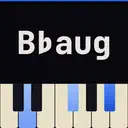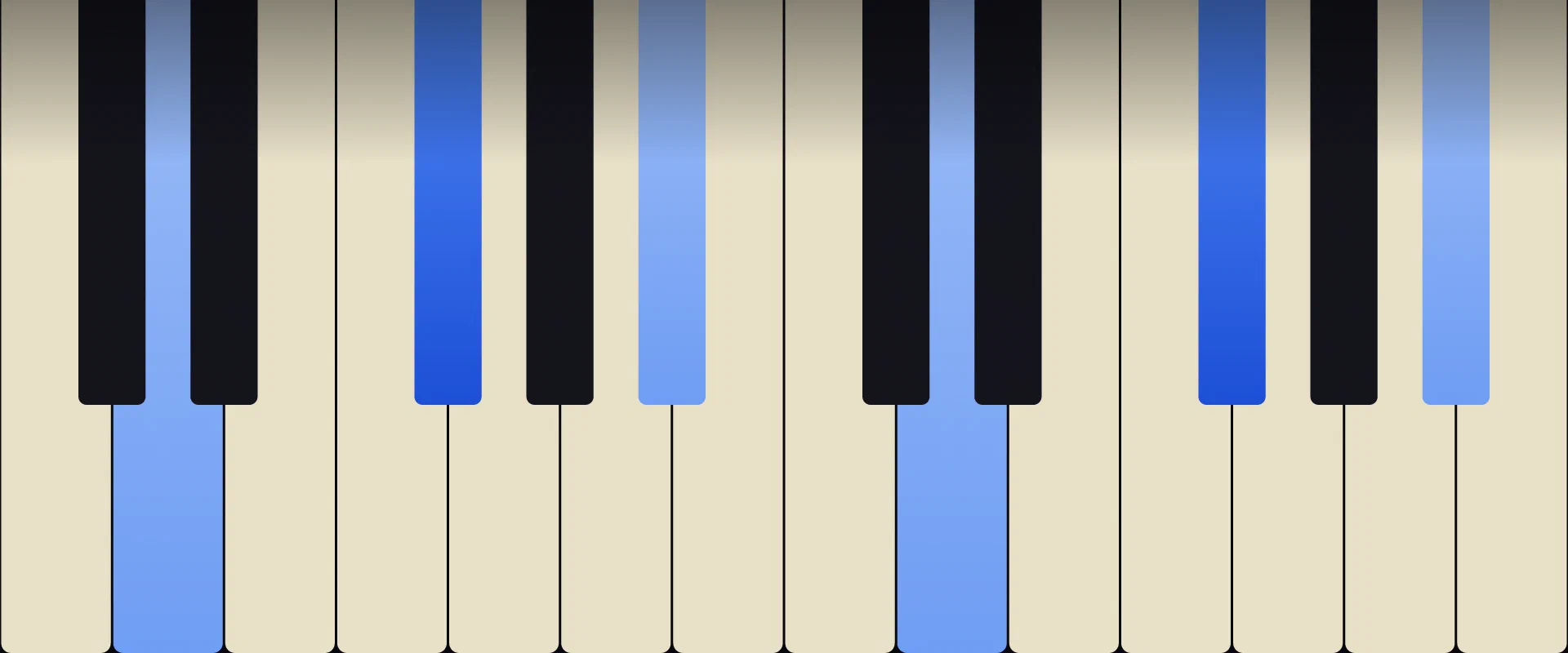
Six flats, and then a natural. G♭ augmented is G♭, B♭ and D, and that D is the only note in the chord carrying no accidental at all, standing in a key signature that has flattened nearly everything else on the stave. It is a small visual shock, and it is the whole point of the chord: the raised fifth is the note that has been pulled out of the key.
Try It: G♭aug in the Chord Finder
The Notes of G♭aug
G♭ augmented contains three notes.
G♭, B♭, D
| Degree | Note | Interval from root | Semitones |
|---|---|---|---|
| 1 | G♭ | Root | 0 |
| 3 | B♭ | Major 3rd | 4 |
| ♯5 | D | Augmented 5th | 8 |
Why G♭ and not F♯
The same three keys can be reached from F♯, and they sound identical, but the spelling then goes wrong. An augmented triad on F♯ has to read F♯, A♯ and C𝄪: a C with a double sharp, played on the key called D. The letters have to run F, A, C, so raising the fifth of F♯ major forces a second sharp onto a note that is already sharp. From G♭ the same raise lands on plain D, because D♭ raised a semitone is simply D.
That is the whole logic of this pitch’s two names: it is G♭ or F♯ depending on what the chord above it has to spell. An augmented triad wants the flat name. A sus2 wants the sharp one, since F♯, G♯ and C♯ need nothing unusual, which is why the site files that chord as F♯sus2 and this one as G♭aug.
How G♭aug Is Built
Take G♭ major, which is G♭, B♭ and D♭, and raise the top note by a semitone. On the stave that turns a flat into a natural. Under the hand it does something more visible: G♭ major is three black keys, and raising the fifth drags the top note off the black group and onto a white one.
The interior is two major thirds of equal size, G♭ to B♭ and B♭ to D, four semitones each. Stack one more and you are back at G♭. That equal division means these three notes are also B♭aug and Daug, and only the music around the chord decides which name is correct.
G♭aug on the Piano
Black, black, white. The right hand takes 1 on G♭, 3 on B♭ and 5 on D, which puts the thumb on a raised key and sends the little finger forward and down onto a white one, so the hand sits at a slight diagonal rather than square to the keyboard. The left hand answers with 5, 3 and 1.
If you already know G♭ major, the change is one finger. Everything stays put and the little finger moves off D♭ onto D, out of the black group and towards you. The stretch grows by a semitone at the same time, from seven to eight, so this chord is wider than any major or minor triad on the same root.
The symmetry is worth playing rather than reading about. Keep the 1, 3, 5 grip and start it on B♭, then on D. The three keys never change, but from D the thumb begins on a white one. The sound is perfectly even. The keyboard is not.
G♭aug on the Guitar
There is no open form, but one of the six open strings does belong here: the 4th string, D, which is the augmented fifth. That gives a useful cheat. Play x x 0 3 3 2 and you get D, B♭, D and G♭, the chord ringing over its own raised fifth with an open string in the bass.
For the full grip the E shape barres at the 2nd fret, 2 5 4 3 3 2 low to high. This is a hard position, close to the nut where the string sits highest off the board and gives the least, and the shape asks for a reach out to the 5th fret on top of the barre. Most players quietly drop the bottom two strings and take x x 4 3 3 2 on the top four, which is the voicing you actually hear on records.
The A shape gives x 9 12 11 11 10, root on the 5th string at the 9th fret. The three-fret span looks worse written down than it feels, since the frets are narrow that high.
The shape also repeats every four frets, since any of its notes can act as the root. Whatever you play at the 2nd fret returns at the 6th and the 10th, so a barre that fights you near the nut has a friendlier twin mid-neck.
Inversions
| Inversion | Notes | Bass note |
|---|---|---|
| Root position | G♭ B♭ D | G♭ |
| 1st inversion | B♭ D G♭ | B♭ |
| 2nd inversion | D G♭ B♭ | D |
Inversions behave oddly here. The three intervals are identical, so each inversion is also a root position augmented triad on another root, and the 1st inversion of G♭aug is indistinguishable from B♭aug. Notation carries the identity, not the sound. See Chord Inversions and Voice Leading for how bass movement shapes that.
Voicings
At the piano, drop G♭ low on its own and voice B♭, D and G♭ above it, with D near the top. The raised fifth is the only thing separating this chord from G♭ major, so burying it inside a texture wastes it.
On guitar, x x 4 3 3 2 is the workhorse, and 2 x 4 3 3 x puts G♭ in the bass with B♭ and D above it.
Which Keys Contain G♭aug
| Degree | Key |
|---|---|
| III | E♭ harmonic minor |
| III | E♭ melodic minor |
The list is this short for a reason. No major scale and no natural minor scale contains an augmented triad at all, so the chord has two diatonic homes on the whole site and both are rooted on E♭. In each, the D is E♭ minor’s raised seventh, the leading note that harmonic and melodic minor supply and natural minor does not. The odd-looking natural is native here, not borrowed.
Where G♭aug Shows Up
E♭m, G♭aug, B♭7, E♭m. The i, III+, V7, i of E♭ harmonic minor, and the most idiomatic use of this exact spelling. G♭aug arrives as a brightened relative major, its D pointing at the same E♭ that the dominant is about to confirm. Nineteenth century piano writing is full of this turn, and E♭ minor is a favourite key for it.
G♭, G♭aug, G♭6. A line rising inside a held chord: D♭ moves to D, then on to E♭, while G♭ and B♭ hold underneath. Songwriters use it to keep a static harmony moving under a long note, and arrangers write it in flats because the chord either side of it is a plain G♭.
G♭7♯5 pressing towards C♭. The augmented triad as an altered dominant, with the raised fifth straining upwards. Almost nobody writes C♭ major, so in practice this progression turns up on the page as F♯+ resolving to B, and the flat spelling quietly disappears.
That last case is the honest limit of this chord’s name. G♭aug is uncommon in print, and a player is likelier to meet these three pitches labelled F♯+, B♭+ or D+, depending on which voice led into them. The flat spelling is right in one situation: when the music around it is already in flats, in E♭ minor, D♭ major, B♭ minor or G♭ major, where a lone sharp reads as a foreign object. Horn and wind writing lives in those keys. For moving a chart out of six flats, see How to Transpose a Song to Any Key.
Related Chords
- F♯ Major Chord, the parent triad, filed under its sharp name because a plain major chord costs nothing to spell that way
- F♯ Diminished Chord, the other triad made of two equal intervals, stacked minor thirds instead of major ones
- Extended Chords and Jazz Harmony for G♭7♯5 and G♭maj7♯5, the seventh chords this triad sits inside
- Guitar Chord Shapes: The CAGED System for the shapes that repeat every four frets
Learn More
- Minor Scales: Natural, Harmonic and Melodic, for the raised seventh that creates this chord
- The Circle of Fifths Explained, where G♭ and F♯ meet at six accidentals each
- The E♭ Harmonic Minor Scale, the key this chord belongs to
Practice Chords
Drill chord recognition with a metronome, MIDI support, and score tracking.
Start PracticingRelated Articles
A Augmented Chord: Notes, Voicings, and How to Play It
Aug 23, 2026 · 8 min
A♭ Augmented Chord: Notes, Voicings, and How to Play It
Aug 23, 2026 · 7 min
B Augmented Chord: Notes, Voicings, and How to Play It
Aug 23, 2026 · 8 min