Nobody finishes a piece on F augmented. The chord is a way of getting from one place to another, and the place it usually goes is B♭. Play F major. Push the C up a semitone to C♯. Let that C♯ climb one more semitone to D and drop a B♭ underneath it. Three chords, F, Faug, B♭, and a single moving voice doing all of the work.
That line, C to C♯ to D, is the entire reason the chord has a name. The raised 5th is a passing note held long enough to need a symbol written above it. Treat F augmented as a function rather than a colour and the rest of it follows, including why you will hardly ever find it at the end of a phrase.
Try It: Faug in the Chord Finder
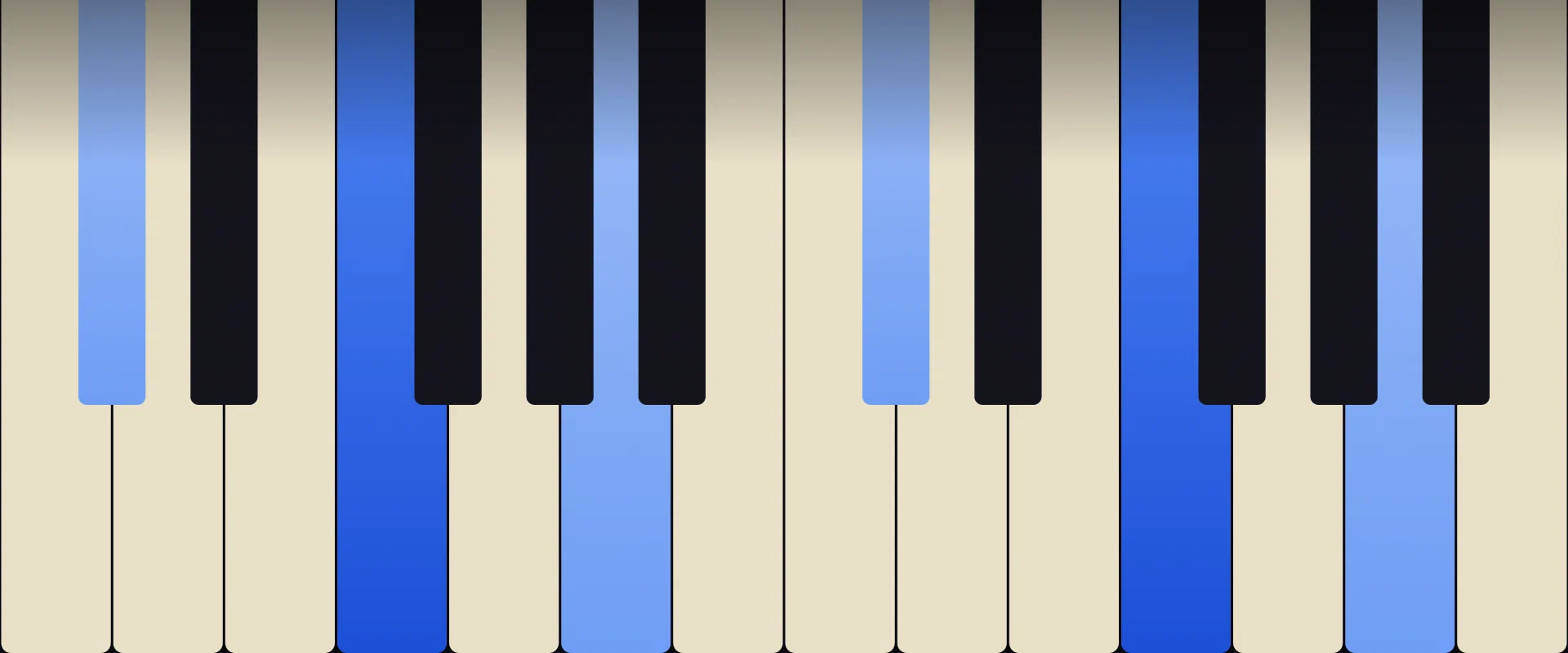
Set F as the root and put the augmented triad next to plain F major. One key moves.
The Notes of Faug
| Degree | Note | Interval from Root | Semitones |
|---|---|---|---|
| 1 (Root) | F | Perfect unison | 0 |
| 3 | A | Major 3rd | 4 |
| ♯5 | C♯ | Augmented 5th | 8 |
Four semitones, then four more. Two identical major 3rds stacked, and eight semitones from bottom to top.
How Faug Is Built
Start from F major, F, A and C, and raise the top note only. F to C♯ is an augmented 5th, one semitone wider than the perfect 5th of F major and two wider than the diminished 5th of F diminished. The 3rd never moves, so the chord keeps its major brightness and adds an edge on top.
Because both intervals are the same size, the triad splits the octave into three equal pieces and nothing inside it points at a root. The identical three sounds spelled from A give Aaug, spelled from D♭ give D♭aug. Only the music around it decides which name is correct, and the name you choose is a prediction about where the top note is going next.
Faug on the Piano
F and A are white keys. C♯ is the lower of the two black keys in the group of two, and it is the only thing separating this chord from F major. Thumb on F, middle finger on A, little finger on C♯: the ordinary 1, 3, 5 grip with the top finger pushed one key further and back onto the raised part of the keyboard.
That backwards reach is the whole difficulty. The span is eight semitones rather than seven, so the hand opens wider than it does for F major while the little finger also has to travel deeper between the white keys. Practise it as a movement, not a shape: hold F and A still and let the little finger walk C, C♯, D over an F, Faug, B♭ bass.
The three inversions are worth playing back to back, because the keys never change but the hand does. Root position runs white, white, black. First inversion runs white, black, white. Second inversion runs black, white, white. Three feels, one set of keys, which is a fair physical demonstration of why this chord has no natural bottom.
Faug on the Guitar
There is no open form, and the standard answer is unkind. The augmented shape with its root on the 6th string lands at fret 1, giving 1 4 3 2 2 1: a full barre across all six strings at the first fret with three fingers stacked above it, in the stretch of neck where string tension is highest and the nut refuses to help. This is the same region that makes F major the chord beginners give up on, with an extra finger to place.
The symmetry offers a way out that no other chord type gives you. Since F, A and C♯ divide the octave equally, the grip repeats every four frets and sounds the identical three notes each time. Play 1 4 3 2 2 1 at fret 5 and a chart would call it Aaug; play it at fret 9 and the chart says C♯aug. All three are this chord. A guitarist handed a Faug in a song book never has to go near the nut for it.
The compact four string form is better still. With the root on the 5th string at fret 8 the notes fall as a descending diagonal, x 8 7 6 6 x, sounding F, A, C♯ and F. Ring finger, middle finger, then the index laid across the top two strings. Nothing is barred at the bottom, and it moves in four fret steps like everything else here.
Inversions
| Inversion | Notes | Bass Note | Symbol |
|---|---|---|---|
| Root position | F, A, C♯ | F | Faug |
| 1st inversion | A, C♯, F | A | Faug/A |
| 2nd inversion | C♯, F, A | C♯ | Faug/C♯ |
Ordinary triads change character when you invert them because the intervals inside rearrange. This one cannot. Every inversion is two stacked major 3rds again, so the ear hears root position in all three cases and relabels the bottom note as the root. The slash symbols above are doing analytical work rather than describing a sound: Faug/A tells a player that A is passing through, and promises nothing audible.
Voicings
Keep the C♯ at the top. That is the note in motion, and burying it in the middle of a voicing wastes it. Put C♯ in the bass instead and the ear will happily hear D♭aug, which is a different prediction about the next bar.
The chord is also the top half of two more common shapes. Add E♭ and you have F7♯5, the altered dominant that drives into B♭. Add E natural and you have Fmaj7♯5, a floating lydian augmented colour content to stay put. All three sit inside the whole tone scale F, G, A, B, C♯, D♯.
| Shape | Frets, low to high | Sounding notes |
|---|---|---|
| Root on 5th string, compact | x 8 7 6 6 x | F, A, C♯, F |
| Root on 6th string, full barre | 1 4 3 2 2 1 | F, C♯, F, A, C♯, F |
| Same grip, fret 5 | 5 8 7 6 6 5 | A, F, A, C♯, F, A |
| F7♯5, root on 6th string | 1 x 1 2 2 x | F, E♭, A, C♯ |
Which Keys Contain Faug
- III of D harmonic minor
- III of D melodic minor
Two entries, and the shortness of that list is the most informative thing on this page. No major scale contains an augmented triad, and neither does any natural minor scale. It turns up only where a scale has already been altered, on the 3rd degree of D harmonic and D melodic minor, and the note that makes it augmented is C♯, D minor’s leading tone. The raised 5th here is a leading tone in disguise, and leading tones lean upwards.
Where Faug Shows Up
B♭ is the horn key. Trumpet, tenor saxophone, clarinet and trombone all read in B♭, and the concert band and the big band live there. F, in turn, is the French horn’s key. So the V+ to I move that this chord exists to make belongs to brass and reed writing far more than to the guitar repertoire, and you will meet it in arrangements before you meet it in song books.
| Progression | Chords | What the C♯ does |
|---|---|---|
| I, I+, IV | F, Faug, B♭ | Climbs to D, the 3rd of B♭ |
| V+, I | Faug, B♭ | Same climb, no preparation |
| I, I+, vi7 | F, Faug, Dm7 | Climbs to D, the root of Dm |
| i, VI, III+, i | Dm, B♭, Faug, Dm | Climbs to D, the tonic |
The first line is the ragtime and gospel turnaround, and it is worth noticing that the F chord does not really leave: F and A stay put through all three chords while one voice walks. The last line is the D minor use, where III+ borrows the leading tone from the harmonic minor scale and behaves as a lightweight substitute for A7.
In barbershop and Tin Pan Alley writing it often appears with no B♭ after it at all, purely to lift a held F major for two beats before dropping back. Used that way it is closer to a decoration than a chord, which is another way of saying the same thing.
Related Chords
- F Major Chord is this chord with the 5th put back to C.
- F Diminished Chord bends the same 5th in the other direction.
- F Minor Chord moves the 3rd instead, the one note this chord leaves alone.
- Secondary Dominants and Borrowed Chords covers the borrowing that produces III+ in a minor key.
- Chord Inversions and Voice Leading is the topic this chord is really about.
Learn More
F and B♭ are neighbours on the circle of fifths, which is why the step from one to the other is short enough for a single passing note to carry it. For F7♯5 and the altered dominants built on this triad, see Extended Chords and Jazz Harmony. For why an augmented triad never appears among the seven chords of a major key, see Diatonic Chords: A Beginner’s Guide. For every scale on the site that contains it, see Scales for Piano and Guitar: The Complete Reference Guide.
Practice Chords
Drill chord recognition with a metronome, MIDI support, and score tracking.
Start PracticingRelated Articles
A Augmented Chord: Notes, Voicings, and How to Play It
Aug 23, 2026 · 8 min
A♭ Augmented Chord: Notes, Voicings, and How to Play It
Aug 23, 2026 · 7 min
B Augmented Chord: Notes, Voicings, and How to Play It
Aug 23, 2026 · 8 min