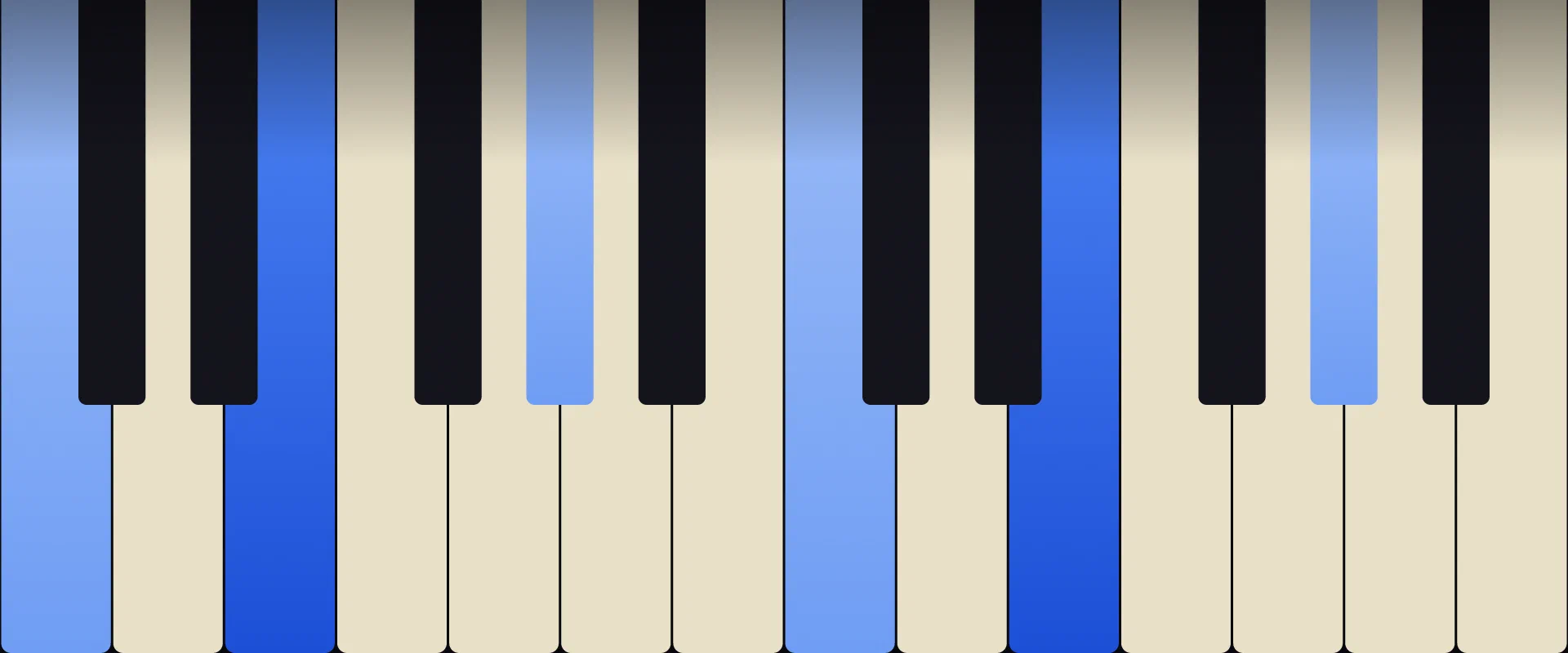
The strange thing about this chord is its top note. Eaug is spelled E, G♯ and B♯, and B♯ is played on the white key everyone calls C. Not a misprint, and nothing is missing from your keyboard: it is what happens when you raise the fifth of a chord rooted on E. Underneath that spelling sits a chord with two practical jobs. It is the V+ of A major, which is where most listeners meet it, and on a guitar it has a genuine near-open form, because E is the one root the instrument treats as home.
Try It: Eaug in the Chord Finder
Select E as the root and C♯ harmonic minor as the scale. The augmented triad is waiting on the third degree.
The Notes of Eaug
E augmented takes the root, major 3rd and raised 5th:
E, G♯ and B♯
| Degree | Note | Interval from Root |
|---|---|---|
| 1 (Root) | E | Perfect unison |
| 3 | G♯ | Major 3rd |
| ♯5 | B♯ | Augmented 5th |
Two of the three notes carry an accidental, yet only one of them is a black key. E and B♯ are both white.
That top note needs explaining. Count letters upwards from E and you get E, F, G, A, B. B is the fifth letter, so the fifth of any chord rooted on E is a B of some kind: B♭ when the fifth is narrowed, B when it is perfect, B♯ when it is stretched a semitone wider. Letters are what make a chord readable as a stack of thirds, and E, G, B is that stack with every second letter used. Write the top note as C instead and you get E, G♯, C, with nothing on the B line and the interval from G♯ upwards forced to be called a diminished 4th. The chord would stop looking like a triad at all.
In plain terms: press E, then the black key G♯, then the white key C. What you hear is correct. Its name is B♯.
How Eaug Is Built
Start from E major, E, G♯ and B, and push the B up one semitone. What remains is two major thirds in a row: E up to G♯ is four semitones, G♯ up to B♯ is four more. There is no perfect fifth left anywhere in the chord, which is why it will not sit still.
Add a D on top and you have E7♯5, an altered dominant. Most players who use these three notes regularly are using them inside that larger chord rather than strumming the bare triad.
Eaug on the Piano
The hand sees an evenly spaced shape and the page says something else. E sits just right of the group of two black keys, G♯ is the middle key of the group of three, and B♯ is the white key immediately left of the next group of two. Three keys, each the same distance apart, which is exactly what two stacked major thirds look like from above.
Right hand: thumb on E, second finger on G♯, fifth finger on B♯.
Left hand: fifth finger on E, third finger on G♯, thumb on B♯.
Eight semitones from E to B♯ is comfortable in either hand. Use the second finger rather than the third on G♯: the black key sits further into the keyboard, and keeping the thumb and fifth finger forward on white keys stops the wrist twisting.
Reading it is harder than playing it. B♯ sits in no key signature you are likely to meet, so it always arrives as a written accidental and beginners play B natural by reflex. It turns up honestly in C♯ minor, where B♯ is the leading note a semitone under the tonic. Anyone who has played a G♯7 in that key has already pressed this white key and called it by this name.
Eaug on the Guitar
The open form is 0 3 2 1 1 0, and the neatest way to learn it is as a modification of the open E major, 0 2 2 1 0 0. Both B’s in that shape move up one fret and become B♯: the fifth string goes from the 2nd fret to the 3rd, and the second string goes from open to the 1st fret. Nothing else changes.
Bottom to top the strings sound E, B♯, E, G♯, B♯, E: three roots, two augmented fifths and one major third buried in the middle, so the chord keeps the weight of the open E it came from.
Lay the index flat across the second and third strings at the 1st fret, the middle finger on the fourth string at the 2nd, the ring finger on the fifth string at the 3rd, and leave both E strings open. A small barre rather than a stretch, all inside the first three frets.
Because the augmented triad divides the octave into three equal steps, the grip repeats every four frets and each of its notes can act as the root. The fifth-string movable form lands at the 7th fret, x 7 6 5 5 x, and is worth learning as a way of getting the same chord without the open bass roaring underneath.
Inversions
| Voicing | Notes | Bass note |
|---|---|---|
| Root position | E G♯ B♯ | E |
| 1st inversion | G♯ B♯ E | G♯ |
| 2nd inversion | B♯ E G♯ | B♯ |
Every pair of notes here is four semitones apart, so no rearrangement sounds more settled than another and the three positions are the same keyboard shape moved bodily up the octave. The bass note decides everything: put E underneath and the chord behaves as a dominant of A, put another chord tone there and it will pull somewhere else entirely.
Voicings
- Near-open form, 0 3 2 1 1 0, the full six strings with the low E ringing.
- Top three strings, x x x 1 1 0, sounding G♯, B♯ and E. Two fingers and no bass, useful as a passing colour.
- Movable form, x 7 6 5 5 x, rooted on the fifth string at the 7th fret.
- E7♯5, 0 3 0 1 1 0, the same grip with the fourth string released to an open D.
- Piano spread, low E in the left hand with G♯ and B♯ close together above middle C.
Give the B♯ somewhere to go. Burying the raised fifth inside a thick voicing wastes the only restless thing in the chord.
Which Keys Contain Eaug
Two scales on the site produce this chord, and they are both built on the same root:
- III of C♯ harmonic minor
- III of C♯ melodic minor
No major key contains an augmented triad at all. It takes a raised seventh degree to make one, so stacking thirds from the third degree of C♯ harmonic minor gives E, G♯ and B♯, with the leading note supplying the augmented fifth. Everywhere else this chord arrives as a borrowed colour rather than as a member of the key.
Where Eaug Shows Up
As the V+ of A major. A, D, E+, A is the plain version: I, IV, V+, I. The augmented fifth sits a semitone under C♯, the third of A major, and pulls up into it, so the return home carries a leading note in an inner voice as well as in the bass. That resolution is also why the note has to be called B♯. It moves up a semitone into C♯, and on the page that is a step from the letter B to the letter C. Spell it as C and the same movement becomes C to C♯, which reads as no step at all.
As a rising line over a held E. Play E, E+, E6 and E7 in sequence with the bass staying on E, and one voice climbs B, B♯, C♯, D while everything around it stays put. Soul, doo-wop and countless slow blues intros run on this. The Beatles’ “Oh! Darling” opens on an E augmented and then lands on A, which is the V+ resolution above arriving before the song has properly started.
As III+ in C♯ minor. C♯m, E+, G♯7, C♯m. Here the chord arrives almost by accident, as the by-product of a raised leading note rather than as a choice, and nineteenth century keyboard writing is full of it. Guitarists rarely meet it this way: C♯ minor keeps them above the 4th fret, while the good open form of this chord lives at the nut.
Be realistic about how often you will strum it. An augmented triad is a hinge rather than a destination, three or four beats on the way from a major chord to whatever the raised fifth points at. Because the octave is split evenly, that hinge swings through any of three doors, handy for leaving a key quickly and awkward when you want the ear to stay put.
Related Chords
- E Major Chord: Notes, Voicings, and How to Play It is this chord with the fifth put back, one fret away.
- E Minor Chord: Notes, Voicings, and How to Play It lowers the third instead of raising the fifth.
- E Diminished Chord: Notes, Voicings, and How to Play It shrinks the fifth rather than stretching it.
- Extended Chords: Which Tensions Work, and How to Voice Them covers E7♯5, where this triad usually hides.
Learn More
- Diatonic Chords: A Beginner’s Guide to Building Chords from Scales on why no major key produces one of these.
- Chord Inversions and Voice Leading on keeping the raised fifth where it can move.
- The Circle of Fifths Explained puts A major and C♯ minor next to each other.
- E Major Scale: Notes, Chords, and How to Play It is the scale this chord starts from.
Practice Chords
Drill chord recognition with a metronome, MIDI support, and score tracking.
Start PracticingRelated Articles
A Augmented Chord: Notes, Voicings, and How to Play It
Aug 23, 2026 · 8 min
A♭ Augmented Chord: Notes, Voicings, and How to Play It
Aug 23, 2026 · 7 min
B Augmented Chord: Notes, Voicings, and How to Play It
Aug 23, 2026 · 8 min