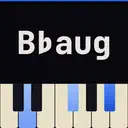
Read E♭, G, B quickly and the eye supplies a flat that is not there. Of the twelve augmented triads this is the one that hides best on the page: all three note names are ordinary letters with a single flat between them, and E♭ G B♭ is a chord every musician has played a thousand times. One semitone on the top note is the whole difference, and it turns the most settled triad in flat key music into one that cannot sit still. Concert band and brass band players meet it constantly, almost always as a chromatic step inside a phrase rather than somewhere anyone stops.
Try It: E♭aug in the Chord Finder
The Notes of E♭aug
The chord contains three notes: E♭, G and B.
| Degree | Note | Interval from root | Semitones |
|---|---|---|---|
| 1 | E♭ | Root | 0 |
| 3 | G | Major 3rd | 4 |
| ♯5 | B | Augmented 5th | 8 |
The usual symbol is E♭aug. Jazz charts prefer E♭+. Classical editions write E♭(♯5), a form that exists purely so the alteration cannot be missed.
How E♭aug Is Built
Take E♭ major, E♭ G B♭, and raise the top note a semitone. The perfect 5th becomes an augmented 5th, a semitone too wide, and that is the whole test: if the fifth above E♭ is B♭ the chord is major, if it is B the chord is augmented. Nothing else changes, so B is the only note worth checking when a chart looks wrong.
The result is two major thirds stacked with no interval left over. That even division is why the same three pitches also spell Gaug and Baug depending on the bass note, and why four augmented triads account for all twelve roots.
E♭aug on the Piano
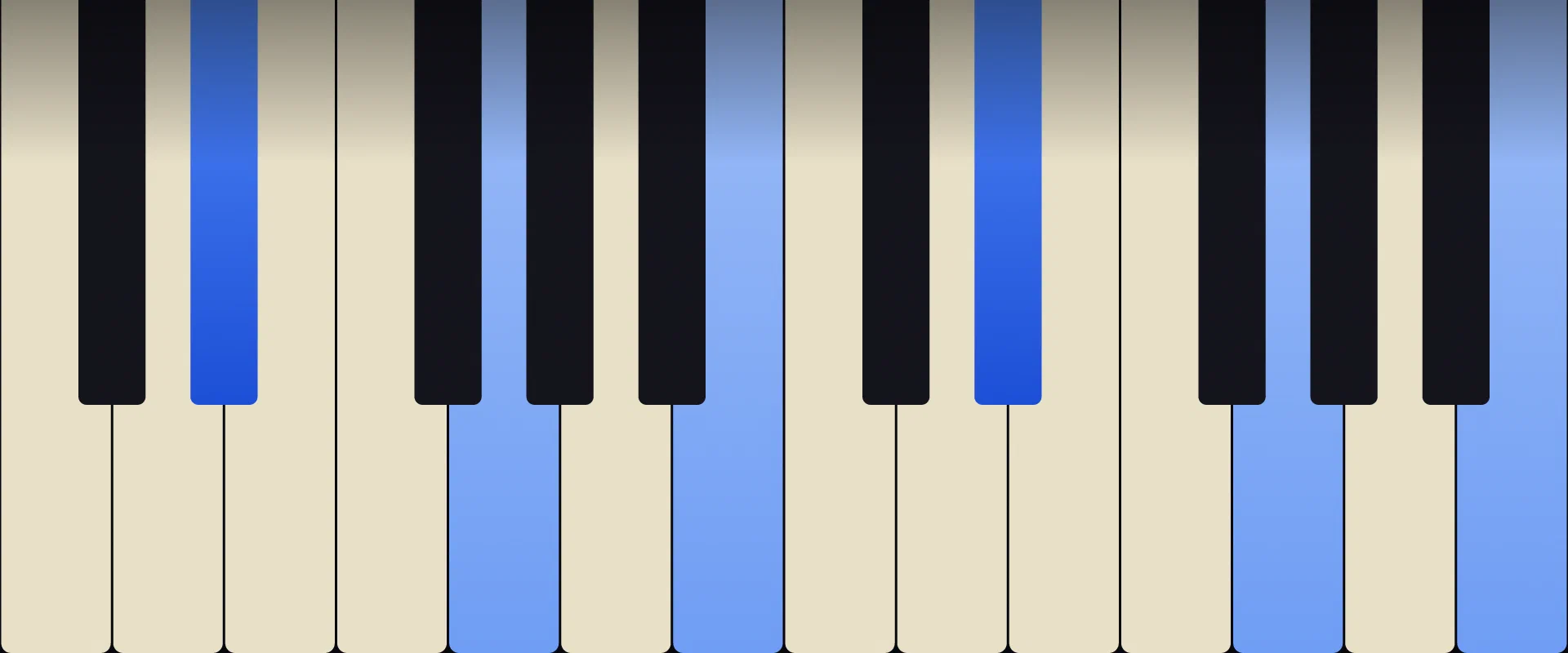
One black key and two white, in that order going up: E♭ set back among the raised keys, then G and B at the front. Right hand fingering is 1 on E♭, 3 on G, 5 on B; the left hand mirrors it.
The hand tilts, and the tilt is what to manage. Your thumb sits deep in the keyboard on the black key while the middle and little fingers run forward along the white ones, so the wrist wants to rotate outwards. Keep the forearm level and let the thumb reach back rather than dragging the hand towards the fallboard. G is the cramped note, narrow at the back with F♯ and G♯ crowding it; B has the far right of the group of three to itself.
To feel what the chord does, practise the move it exists for. Play E♭ G B♭, then E♭ G B, then E♭ G C. The little finger walks off the black B♭ onto the white B beside it, then onto C, and the top voice has climbed from the fifth of E♭ major to the third of A♭ major without the other two fingers moving.
E♭aug on the Guitar
Symmetry does the guitarist a favour here. The shape repeats every four frets, so the same grip at frets 2, 6 and 10 sounds the same three pitches, and the lowest of those sits close enough to the nut to use open strings.
The root position grip is x 6 5 4 4 x, root on the 5th string at the 6th fret, the notes falling away in a staircase. No full barre is needed: second finger on the root, first on G, a two string barre with the third finger at the 4th fret. It lands in the friendly middle of the neck where string tension forgives you.
Drop that shape four frets and you get x 2 1 0 0 x, almost an open chord, the G and B strings ringing free. B is the lowest note, so it is not root position, but the chord is E♭aug and it sings in a way no barre does. Take the shape up instead, to x 10 9 8 8 x, and G sits in the bass.
For a low root there is 11 10 9 8 x x on the 6th string. That is honest work: the 11th fret crowds the fingers and on an acoustic the body is in the way. Use it only when the bass line demands E♭ underneath.
Two warnings. Tuners and fretboard diagrams label the 6th fret of the A string D♯, so a guitarist hunting for E♭ can look straight past it. And since every position of the shape is a valid augmented triad, nothing on the neck tells you which note is acting as the root. The bass player decides that, not you.
Inversions
| Inversion | Notes | Lowest note |
|---|---|---|
| Root position | E♭ G B | E♭ |
| 1st inversion | G B E♭ | G |
| 2nd inversion | B E♭ G | B |
Inversion means less here than for any other triad, because each of these three arrangements is itself an augmented triad in root position. G B E♭ is Gaug with its top note written as E♭ instead of D♯, and B E♭ G is Baug spelled without the double sharp a strict Baug would need. Editors reach for the flat spelling to dodge exactly that, which is one reason this chord turns up in print more often than its rotations. Context supplies what notation cannot: put E♭ in the bass and the chord reads as E♭ with a raised fifth, put G there and the same sound starts behaving like a chord of G.
Voicings
Space matters more than usual. Drop E♭ low in the left hand and put G and B above it in the right, so the outer voices open out and the two thirds stop sounding like a mechanical stack. Kept close in the middle register it goes cloudy fast, having no perfect fifth to anchor it.
Doubling tells the listener where home is. Double the E♭ and the ear accepts E♭ as the root; double the G and the chord leans towards G. To lose the ambiguity, add a seventh: E♭7♯5, E♭ G B D♭, has only one note that can be the root.
That missing fifth causes real trouble in a wind section. Players tune a major third slightly flat against the root by ear, but this chord offers three equally major thirds and no stable target, so it spreads. Hold it long and quiet and it will drift; write it short and it behaves.
Which Keys Contain E♭aug
- III of C harmonic minor
- III of C melodic minor
Two entries, and that scarcity is the point. The augmented triad is barely diatonic: it appears in no major scale and no natural minor, only on the third degree of harmonic and melodic minor, where the raised leading note drags the fifth up with it. Both scales that produce this chord are C minor scales, and C minor is the relative minor of E♭ major, so a band already sitting in three flats has E♭aug within reach.
Where E♭aug Shows Up
I, I+, IV: E♭, E♭aug, A♭. The workhorse. Hold E♭ and G, walk the top voice B♭ to B to C, and the augmented triad is just the middle frame of that climb. The whole gesture lasts a bar.
V+, I: E♭aug to A♭. As the dominant of A♭ major with its fifth raised, the B leans hard into C and the cadence lands with extra weight. Gospel and big band writers use the seventh chord version, E♭7♯5 to A♭, so often that the raised fifth is close to a default on a final dominant.
Cm, E♭aug, A♭, G7. Now the chord is III+ in C minor, the mediant made augmented by the B natural that C harmonic minor supplies as its leading note. It sounds nothing like the first example. As I+ it is a passing brightening of home; as III+ it is home’s leading note showing through the texture on the way to the dominant.
The band room angle is worth spelling out. Concert E♭ is the pitch alto and baritone saxophones, E♭ clarinets and E♭ basses read as C, so an alto part asking for this chord prints as a plain C augmented while the trumpets read F augmented for the same sound. Three symbols, one chord. Since that repertoire lives in E♭, A♭ and B♭ by default, this is the chromatic connecting chord those players meet most.
Related Chords
- E♭ Major Chord
- E♭ Minor Chord
- D♯ Diminished Chord, the same root pitch with the fifth lowered instead of raised, spelled with sharps as the diminished context requires
- Secondary Dominants and Borrowed Chords
- Guitar Chord Shapes: The CAGED System
Learn More
Practice Chords
Drill chord recognition with a metronome, MIDI support, and score tracking.
Start PracticingRelated Articles
A Augmented Chord: Notes, Voicings, and How to Play It
Aug 23, 2026 · 8 min
A♭ Augmented Chord: Notes, Voicings, and How to Play It
Aug 23, 2026 · 7 min
B Augmented Chord: Notes, Voicings, and How to Play It
Aug 23, 2026 · 8 min