The top note of Daug is written A♯ and not B♭, and that spelling is the whole argument of the chord. A♯ sits a semitone below B, so it is written as a note with somewhere to be. Push it up to B, push the F♯ under it up to G, leave the D alone, and D F♯ A♯ has become G B D. Two voices rise a semitone each, one does not move, and an unsettled triad turns into an ordinary G chord.
That is what an augmented chord is for. It is not a colour you sit on. It is a D major chord with its fifth prised upwards so the fifth can become the third of the next chord. In G major it is V+, and the plus sign is an instruction.
Try It: Daug in the Chord Finder
The Notes of Daug
Daug is three notes: D, F♯ and A♯.
| Degree | Note | Interval from Root | Semitones |
|---|---|---|---|
| 1 (Root) | D | Perfect unison | 0 |
| 3 | F♯ | Major 3rd | 4 |
| ♯5 | A♯ | Augmented 5th | 8 |
You will see it written Daug, D+ or D(♯5). Older popular sheet music prefers the plus sign, which takes less room above a staff.
How Daug Is Built
Take D major, D F♯ A, and lift the A one semitone to A♯. The root and the major third stay exactly where they were, which is why the chord still sounds bright rather than dark, only stretched.
Read it as stacked thirds and the oddity shows. D up to F♯ is a major third, and F♯ up to A♯ is also a major third. Every other triad has one major and one minor third in some order. This one has two of the same size, so the ear gets no long side to navigate by, and A♯ up to the D above is a diminished fourth rather than a minor sixth.
Two equal thirds divide the octave into three, so Daug uses the same keys as G♭aug and B♭aug. What makes this one Daug is a D underneath and an A♯ on top.
Daug on the Piano
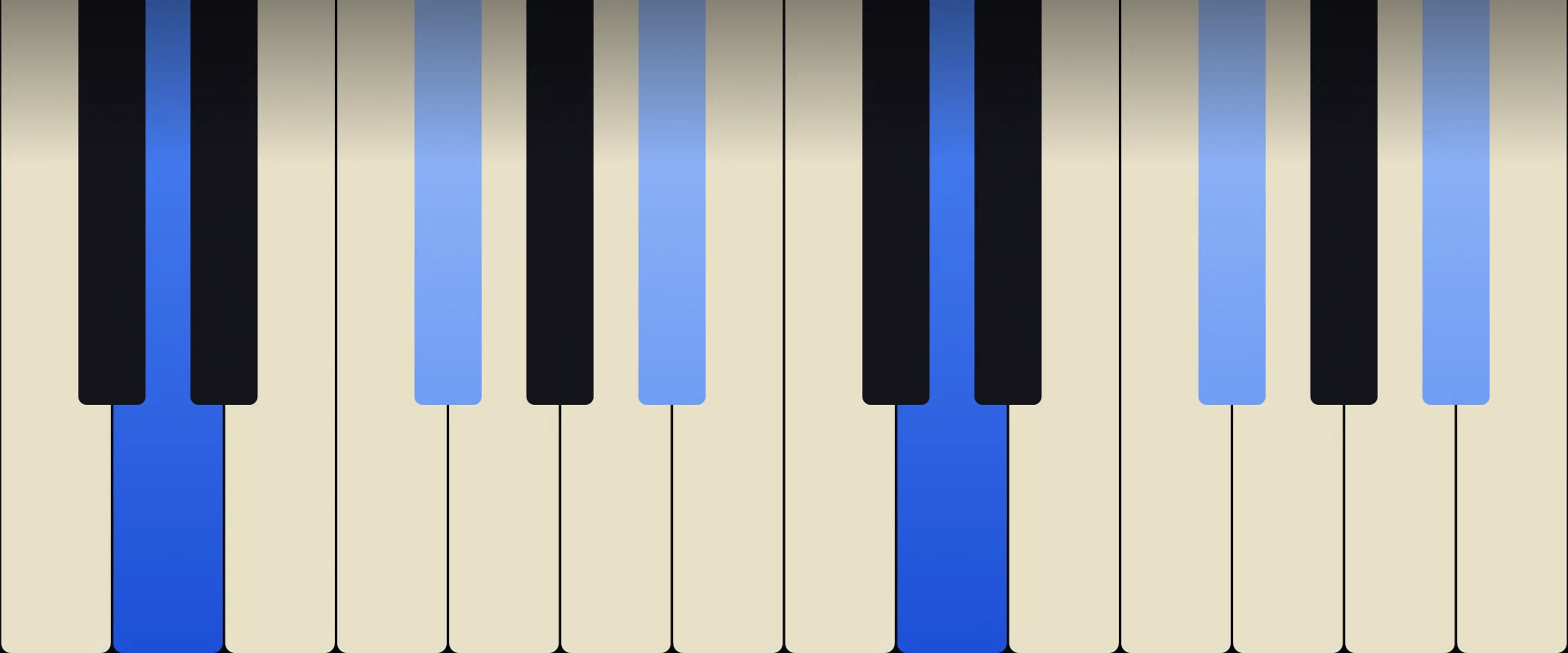
One white key and two black. The D is wedged between the two black keys of the group of two, and both other notes come from the group of three next door: F♯ is the first of that group, A♯ the last, with G♯ skipped in the middle. Thumb out at the front on D, then two fingers up on black keys that bracket one untouched black key. Right hand 1, 2, 4 works, and 1, 3, 5 reaches further.
Because those two black keys are the outer pair of one group, the hand finds Daug by feel: let the middle finger hover over the G♯ you are not playing and drop the thumb straight down.
The resolution is what to practise, and on a keyboard it is almost comically visual. Both black keys slide off to the white key immediately on their right: A♯ to B, F♯ to G. The thumb never leaves D. Let those two fingers fall forward off the black keys without lifting the hand and you are holding G major in second inversion. Do it slowly enough to hear the A♯ becoming the third of the new chord.
Set it against D major too. Alternating A and A♯ under a fixed thumb and second finger sends the little finger from white to black, so the hand travels inwards as well as sideways. That small in and out motion is the feel of a raised fifth.
Daug on the Guitar
No open form exists. D, F♯ and A♯ do not line up with the open strings the way D major does, and the raised fifth wrecks the usual trick of letting a low string ring underneath, because the note you want down there is A and this chord has A♯ instead.
Use three note grips. The best puts the root on the 5th string at the 5th fret and runs diagonally down: x 5 4 3 x x, D on the 5th string, F♯ on the 4th, A♯ on the 3rd. Three consecutive descending frets, no stretch, easy to mute either side of. The same staircase appears on the 6th string at the 10th fret, 10 9 8 x x x, but the frets are cramped there and the voicing is muddy.
The descent is no coincidence. Adjacent strings are a perfect fourth apart, five semitones, and a major third is four, so each next note sits one fret lower. The B string breaks the run, being only a major third above the G string, and the pattern flattens there: x x x 3 3 2 puts A♯ and D on the same fret with F♯ one below, a compact second inversion for comping in G.
Guitarists meet Daug in two situations: a song in G reaching for its dominant, or a song in D walking up out of the tonic. Both sit in friendly territory, which is more than most augmented triads can claim.
Inversions
| Inversion | Bass Note | Notes | Symbol |
|---|---|---|---|
| Root position | D | D, F♯, A♯ | Daug |
| 1st inversion | F♯ | F♯, A♯, D | Daug/F♯ |
| 2nd inversion | A♯ | A♯, D, F♯ | Daug/A♯ |
Inversion is a slippery idea here. The notes are evenly spaced, so first inversion also sounds like an augmented triad rooted on F♯, and the sound alone cannot contradict that. The bass line decides. If the piece is heading for G, keep D underneath. An A♯ in the bass will be heard as a B waiting to happen.
Voicings
Guitar, root position (x 5 4 3 x x). The default working shape, clean and easy to damp.
Guitar, top strings (x x x 3 3 2). Light and high, good for a quick jab between D and G.
Piano, close (D, F♯ and A♯ in one hand). The two major thirds stay transparent above middle C.
Piano, D low and F♯ with A♯ above. Spreading the chord keeps the root unambiguous and stops the ear hearing F♯aug instead.
Which Keys Contain Daug
Daug is diatonic to only two scales on this site, and both of them are B:
- III+ of B harmonic minor
- III+ of B melodic minor
That short list is the point, not an omission. No major key contains an augmented triad at all. One appears only once the seventh degree of a minor scale is raised, and in B minor that raised seventh is A♯. Stack a triad on the third degree and you get D, F♯ and A♯. So the awkward spelling has a plain explanation: A♯ is the leading note of B minor, and a leading note is never a flat.
Where Daug Shows Up
V+ into I in G major: Daug, then G. This is why the chord exists in popular music. Play D, F♯, A♯ and then G, B, D. Both moving voices climb a semitone, the D holds through, and the cadence arrives with more push than a plain D gives you and none of the grit of a seventh. Music hall pianists used it constantly and the Beatles inherited it wholesale. “Oh! Darling” opens with exactly this gesture a fourth higher. Move that idea to the key of G and it is Daug into G.
The rising line out of D: D, D+, D6, D7. Hold a D chord and send one inner voice up by step: A, A♯, B, C. The second chord in that run is Daug, and the raised fifth is a passing note that has been harmonised. Notice where the line lands. The C makes the chord D7, and D7 goes to G, so even this use of Daug is a slow walk to the same place.
III+ in B minor. In B harmonic minor the A♯ that makes the key work sits above a D and an F♯ whenever the harmony passes through the third degree. Composers in B minor produce Daug almost by accident this way, in passing, with the A♯ resolving up to B on the next beat. That is the classical face of the chord, and why string players know the sound long before they meet the pop cadence.
Related Chords
- D Major Chord, the chord this one is a stretched version of.
- G Major Chord, where Daug almost always ends up.
- D Minor Chord, the same root pulled the other way.
- D Diminished Chord, the triad with its fifth lowered instead.
- B Minor Chord, the key whose leading note explains the A♯.
Learn More
Practice Chords
Drill chord recognition with a metronome, MIDI support, and score tracking.
Start PracticingRelated Articles
A Augmented Chord: Notes, Voicings, and How to Play It
Aug 23, 2026 · 8 min
A♭ Augmented Chord: Notes, Voicings, and How to Play It
Aug 23, 2026 · 7 min
B Augmented Chord: Notes, Voicings, and How to Play It
Aug 23, 2026 · 8 min