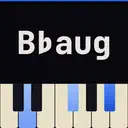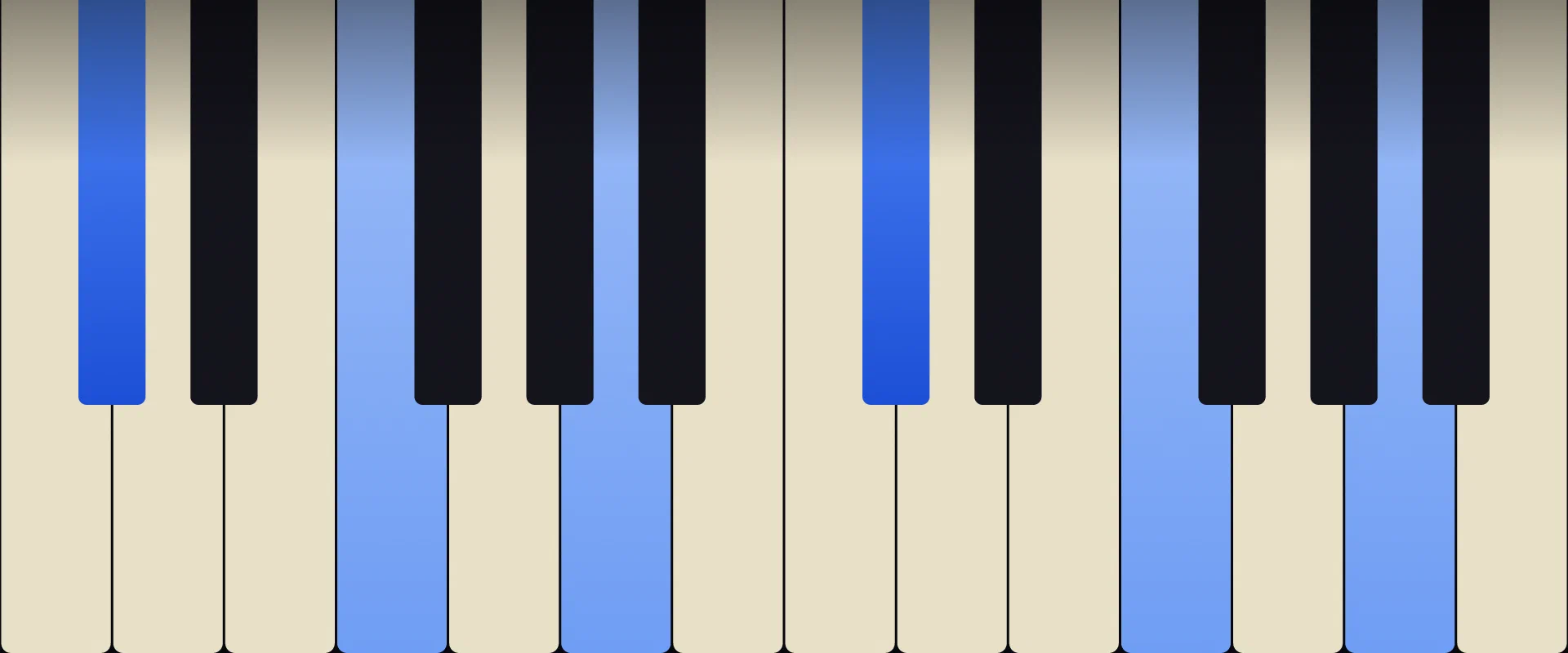
Every other triad on this pitch is filed under C♯ on this site. The augmented one is filed under D♭, and a single note decides it. Raise the fifth of C♯ major and G♯ has to become G𝄪, a double sharp, which is the note your finger already knows as A. Raise the fifth of D♭ major instead and A♭ simply becomes A, with nothing in front of it at all. Either spelling sounds identical. One costs a double accidental and the other costs nothing, so this chord is D♭ F A and it is called D♭aug.
Try It: D♭aug in the Chord Finder
The Notes of D♭aug
| Degree | Note | Interval from root | Semitones |
|---|---|---|---|
| 1 | D♭ | Root | 0 |
| 3 | F | Major 3rd | 4 |
| ♯5 | A | Augmented 5th | 8 |
The altered note, the one that gives the chord its name, is the only one written without an accidental. A is just A. The flat belongs to the root.
How D♭aug Is Built
Chord tones are named by letter before they are counted in semitones. From D you count D, E, F, so the third of anything rooted on a kind of D is a kind of F. Count on to A for the fifth. D♭ major fills that frame as D♭, F, A♭. Augmenting means pushing the fifth up one semitone, and A♭ pushed up is A natural. Three notes, one accidental, no ambiguity.
Now run the same frame from C♯. The third is a kind of E, so E♯. The fifth is a kind of G, so G♯, and raised it becomes G𝄪. That symbol is a double sharp and it means the note two semitones above G, which on the keyboard is the white key A. Writing C♯ E♯ G𝄪 is not wrong, just costly: that double sharp would have to be printed every time the chord appears. D♭ F A says it once.
This is the principle behind every accidental choice in the set. A root’s letter is not fixed by the key you press. It is chosen so that the notes stacked above it can be named by degree without accidentals piling up. The same black key is D♭ when the chord above it wants F and A, and C♯ when the chord above it wants E and G♯. Neither spelling is a compromise, and insisting on one of them everywhere buys double sharps for nothing.
One property matters before you play it. Every gap is four semitones, D♭ to F, F to A, A back up to D♭, so the chord cuts the octave into three equal pieces and answers to the names Faug and Aaug just as well. Four augmented triads cover all twelve roots between them. In use that means this one sonority is the dominant of G♭, of B♭ or of D, depending only on which note you decide will rise.
D♭aug on the Piano
One black key and two white ones, and the black key is underneath, so the hand tips slightly backwards rather than forwards. Put the right thumb well back on D♭, between C and D, then let the third and fifth fingers come out to F and A. Left hand mirrors it: 5, 3, 1. Nothing here stretches, since both gaps are major thirds and the whole chord spans a minor sixth.
The instructive part is what happens when you move it. Slide the shape up four semitones and the notes become F, A, D♭, which is the same chord in first inversion. Slide it up four more and you get A, D♭, F. An augmented triad is the only common triad whose inversions have the same interior spacing as its root position, so all three sit under the hand identically. Major and minor triads change shape when you invert them. This one does not, and the fingering problem disappears for good.
Learn it as a movement rather than a grip. Play D♭, F, A♭ with the right hand, hold the lower two, and lift the little finger a semitone onto A. That one white key is the whole difference between a settled major chord and a chord that wants to go somewhere.
D♭aug on the Guitar
There is no open form, and there was never going to be one. The frets that matter are the 4th and the 9th.
The 5th string shape is the workable one: x 4 3 2 2 x, giving D♭, F, A and D♭ again on the top. Nothing is barred and the fingering descends neatly across the strings, which makes it one of the few chords in this region easier than the major triad it comes from. Mute the top string with the underside of the index finger. The 6th string version at the 9th fret, 9 12 11 10 10 9, needs a full barre plus a reach three frets above it, and up there the spacing is tight enough that most players go elsewhere.
Then the symmetry pays out. The grip repeats every four frets, so x 4 3 2 2 x at the 8th and at the 12th produces the same three pitches. A chart calling for Faug or Aaug wants a sound your hand already has.
The awkward part is the surroundings, not the chord. In D♭ major every neighbour is a barre, so players usually capo the 1st fret and use an open Caug shape (x 3 2 1 1 x). Most guitarists meet these three notes not as a triad but as the top of a D♭7♯5.
Inversions
| Inversion | Notes | Lowest note |
|---|---|---|
| Root position | D♭ F A | D♭ |
| 1st inversion | F A D♭ | F |
| 2nd inversion | A D♭ F | A |
All three rows sound like the same stack of major thirds, and out of context your ear cannot tell them apart. The bass note is the only evidence, and what it decides is not which inversion you are hearing but which chord this is about to become. D♭ underneath points the music at G♭. F underneath points it at B♭. A underneath points it at D.
Voicings
Keep the tension on top. Left hand takes D♭ and A alone, an open augmented fifth, and the right hand takes F, A and D♭ above it. The raised fifth sitting at the top of the texture is what makes the chord lean forward, because that is the voice with somewhere to go.
Add a seventh and the spelling turns awkward again. D♭7♯5 is D♭, F, A and C♭, and C♭ is played on the white key B. D♭maj7♯5, with C natural on top, avoids that entirely and floats rather than pushes.
Which Keys Contain D♭aug
- III of B♭ harmonic minor
- III of B♭ melodic minor
Two entries, and the shortness of the list is the finding. No major scale contains an augmented triad anywhere, so this chord is never plainly diatonic in a major key. It appears when a minor scale raises its seventh degree: B♭ minor with A natural in it puts a major third above F, which already sits a major third above D♭, and the augmented triad falls out on the third degree. Everywhere else it arrives as an alteration somebody chose.
Where D♭aug Shows Up
| Progression | Chords | Turns up in |
|---|---|---|
| I, I+, IV in D♭ major | D♭, D♭aug, G♭ | Ballads, gospel, musical theatre |
| V+, I in G♭ major | D♭aug, G♭ | Cadences wanting extra lift |
| i, III+, i in B♭ minor | B♭m, D♭aug, B♭m | Harmonic minor writing |
| ii, V♯5, I in G♭ | A♭m7, D♭7♯5, G♭maj7 | Jazz standards, film scoring |
The first row is the one to hear. Hold D♭ major, lift A♭ to A, carry on to B♭ for D♭6 and to C♭ for D♭7. That rising inner voice under a stationary chord is a Broadway and gospel staple, and the augmented triad is its second step.
Row two is the formal job. D♭ is the dominant of G♭ major, and raising its fifth turns A♭ into A, a semitone below B♭, the third of the chord you are heading for. The cadence gains a second voice moving by semitone and lands harder for it.
Who plays it follows from the key. D♭ major carries five flats and suits pianists, whose hands sit naturally on the raised keys, which is why so much ballad repertoire lives here: Debussy’s “Clair de lune” and Chopin’s Raindrop prelude among it. Horn sections like it for another reason, since concert D♭ reads as E♭ major on a B♭ trumpet and B♭ major on an alto saxophone. Everyone is comfortable except the guitarist, which is why guitar songs rarely sit in D♭ without a capo.
Related Chords
- C♯ Major Chord, the parent triad, which this site spells C♯ E♯ G♯. Raise its fifth and the flat spelling takes over
- C♯ Diminished Chord, the other triad that divides the octave evenly, in minor thirds rather than major ones
- C♯ Minor Chord
- Extended Chords and Jazz Harmony for D♭7♯5 and D♭maj7♯5
- Guitar Chord Shapes: The CAGED System for moving the augmented grip around the neck
Learn More
- Secondary Dominants and Borrowed Chords
- Diatonic Chords: A Beginner’s Guide
- Chord Inversions and Voice Leading
- The Circle of Fifths Explained, where the C♯ and D♭ spellings meet
- B♭ Harmonic Minor Scale, the one key that owns this chord outright
Practice Chords
Drill chord recognition with a metronome, MIDI support, and score tracking.
Start PracticingRelated Articles
A Augmented Chord: Notes, Voicings, and How to Play It
Aug 23, 2026 · 8 min
A♭ Augmented Chord: Notes, Voicings, and How to Play It
Aug 23, 2026 · 7 min
B Augmented Chord: Notes, Voicings, and How to Play It
Aug 23, 2026 · 8 min