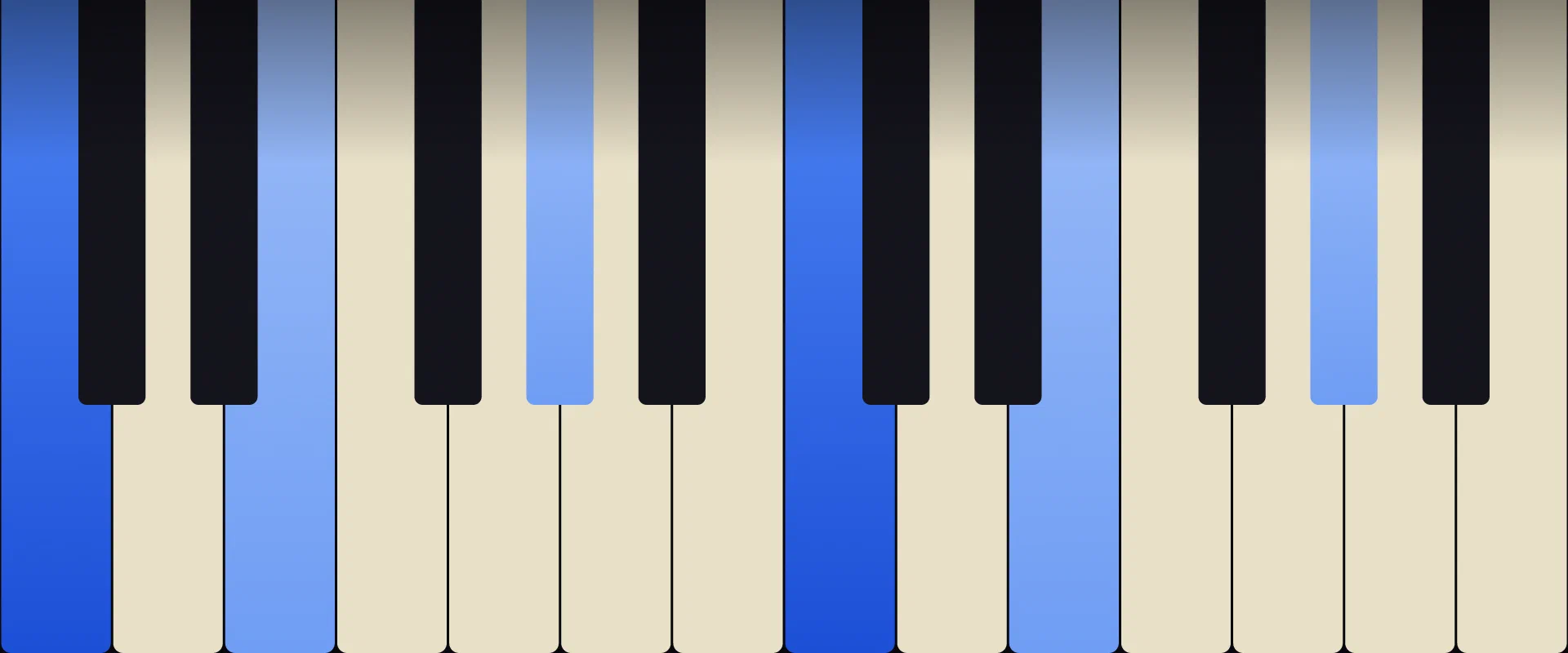
Take a C major triad and push the G up one semitone. That is the entire alteration, and it removes the one interval that was holding the chord still. C to G♯ is an augmented 5th, eight semitones, and there is no perfect 5th left anywhere in the chord. Without a perfect 5th nothing declares C to be the root, which is why Caug cannot end a phrase. It leans, and the listener waits.
The spelling catches people out too. C is the key that normally needs no accidentals, and here it is with a sharp in it. The note must be written G♯ and not A♭, because the 5th of any C chord has to be some kind of G. Call it A♭ and you have written a chord with a 3rd, a 6th and no 5th at all.
One structural fact before the detail, because it returns on the fretboard: three major 3rds stacked end to end fill exactly one octave, so C, E and G♯ are the same three pitches as Eaug and A♭aug. Only four distinct augmented triads exist across all twelve roots.
Try It: Caug in the Chord Finder
Set the root to C and watch the 5th move off G and onto the black key beside it.
The Notes of Caug
| Degree | Note | Interval from root | Semitones |
|---|---|---|---|
| 1 (root) | C | Perfect unison | 0 |
| 3 | E | Major 3rd | 4 |
| ♯5 | G♯ | Augmented 5th | 8 |
Written out: C, E, G♯. Two white keys and one black one, with the gaps between them identical: four semitones from C to E, four again from E to G♯.
How Caug Is Built
Caug is the major triad with the 5th raised, so it sits one semitone away from C major on one voice only. That closeness is the whole reason the chord exists in popular music: it is what a C major chord becomes when an inner voice starts to climb. Move the G♯ up one more semitone and you reach A, which turns the chord into C6 or into A minor with C in the bass. Add a B♭ on top instead and you have C7♯5, the altered dominant jazz players write when they want this tension inside a functioning V chord.
Caug on the Piano
Only G♯ is black, which makes this one of the cleanest introductions to a mixed hand shape. Thumb on C, third finger on E, fifth finger pushed forward and up onto G♯ in the right hand. The little finger is the only one that has to travel in towards the fallboard, so the hand tilts slightly rather than sitting flat, and the wrist should rotate a few degrees rather than the arm lifting.
Compare it directly with C major, where all three fingers stay out on the white plane. Play C major, then move only the fifth finger back and up, and the physical difference between a white key and a black key registers under a single finger while everything else stays anchored. Teachers use this pair for exactly that reason.
Left hand takes 5 on C, 3 on E and 1 reaching in for G♯, and because the thumb is the finger going to the black key the reach stays short.
The most useful drill in this key is the walking 5th: hold C and E, then move the top voice G, G♯, A, B♭ with the fifth finger alone. That gives you C, Caug, C6 and C7 in sequence without the rest of the hand moving at all.
Caug on the Guitar
There is no standard open Caug, but there is something better: the chord is one finger away from the open C shape. Open C is x 3 2 0 1 0, and the note ringing on the open 3rd string is the G. Stop that string at the 1st fret and it becomes G♯. The result, x 3 2 1 1 0, is a complete Caug, and the easiest way to hold it is to flatten the first finger across the 2nd and 3rd strings at the 1st fret while the rest of the C shape stays where it was.
Now play the same fingers again and let the low open 6th string ring: 0 3 2 1 1 0. Nothing changed except the bass, and that voicing is normally written Eaug. Both names are correct. This is the clearest demonstration on the whole instrument of why an augmented triad has no settled root: the grip does not know which of its three notes you intend to hear as the bottom, and only the bass line tells it.
For movable forms, the A shape barred at the 3rd fret gives x 3 6 5 5 4, and the E shape barred at the 8th fret gives 8 11 10 9 9 8. Both span four frets, so most players take only the top four strings of either rather than fighting the stretch below the barre. The 3rd fret version is the comfortable one and it puts C in the same register as an open C.
Because the chord repeats every four frets, x 3 6 5 5 4 at the 3rd fret, at the 7th and at the 11th are all the same three notes. Slide it and you have transposed nothing, only changed which note is lowest, which is a free way to move an augmented chord into a better register. On shifting shapes up the neck, see Guitar Chord Shapes: The CAGED System.
Inversions
| Inversion | Notes | Bass | Symbol |
|---|---|---|---|
| Root position | C E G♯ | C | Caug |
| 1st inversion | E G♯ C | E | Caug/E |
| 2nd inversion | G♯ C E | G♯ | Caug/G♯ |
Inversions behave oddly here. In the 1st inversion, E to G♯ is a major 3rd and G♯ up to C is a diminished 4th, which sounds identical to a major 3rd on any keyboard or fret. So Caug/E is audibly indistinguishable from Eaug in root position, and Caug/G♯ from A♭aug. The notation records which chord the composer meant and the ear gets no help. Voice leading settles it, so see Chord Inversions and Voice Leading.
Voicings
Keep the augmented 5th above the 3rd and the chord stays bright, and guard the bass: with G♯ underneath, the C to E above it reads as the top of a different chord entirely.
The widest useful piano spread is C alone in the left hand with E and G♯ high in the right, where the G♯ sounds like an alteration rather than a note fighting the G it replaced. Doubling the root is safe. Doubling the G♯ makes the chord sound as though it has already left C behind.
| Shape | Frets | Result |
|---|---|---|
| Caug | x 3 2 1 1 0 | Open C with the G♯ added |
| Caug | x 3 6 5 5 4 | A shape at the 3rd fret |
| Caug | 8 11 10 9 9 8 | E shape at the 8th fret |
| C7♯5 | x 3 2 3 1 4 | Altered dominant |
Which Keys Contain Caug
Caug belongs to no major scale at all, which is why it always arrives as a chromatic event rather than a diatonic one. Two of the site’s scales produce it by stacking thirds:
- III of A harmonic minor
- III of A melodic minor
Both are A minor scales with G♯ as the raised 7th, and the augmented triad falls on the third degree in each. It also sits inside the whole tone scale built on C, which is where composers went looking for it before jazz harmony gave it a day job.
Where Caug Shows Up
| Progression | Chords | Context |
|---|---|---|
| I, I+, vi | C, Caug, Am | Rising inner voice G, G♯, A |
| V+, I (F major) | Caug, F | G♯ resolves up to A |
| i, i(maj7), i7 (A minor) | Am, Am(maj7), Am7 | The middle chord is Caug over A |
| I, I+, IV | C, Caug, F | Turning a static C chromatic |
The second row is the chord’s oldest job. C is the dominant of F, and raising its 5th puts G♯ a semitone below the A that is the 3rd of F major. Two voices now pull inwards at once, B up to C and G♯ up to A, so V+ to I in F bites harder than plain V to I. Ragtime, early popular song and barbershop writing all lean on it. See Secondary Dominants and Borrowed Chords.
The third row is where most listeners have actually heard these three notes without knowing it. Am, Am(maj7), Am7, Am6 is the minor line cliché that fills film scores, spy themes and ballads, and Am(maj7) is A, C, E and G♯: Caug with an A underneath. The augmented triad does the work while the bass hides its identity.
Guitarists get the first row almost free, since the move costs one finger on the 3rd string. Pop, soul and country writers reach for C, Caug, Am, F because that chromatic lift sounds far more sophisticated than it is to play.
Related Chords
- C Major Chord, the triad Caug alters
- C Minor Chord and C Diminished Chord, the other two triad qualities on this root
- Seventh Chords: The Complete Guide for C7♯5 and Cmaj7♯5
- Extended Chords and Jazz Harmony for the altered dominant family
Learn More
Practice Chords
Drill chord recognition with a metronome, MIDI support, and score tracking.
Start PracticingRelated Articles
A Augmented Chord: Notes, Voicings, and How to Play It
Aug 23, 2026 · 8 min
A♭ Augmented Chord: Notes, Voicings, and How to Play It
Aug 23, 2026 · 7 min
B Augmented Chord: Notes, Voicings, and How to Play It
Aug 23, 2026 · 8 min