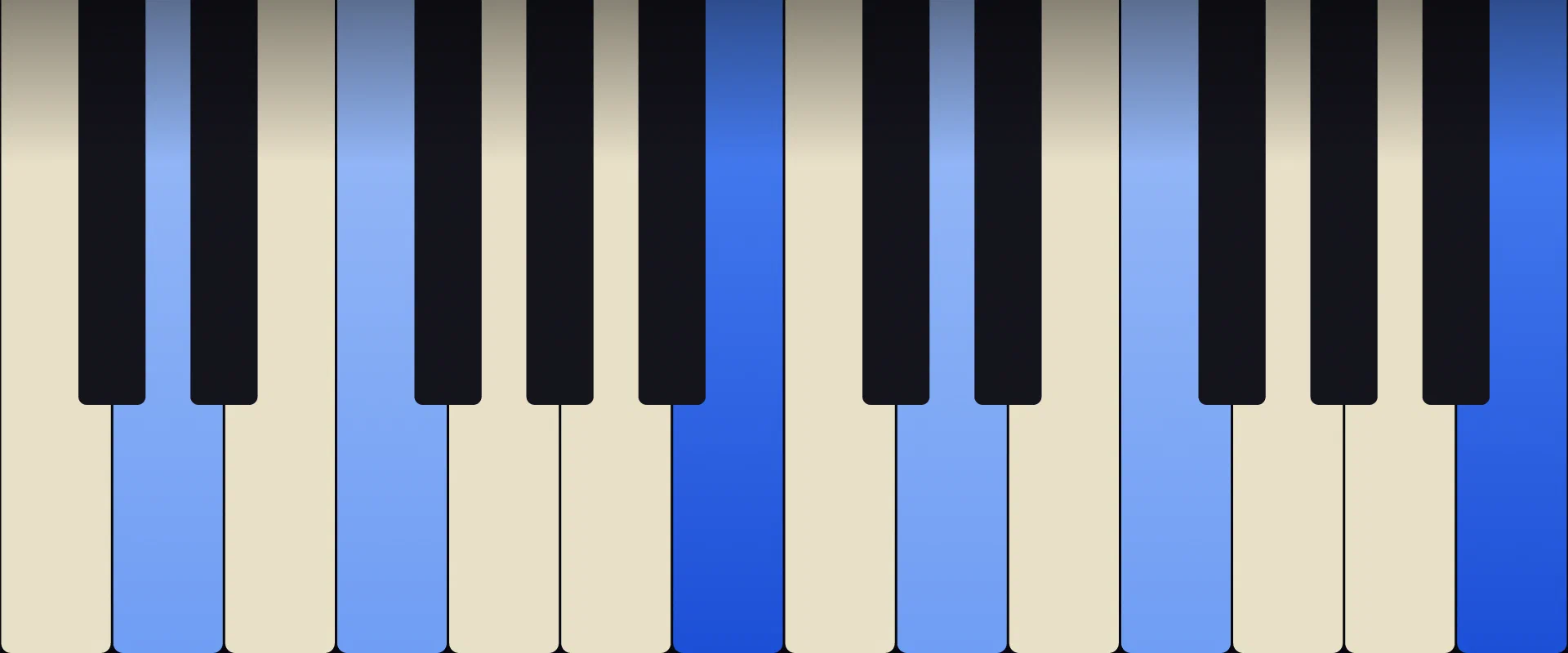
Start at B and play every other white key: B, D, F. That is a diminished triad, spelled without a single sharp or flat. Of the twelve diminished chords it is the only one that can be built without touching a black key, and it is also the one the textbooks reach for first, because it is what appears when you stack thirds on the seventh degree of C major.
That coincidence is worth more than it looks. Diminished chords have a reputation as exotic imports, borrowed from jazz or from horror soundtracks. They are not. The plainest scale in music, the one with no key signature at all, contains exactly one of them, and this is it.
Try It: Bdim in the Chord Finder
The Notes of Bdim
| Degree | Note | Interval from Root | Semitones |
|---|---|---|---|
| 1 (Root) | B | Perfect unison | 0 |
| ♭3 | D | Minor 3rd | 3 |
| ♭5 | F | Diminished 5th | 6 |
Six semitones from bottom to top, exactly half an octave: the tritone. In the C major scale, B and F are the only pair of notes that far apart, so this chord is where the scale keeps its one unstable interval. The top note is F and not E♯ because a fifth of any kind spans five letters, and B, C, D, E, F does that.
How Bdim Is Built
Start from B minor, B D F♯, and lower the fifth a semitone to F. From B major you would have to lower both upper notes, D♯ to D and F♯ to F, which is why diminished counts as two moves from major.
The better route is through the scale. Take C major, use nothing but white keys, and build a triad on each degree. C, F and G come out major, D, E and A come out minor, and B comes out different. The reason is precise: B to D contains the half step B to C, and D to F contains the half step E to F. The chord on the seventh degree is the only one in the key that swallows both of the scale’s half steps, and two narrow thirds stacked on each other are what a diminished triad is.
Add a fourth note and it splits into two families. B D F A is Bm7♭5, half diminished, which is what the seventh degree of C major produces. Flatten the A and you have B D F A♭, Bdim7, fully diminished, which belongs to C harmonic minor.
Bdim on the Piano
Three white keys and nothing else. Every other diminished triad needs at least one black key, so this is the shape for showing a beginner the sound before they have met an accidental.
The span is narrower than usual. A major or minor triad reaches seven semitones from root to fifth; this one reaches six, so the hand closes up slightly. Right hand, 1 on B, 3 on D, 5 on F, all fingers flat and level, nothing to arch over. Left hand, 5, 3, 1. Because the two thirds are the same size the fingers land evenly spaced, which is not true of C major or A minor either side of it.
The resolution is the part worth practising, and it also stays on the white keys. Hold B D F and let the outer notes squeeze inwards by a semitone each: B rises to C, F falls to E, and the D takes whichever of those is short of a voice. You land on C major without the hand leaving the ground it started on, which makes the reason this chord exists audible rather than theoretical. Both inversions stay white too, so D F B and F B D are the same hand rotated.
Bdim on the Guitar
There is no standard open shape, but two of the three notes are open strings already. D is the fourth string, B is the second, and F sits on the first string at fret 1. Play xx0x01 and you have D, B, F: a first inversion Bdim for one finger. It sounds thin and off balance, which suits a chord that is meant to be leaning somewhere.
Lean it into an open C, x32010, and watch each note move. The F on the top string drops a semitone to the open E. The open B rises a semitone to the C at the first fret of the second string. The whole leading tone resolution happens inside the first fret, and nothing else on the instrument shows it that cheaply.
For a movable root position grip, go to the middle strings: xx976x puts B on the fourth string at fret 9, D on the third at fret 7 and F on the second at fret 6. Three fingers, no barre, and it slides to any root. Down at the nut the tritone lands on adjacent strings a fret apart, B at fret 2 on the fifth string and F at fret 3 on the fourth, so x23x3x adds D on the second string and mutes the third. No barre, which is a mercy at fret 2, where the strings are widest spaced and tightest.
In practice, guitarists play the seventh far more often than the bare triad. x2313x gives B, F, A♭ and D, the fully diminished Bdim7, and since that is four minor thirds in a circle, the identical shape three frets higher, x5646x, holds the same four notes. One grip covers the neck in four positions and answers to four names: Bdim7, Ddim7, Fdim7 and A♭dim7 are one chord. Three shapes cover every diminished seventh there is.
Inversions
| Inversion | Notes | Bass Note |
|---|---|---|
| Root position | B D F | B |
| 1st inversion | D F B | D |
| 2nd inversion | F B D | F |
Classical practice almost never puts B in the bass. The standard form is first inversion, D F B, written vii°6, for an acoustic reason rather than a dogmatic one: with the root underneath, the tritone sounds against the lowest note and the chord’s instability becomes the loudest thing in it. Put D below and the same three pitches read as a light dominant.
Voicings
At the keyboard, keep B and F inside one hand so the tritone stays one object rather than spreading across the texture. For a fourth voice, double the D. Doubling the root or the fifth weights the tritone and pulls the ear to the part of the chord that wants to leave.
On guitar, xx976x extends neatly: add the A at fret 5 on the first string for xx9765, B D F A, the half diminished chord that opens a minor key ii, V, i.
Which Keys Contain Bdim
- VII of C major
- II of A natural minor
- VII of C harmonic minor
- II of A harmonic minor
- VII of C melodic minor
- VI of D melodic minor
Read that as two groups. In C major and in both altered forms of C minor it is the leading tone chord, so it belongs to C in every mode C comes in, despite containing no C. In A minor it is the supertonic.
Where Bdim Shows Up
| Progression | Numerals | Chords |
|---|---|---|
| Passing chord in C | I, vii°6, I6 | C, Bdim/D, C/E |
| Cadence in C | vii°6, I | Bdim/D, C |
| Minor key opener | ii°, V, i | Bdim, E, Am |
| Rootless dominant | V7 minus its root | G7 becomes Bdim |
The last row explains the other three. G7 is G, B, D and F. Remove the G and what remains is B, D and F, note for note. The diminished triad is a dominant seventh with its root taken away, which is why it pulls towards C just as hard: the tritone doing the pulling is the same tritone. Anywhere a G7 fits, Bdim does the same work with less weight underneath it.
The first row is the everyday use. C, then Bdim over D, then C over E walks the bass up C, D, E while the harmony barely moves. The chord is filling a step rather than going anywhere, which is what most diminished chords in written music are doing.
In A minor it rarely stays a bare triad. It picks up an A to become Bm7♭5, which is why half diminished turns up in jazz far more often than plain diminished. Take A♭ instead and you get Bdim7, a G7♭9 without its root: the same trick with one more note of tension. A great many diminished symbols in the standards repertoire are dominants in disguise.
Which is why the chord confuses people. It is named after a note it usually does not resolve to, and it works as the upper half of a chord whose root is not being played.
Related Chords
- B Major Chord
- C Major Chord
- B Locrian Scale
- What Are Intervals and How to Identify Them
- Secondary Dominants and Borrowed Chords
Learn More
Practice Chords
Drill chord recognition with a metronome, MIDI support, and score tracking.
Start PracticingRelated Articles
A Diminished Chord: Notes, Voicings, and How to Play It
Aug 22, 2026 · 8 min
B♭ Diminished Chord: Notes, Voicings, and How to Play It
Aug 22, 2026 · 8 min
C Diminished Chord: Notes, Voicings, and How to Play It
Aug 22, 2026 · 8 min