Spelled properly, B♭ diminished is B♭, D♭ and F♭. Two of those are black keys. The third has a flat sign in front of it and is played on a white key, the one everybody calls E. That is not a misprint. F♭ and E are the same pitch, and this chord genuinely needs the letter F. Working out why is most of what there is to learn here, because the sound itself, a stack of two minor thirds, is the least surprising thing on the page.
Try It: B♭dim in the Chord Finder
Set the root to B♭ and look at where the third note lands on the keyboard.
The Notes of B♭dim
B♭ diminished is a three note triad: B♭, D♭ and F♭.
| Degree | Note | Interval from B♭ | Semitones |
|---|---|---|---|
| 1 (root) | B♭ | Perfect unison | 0 |
| ♭3 | D♭ | Minor 3rd | 3 |
| ♭5 | F♭ | Diminished 5th | 6 |
Written B♭dim or B♭°. On a keyboard you press B♭, D♭ and the white key E.
How B♭dim Is Built
Start from B♭ minor, which is B♭, D♭ and F, and drop the 5th a semitone as well. Both notes above the root are now flattened and the outer interval shrinks from a perfect 5th to a tritone, which is what removes the chord’s stability.
The 5th has to keep the letter F. Count upwards from the root, B♭, C, D, E, F, and F is the fifth letter, so any chord built on B♭ spells its 5th as some kind of F: F for a perfect 5th, F♯ for an augmented one, F♭ for a diminished one. Call it E and the degree table stops lining up with the note names. So F♭ it is, sounding as E, and the whole chord sounds exactly like A♯, C♯, E played on the same keys.
Spelling depends on the whole chord, not just the root, and this one shows it neatly. Add a diminished 7th and the letter you need is a double flat, A♭♭, because the seventh letter up from B♭ is A. The spelling reference this site uses sidesteps that by naming the four note chord A♯dim7, where the same pitches come out as A♯, C♯, E and G. The plain triad keeps B♭ as its root, because one white key flat is a small price; the seventh chord changes its root name, because a double flat is not.
B♭dim on the Piano
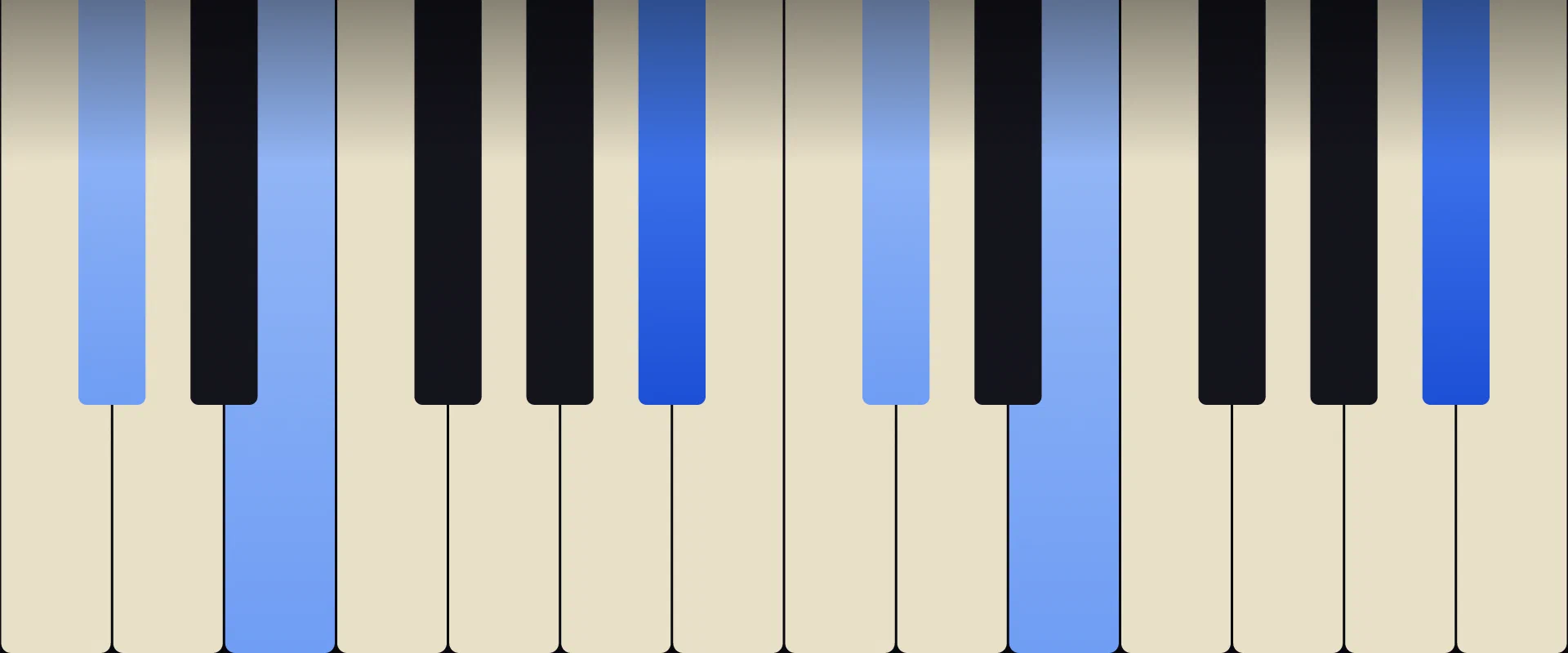
The hand shape is easier than the notation. Two black keys, B♭ and D♭, then the white key marked E, which is your F♭. The gaps are identical, three semitones each, so the fingers sit evenly spaced with no stretch anywhere.
Right hand, use 1 on B♭, 2 on D♭ and 4 on F♭. That keeps the hand compact and puts the fourth finger, rather than the little finger, on the note reaching forward to the white key. Some prefer 1, 3, 5; both work, but 1, 2, 4 transfers better once you add the seventh. Left hand, take 5 on B♭, 3 on D♭ and 1 on F♭, and let the thumb find E by feel. Reading F♭ and then hunting for it visually is what slows people down.
The shape stops being even under inversion. Root position stacks 3 semitones then 3; first inversion, D♭ F♭ B♭, stacks 3 then 6. The triad has a clear top and bottom, unlike the four note diminished seventh, which repeats every three semitones in every inversion. That symmetry is why the seventh can be respelled from any of its four notes, and why it ends up written A♯dim7.
B♭dim on the Guitar
No open chord exists for this root, and diminished triads are almost never played as full six string shapes anyway. They live as movable three note grips.
The one to learn has its root on the fifth string. At the 1st fret that is index on the A string at fret 1 for B♭, middle on the D string at fret 2 for F♭, ring on the B string at fret 2 for D♭, with the G string and both outer strings muted. Fret 1 is a stiff place to work, but three fingers is not a barre, so the difficulty here is the muting rather than the pressure.
One grip does use an open string, though it is a partial rather than an open chord: ring finger on the G string at fret 3 for B♭, middle on the B string at fret 2 for D♭, top E string left open. That open string is your F♭, which puts the answer to the whole spelling question straight into the guitarist’s hands.
In practice you will more often meet the four note version. Fret the A string at 1, the D string at 2 and the B string at 2, and leave the G string open, for the diminished seventh grip, sounding B♭, F♭, A♭♭ and D♭. The open string is the A♭♭, and stopping it at fret 1 instead raises it to A♭ and turns the chord half diminished. The diminished seventh is symmetrical, so the same shape with its root at frets 4, 7 and 10 gives the same four pitches in a different order, which is why guitarists treat diminished harmony as one repeating shape rather than twelve chords.
Inversions
| Inversion | Notes | Bass note | Symbol |
|---|---|---|---|
| Root position | B♭ D♭ F♭ | B♭ | B♭dim |
| 1st inversion | D♭ F♭ B♭ | D♭ | B♭dim/D♭ |
| 2nd inversion | F♭ B♭ D♭ | F♭ | B♭dim/F♭ |
Slash notation gets uncomfortable here. B♭dim/F♭ is correct and almost nobody writes it, because a symbol with a flatted E underneath looks like an error on a lead sheet. Arrangers who want that bass note rename the whole chord instead.
The inversion that does get used is the first, with D♭ in the bass, because it buries the tritone in the upper voices where it reads as colour rather than tension. See Chord Inversions and Voice Leading for how to move in and out of it cleanly.
Voicings
Keep the tritone off the bottom. B♭ and F♭ close together below middle C turn into a growl with no discernible pitch, so spread it: B♭ in the left hand, D♭ and F♭ up in the right.
The chord improves once something sits underneath it. Put G♭ in the bass and B♭, D♭, F♭ become the 3rd, 5th and 7th of G♭7, a dominant seventh with its root missing. Put G there instead and the same three notes become Gdim7. Neither asks you to move a finger, and both are far more common in real music than the bare triad alone. That is the practical route into Seventh Chords: The Complete Guide.
Which Keys Contain B♭dim
Spelled as B♭, D♭ and F♭, this triad is the vii° of C♭ major and the ii° of A♭ minor. Both carry seven flats, both are remote, and neither has a scale page here, because composers write B major and G♯ minor instead. The scales on this site containing these three pitches all spell the chord the sharp way, as A♯dim:
- vii° of B major
- vii° of B harmonic minor
- vii° of B melodic minor
- ii° of G♯ natural minor
- ii° of G♯ harmonic minor
- vi° of C♯ melodic minor
Where B♭dim Shows Up
Be honest about this one: you will rarely meet the bare triad spelled this way. It turns up inside something larger, and two cases are worth knowing on sight. The first is a dominant with no root:
B♭dim | C♭
a vii° resolving to its tonic, which is the same motion as G♭7 to C♭. Every voice moves by a semitone or stays put, so the resolution sounds inevitable even though the chord starting it has no root.
The second is the minor ii V i, where the chord grows a 7th and turns half diminished:
B♭ø7 | E♭7 | A♭m
Here B♭, D♭, F♭ and A♭ are the ii of A♭ minor, and this cadence is the standard approach to any minor tonic in jazz. A♭ minor is written far more often than C♭ major, so of the two flat side functions this is the one you will see.
Everywhere else, listen for the sound rather than reading for the spelling: held between two chords a semitone apart it is a passing chord, which a sharp key arranger writes as A♯dim on the way from A to B. Connectors like that are covered in Secondary Dominants and Borrowed Chords.
Related Chords
- B♭ Major Chord, the same root with both upper notes a semitone higher.
- Diatonic Chords: A Beginner’s Guide, on why the diminished triad lands on the seventh degree.
- Extended Chords and Jazz Harmony, on stacking further thirds above it.
- The ii V I Progression in Jazz, which works through the minor version.
Learn More
Practice Chords
Drill chord recognition with a metronome, MIDI support, and score tracking.
Start PracticingRelated Articles
A Diminished Chord: Notes, Voicings, and How to Play It
Aug 22, 2026 · 8 min
B Diminished Chord: Notes, Voicings, and How to Play It
Aug 22, 2026 · 8 min
C Diminished Chord: Notes, Voicings, and How to Play It
Aug 22, 2026 · 8 min