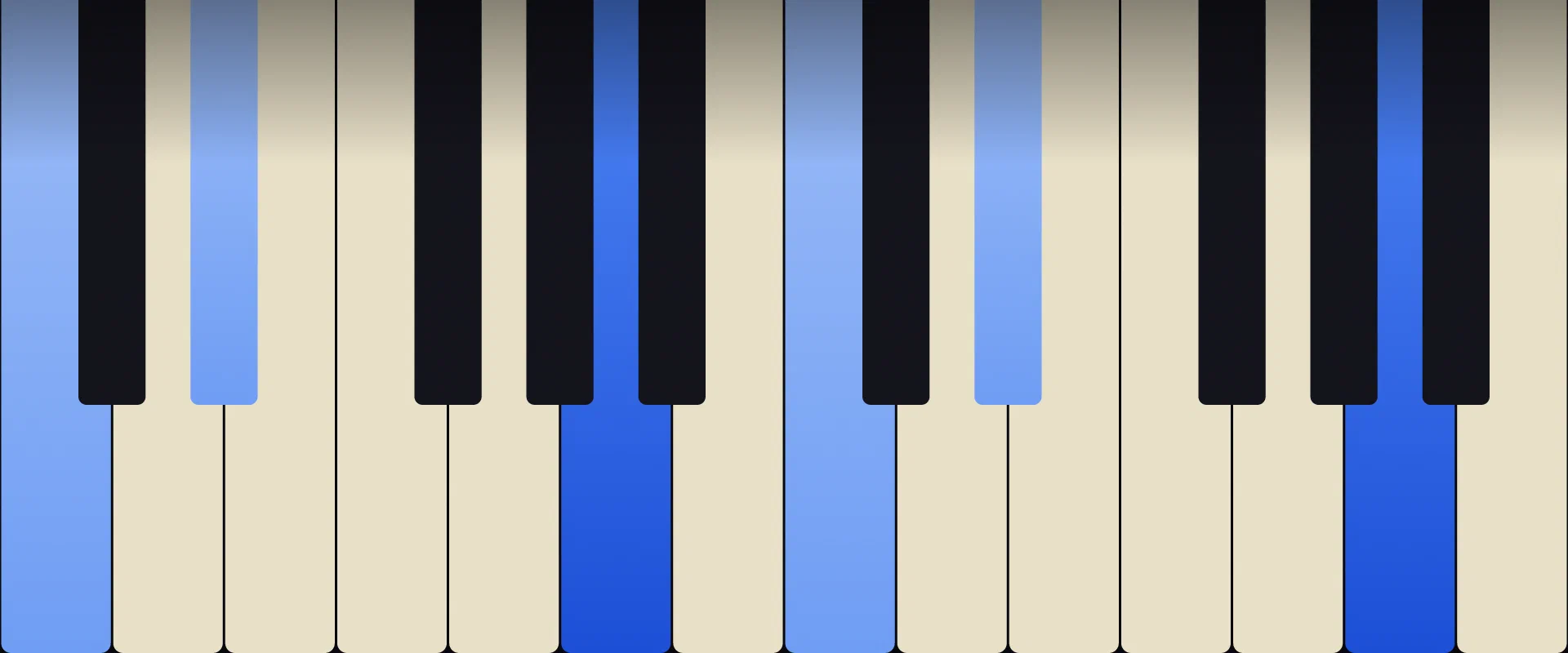
Play A, C and E. Now move the top note down one key, so E becomes E♭, and hold it. Nothing else has changed and everything has: the chord has stopped being somewhere you can sit and become somewhere you have to leave. That is A diminished, A, C and E♭, and it is worth doing before reading another sentence, because one finger sliding a semitone demonstrates the character of a diminished triad better than any description can.
The bare chord is rare. With nothing on top, A diminished works as the leading note triad of B♭ major and the supertonic of G minor, and in both roles it passes by in under a beat. Add a seventh and it becomes something players use constantly.
Try It: Adim in the Chord Finder
Play A minor first, then switch to the diminished triad and watch the top note drop onto the black key beside it.
The Notes of Adim
| Degree | Note | Interval from root | Semitones |
|---|---|---|---|
| 1 (root) | A | Perfect unison | 0 |
| ♭3 | C | Minor 3rd | 3 |
| ♭5 | E♭ | Diminished 5th | 6 |
Written out: A, C, E♭. One accidental, and it falls where the eye expects, on a black key.
The spelling deserves a moment. The black key between D and E is E♭ here and never D♯, because a triad has to read as a stack of thirds: A, C, E with the E altered. Spell it A, C, D♯ and the top interval becomes an augmented 2nd, and the rules about how the chord resolves stop applying.
A to C and C to E♭ are both minor 3rds, so the chord has no obvious weight at either end, and A up to E♭ is a tritone, exactly half an octave.
How Adim Is Built
The nearest chord is A minor, one semitone away at the fifth. Lower that E and the perfect 5th holding the chord upright becomes a diminished 5th that pulls inwards from both ends. Coming from A major instead, both upper notes move down: C♯ to C and E to E♭.
What sits on top decides how the chord gets used. Add G for Am7♭5, the half diminished chord that opens a minor ii V i. Add G♭ for Adim7, fully diminished, four notes a minor 3rd apart. That four note version is far more common in real music than the bare triad.
Adim on the Piano
Two white keys and one black, with the black one on top, which is the least comfortable of the three possible arrangements. A sits wedged between the second and third keys of the group of three, C sits in front of the group of two, and E♭ is the right hand key of that pair. The hand leaves one black key group, crosses a white key, and climbs back onto a black key.
Use right hand 1, 2 and 4: thumb on A, index on C, ring finger on E♭, which keeps the little finger off a raised key and lets the hand tilt forward as a unit. Reaching for E♭ with the fifth finger twists the wrist outwards.
The drill that teaches the sound is the one from the opening. Set the hand on A, C and E, then move only the top finger. It travels back into the keyboard as well as to the left, because E♭ sits behind the front edge of E, so the whole hand shifts forward to meet it. That shift is the physical signature of the chord: A diminished asks the hand to sit deeper in the keys than A minor does.
Because the two 3rds are narrow, the chord clouds quickly low down. Keep A below middle C on its own, or leave the root to a bass instrument and play the tritone C and E♭ alone.
Adim on the Guitar
A minor has one of the friendliest open shapes on the instrument. A diminished, a single semitone away, has no standard open shape at all, and the reason explains a great deal about why some chords are easy on guitar and others are not.
Standard tuning is E, A, D, G, B, E. Every open string comes from the small pool of notes that A minor and E minor are made of, so those chords collect free notes and free sustain simply by existing. A diminished needs an E♭, which is not in that pool, and the note it has to remove is E, which sits on two open strings. The harmony has barely moved and the instrument has withdrawn its help.
You can still derive the shape from A minor. Take x 0 2 2 1 0, move the finger on the D string back from the 2nd fret to the 1st, and mute the top string, giving x 0 1 2 1 x. Middle finger takes E♭, ring finger stays on the G string at the 2nd fret, index sits on the B string at the 1st fret and leans far enough to deaden the top string. Low to high that sounds A, E♭, A and C. Few chord books carry it, but it makes the one note argument audible and keeps the root in the bass.
In practice guitarists play the fully diminished seventh instead, and the first position grip is x x 1 2 1 2: E♭, A, C and G♭. Because those notes are spaced in equal minor 3rds, the same shape moved up three frets gives the same four notes again. Adim7, Cdim7, E♭dim7 and G♭dim7 are one chord under four names, so a player learns only three diminished seventh shapes to cover twelve roots. The bare triad has no such trick, another reason it stays in the background.
Inversions
| Inversion | Notes | Bass | Symbol |
|---|---|---|---|
| Root position | A C E♭ | A | Adim |
| 1st inversion | C E♭ A | C | Adim/C |
| 2nd inversion | E♭ A C | E♭ | Adim/E♭ |
First inversion is the normal one. Classical practice puts the third of a diminished triad in the bass, so Adim/C appears on the page far more often than root position. It keeps the tritone out of the bass, where it sounds harsh, and lets the bass move by step in the passing figure where this chord earns its living.
Second inversion puts E♭ underneath and is correspondingly unstable.
Voicings
| Voicing | How to play it |
|---|---|
| Guitar, derived from Am | x 0 1 2 1 x, root on the open fifth string |
| Adim7, first position | x x 1 2 1 2, repeats every three frets |
| Am7♭5 | x 0 1 0 1 x, half diminished, open G string |
| Piano, root position | Right hand 1, 2 and 4 on A, C and E♭ |
| Piano, first inversion | C and E♭ in the right hand over A in the left |
| Piano, tritone only | C and E♭ alone, root left to the bass |
The last is the one arrangers use: two notes carry the identity.
Which Keys Contain Adim
- vii° of B♭ major
- ii° of G natural minor
- ii° of G harmonic minor
- vii° of B♭ harmonic minor
- vii° of B♭ melodic minor
- vi° of C melodic minor
Two of these do the real work. In B♭ major this is the leading note triad, and it behaves like a dominant because it is one: F7 is F, A, C and E♭, so A diminished is that dominant minus its root. In G minor it is the supertonic, the step that walks into D7 and then home.
Where Adim Shows Up
| Progression | In this key | Chords |
|---|---|---|
| I, vii°6, I6 | B♭ major | B♭, Adim/C, B♭/D |
| ii°, V, i | G minor | Adim, D7, Gm |
| iiø7, V7, i | G minor | Am7♭5, D7, Gm |
| Chromatic ascent | B♭ major | B♭, Adim/C, B♭/D, E♭ |
The first row is the classic use and explains why first inversion matters. The bass climbs B♭, C, D by step while the harmony above barely shifts, and the diminished chord in the middle is a passing event rather than a destination. Bach chorales are full of it, and so is hymn writing, where a bass line that walks is worth more than a chord that surprises.
The keys point at particular players. B♭ major is the home key of the wind band: trumpets, clarinets and tenor saxophones are pitched in B♭ and read it as C major, so concert band, brass band and traditional jazz all live there. A diminished turns up far more often in that music than a guitarist would guess.
G minor is the other side of it. Am7♭5 to D7 to Gm is one of the first minor ii V i progressions a jazz student drills, and a B♭ instrument reads those same chords as Bm7♭5, E7 and Am.
The fully diminished seventh has a use the triad cannot match. Because Adim7 divides the octave evenly, it sits plausibly in several keys at once, so composers use it as a hinge: arrive in one key, hold the chord, leave in another. Nineteenth century opera runs on the device, and so did silent film accompaniment, which is where the chord got its reputation for melodrama.
Related Chords
- A Minor Chord the chord one semitone away
- A Major Chord for the same root with both upper notes raised
- Seventh Chords: The Complete Guide for Adim7 and Am7♭5
- Chord Inversions and Voice Leading for why first inversion is the default here
- Secondary Dominants and Borrowed Chords
Learn More
Practice Chords
Drill chord recognition with a metronome, MIDI support, and score tracking.
Start PracticingRelated Articles
B Diminished Chord: Notes, Voicings, and How to Play It
Aug 22, 2026 · 8 min
B♭ Diminished Chord: Notes, Voicings, and How to Play It
Aug 22, 2026 · 8 min
C Diminished Chord: Notes, Voicings, and How to Play It
Aug 22, 2026 · 8 min