Every guitarist has played G♯ B D thousands of times. Take an open E7, the shape learned in the first month of playing, and remove the E: what is left is exactly these three notes. That is not a coincidence, and it is the shortest route into a chord that otherwise looks forbidding. G♯dim is the leading tone triad of A major, a key built out of open strings and beginner shapes, so the most awkward looking chord in the set belongs to one of the friendliest keys on the instrument.
Try It: G♯dim in the Chord Finder
The Notes of G♯dim
| Degree | Note | Interval from root |
|---|---|---|
| 1 | G♯ | Perfect unison |
| ♭3 | B | Minor 3rd, 3 semitones |
| ♭5 | D | Diminished 5th, 6 semitones |
Written low to high in root position: G♯ B D.
Two minor 3rds stacked, G♯ to B and B to D, with a tritone from bottom to top. That even spacing is what makes the chord restless: no perfect 5th to sit on, and an outer interval every ear treats as unfinished.
How G♯dim Is Built
Start from G♯m, which is G♯ B D♯, and lower the 5th a semitone. D♯ becomes D, and the top finger steps off a black key onto the white one below it. Minor lowers one note compared with major, diminished lowers two, so neither note above the root sits where major put it.
The spelling is worth a moment, because these same three keys could in principle be named from A♭. They cannot usefully be. A diminished triad on A♭ has to be spelled A♭ C♭ E𝄫, since the letters of a triad on A are always A, C and E. That E𝄫 is an E double flat and it is played on the white key D: three plain keys, two accidentals and a double flat to describe them. So the reference writes G♯dim here, for the same reason it writes the minor chord on this key as A♭m in flat music. The name that keeps the page readable wins.
G♯dim on the Piano
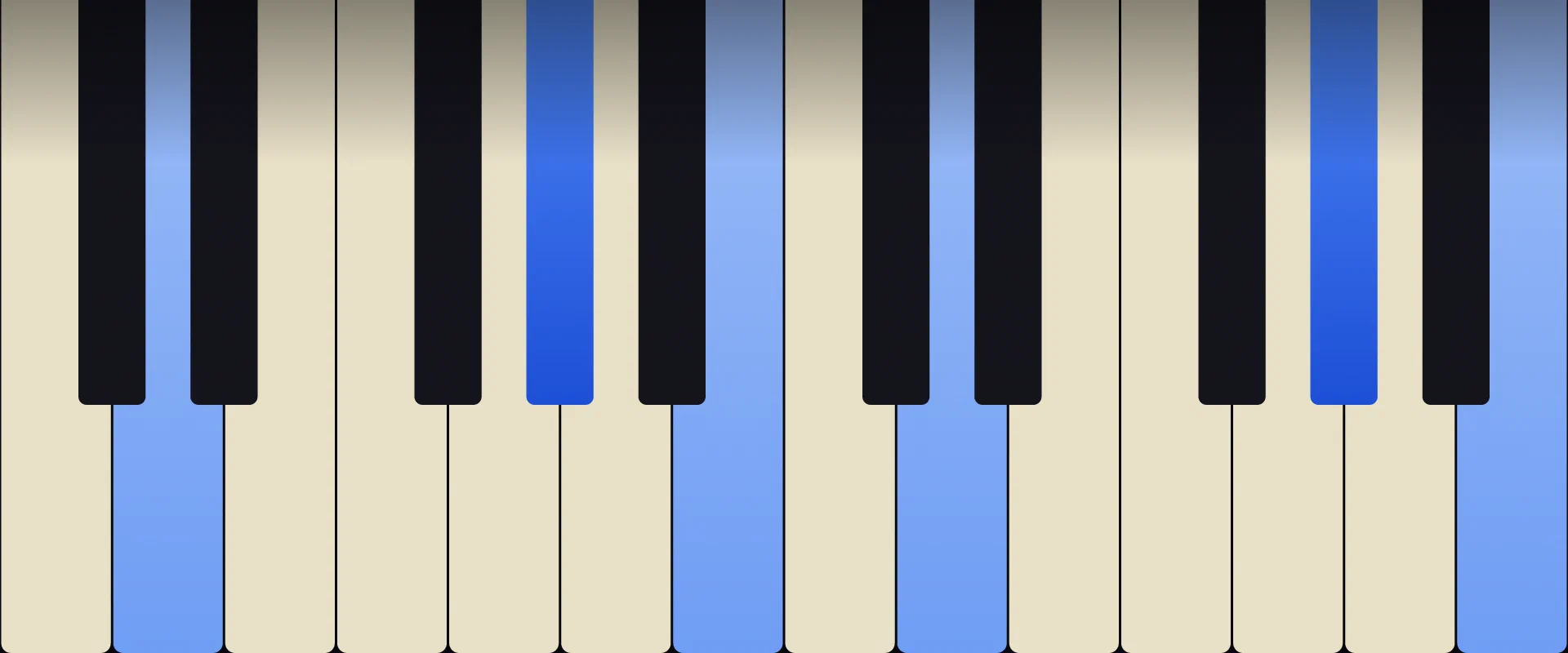
One black key at the bottom, two white keys above it, and the hand ends up flatter than it does for G♯m. Right hand root position is 1 on G♯, 3 on B, 5 on D, left hand 5, 3, 1. The thumb sits forward on the black key, and both B and D can be taken well back between their neighbouring black keys, so the grip stays in one plane instead of reaching out to the front edge.
What separates this chord from every major and minor triad is that the shape survives being moved. Both gaps are three semitones, so the same hand position slid up a minor 3rd gives Bdim, again gives Ddim, again gives Fdim, and one more move returns you to G♯. Four positions, one fingering.
Those four are not unrelated chords either. Add F to G♯ B D and you get G♯dim7, and G♯ B D F are precisely the notes the sliding grip visits. That block has no top and no bottom in any real sense, which is why pianists learn the diminished family as one symmetrical unit rather than as twelve separate chords.
Practise it against the G♯m it comes from, alternating D♯ and D under the fifth finger.
G♯dim on the Guitar
The textbook position is a movable three note shape rooted on the 5th string at the 11th fret. Almost nobody plays it there: the frets are cramped that far up, no open string can help, and on an acoustic the body is already in the way.
Two much better shapes sit low on the neck. For root position, take the D string at the 6th fret (G♯), the G string at the 4th (B) and the B string at the 3rd (D), written x x 6 4 3 x. Three fingers, no barre, and it sits in the middle of the guitar’s range where it stays clear of a bass part. For first inversion, play the G string at the 4th fret, the B string at the 3rd and the top E at the 4th, written x x x 4 3 4. That one can be grabbed in passing, which matters, because this chord is almost always passing through.
Guitarists in practice reach for the fully diminished seventh rather than the bare triad. The grip at 4 5 3 4 x x adds F on the D string and roots G♯dim7 on the 6th string. Higher up, x 11 12 10 12 x is the standard closed dim7 shape, and shifting the G string note from the 10th fret to the 11th turns it into G♯m7♭5, the half diminished chord that acts as ii in F♯ minor.
And the open E7 is always there to fall back on. Play it with the low string muted and you have this chord, ringing open, at the 1st fret.
Inversions
| Inversion | Notes low to high | Bass note |
|---|---|---|
| Root position | G♯ B D | G♯ |
| 1st inversion | B D G♯ | B |
| 2nd inversion | D G♯ B | D |
The bass note does more here than it does under a stable triad, because it tells the ear which way the tritone will unwind. With G♯ underneath, the bass rises a semitone to A. With B underneath the chord sounds like an E7 that has lost its root, so it points at A or at F♯m. With D underneath, the bass tends to fall a semitone to C♯, which is why this chord turns up over a D bass in so many descending lines.
Voicings
The bare triad is rare on its own. Adding the diminished 7th gives G♯dim7 (G♯ B D F), the version that appears in almost all real music. A minor 7th instead gives G♯m7♭5 (G♯ B D F♯), which does a different job: half diminished chords open minor key cadences rather than pass between other chords.
At the piano, put the tritone G♯ and D in the left hand and B D F in the right, and the chord sounds full without being loud. Reduce it to G♯ and D alone and the identity survives, because the tritone is the part the ear tracks.
Which Keys Contain G♯dim
- VII of A major
- VII of A harmonic minor
- VII of A melodic minor
- II of F♯ natural minor
- II of F♯ harmonic minor
- VI of B melodic minor
Two families, two lives. Keys built on A treat G♯ as the leading note, so the chord pushes up into the tonic. Keys built on F♯ treat it as the second degree, so it becomes a supertonic heading for the dominant.
Where G♯dim Shows Up
The key of A major is the point. On guitar it is close to free: A, D and E are open shapes, F♯m, Bm and C♯m are ordinary barres, and then there is this, the one diatonic chord in the key with no comfortable form. So players do not play it. They play E7 over a G♯ bass, or let the bass line supply the G♯ under an open A shape. The chord is in almost every song in the key, wearing a different name.
| Progression | In letters | Where it lives |
|---|---|---|
| I, vii°, vi | A, G♯dim, F♯m | Descending bass in the key of A |
| i, ii°, V7, i | F♯m, G♯dim, C♯7, F♯m | Minor key cadence |
| vii°7, i | G♯dim7, Am | Leading tone into A minor |
The first is the one to internalise. A moves to F♯m by walking the bass down A, G♯, F♯, and the chord over that middle step is this one. Folk, country and guitar pop run on it, and the guitarist writes it as E7/G♯ without ever thinking the word diminished.
The second belongs to written music rather than chord charts. In F♯ minor, G♯dim is the ii chord, and since a diminished triad cannot hold up a phrase it moves on at once, usually into C♯7 and home. Classical writing and film scoring lean on it there.
The third is where the seventh earns its place. In A minor the G♯ comes from the harmonic minor, and G♯dim7 resolving to Am is one of the oldest gestures in tonal music. Jazz players know the chord from the other side: E7♭9 is E G♯ B D F, so removing the root leaves G♯dim7 exactly. A dim7 played a semitone above a dominant root is the standard way to get a ♭9 without adding a note, and in the key of A that dim7 is this chord.
Related Chords
- G♯ Locrian Scale the one mode whose home chord is this diminished triad
- A♭ Major Chord for the same keyboard root spelled the other way
- Seventh Chords: The Complete Guide for G♯dim7 and G♯m7♭5
- Secondary Dominants and Borrowed Chords for diminished chords as passing harmony
- A Harmonic Minor Scale and F♯ Natural Minor Scale
Learn More
Practice Chords
Drill chord recognition with a metronome, MIDI support, and score tracking.
Start PracticingRelated Articles
A Diminished Chord: Notes, Voicings, and How to Play It
Aug 22, 2026 · 8 min
B Diminished Chord: Notes, Voicings, and How to Play It
Aug 22, 2026 · 8 min
B♭ Diminished Chord: Notes, Voicings, and How to Play It
Aug 22, 2026 · 8 min