The quickest way to meet Gdim is to play G minor first. Put down G, B♭ and D, then slide the top note back one semitone to D♭. One finger has moved, from a white key to a black one, and the chord has gone from stable to actively unhappy: it now wants to land on A♭, or to fall into F minor by way of C7. Practise it as a pair rather than in isolation.
The three notes are G, B♭ and D♭. Only the root is a white key. The fifth is spelled D♭ and not C♯ even though your finger lands on exactly the same black key, because every triad stacks letters in thirds: G needs a B and then a D of some sort. Write it as C♯ and the chord stops being a G chord on paper.
Try It: Gdim in the Chord Finder
The Notes of Gdim
| Degree | Note | Interval from Root | Semitones |
|---|---|---|---|
| 1 (Root) | G | Perfect unison | 0 |
| ♭3 | B♭ | Minor 3rd | 3 |
| ♭5 | D♭ | Diminished 5th | 6 |
Written Gdim or G°. The outer interval is six semitones, a tritone, which is what makes the chord sound unresolved no matter how quietly you play it.
How Gdim Is Built
Stack two minor 3rds on G and you have it: three semitones from G to B♭, then three more from B♭ to D♭. Two identical intervals, one on top of the other, with no perfect 5th anywhere to steady the result.
Coming at it from the other direction is more useful for a player. G major is G B D. Flatten the B for G minor, flatten the D as well for Gdim. Each step removes stability, and by the second one the top note has stopped being a resting point and become a pull.
Beyond the triad sits Gdim7, adding a fourth note another minor 3rd up. It is spelled F♭ and sounds as E on the keyboard. That chord is far more common in real music than the bare triad, for reasons the guitar section makes obvious.
Gdim on the Piano
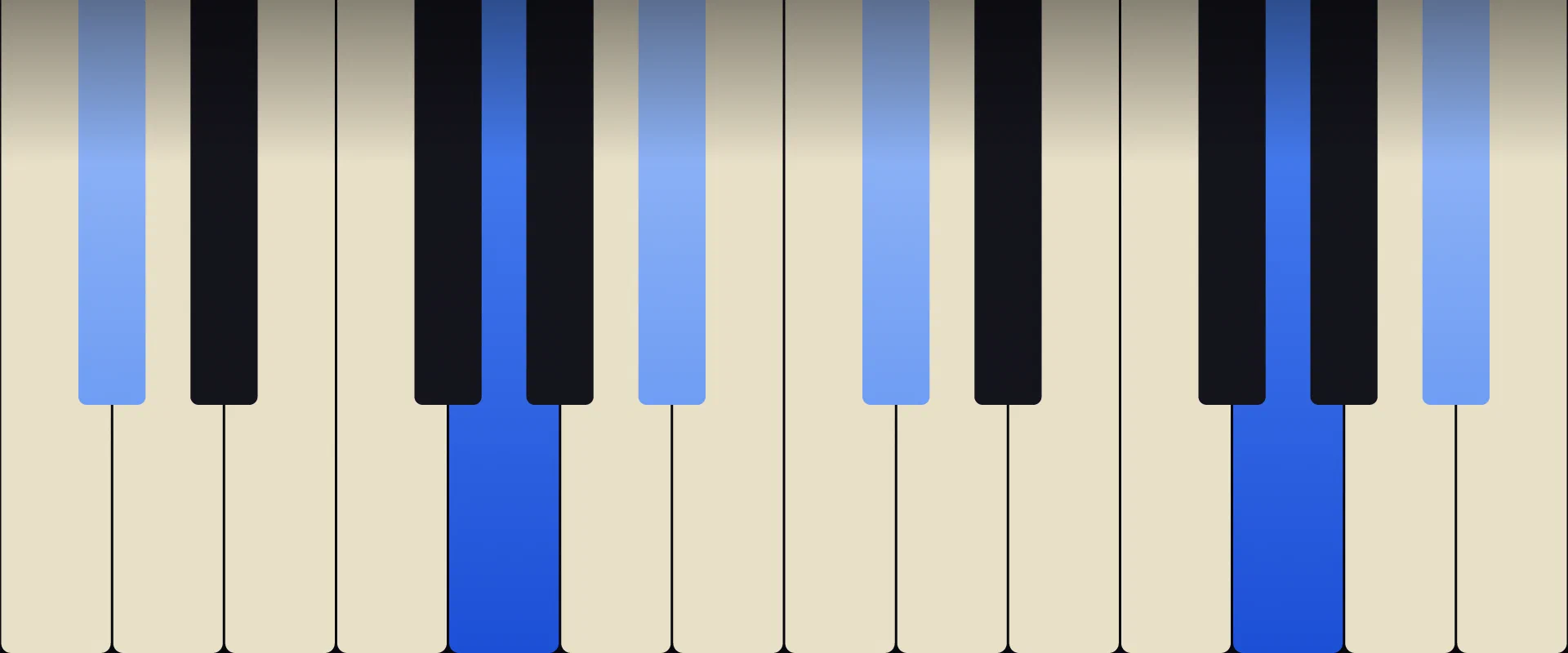
Two black keys and one white, and the blacks come from different groups. B♭ is the last of the group of three; D♭ is the first of the group of two. The shape steps off a white key, on to the end of one black cluster and then the start of the next, which puts the hand deep towards the fallboard and keeps it there.
Use 1 on G, 2 on B♭ and 4 on D♭ rather than the textbook 1, 3, 5. The little finger is the weakest of the five and D♭ sits further back than the keys around it, so asking finger 5 to reach it costs security for no gain. With 1, 2, 4 the hand stays compact, which suits a chord spanning only six semitones.
Now practise the resolution rather than the chord. Put B♭ in the bass, so the notes read B♭, D♭, G. Let B♭ fall a tone to A♭, D♭ fall a semitone to C, and G rise a semitone to A♭. You arrive on A♭ major with the root doubled, and no voice has moved further than a whole step. That is Gdim doing its day job as the leading tone chord of A♭.
The second destination is F minor, where Gdim is the chord on the second degree. The standard route is Gdim over B♭, then C7, then F minor. Play those three and the chord stops sounding like a special effect and starts sounding like a hinge.
Gdim on the Guitar
There is no open form and there is not going to be one: neither B♭ nor D♭ appears among the open strings. Every diminished triad on the guitar is a movable three note grip, which is a feature rather than a shortage.
Two grips cover most situations. On the middle strings, x x 5 3 2 x puts G on the 4th string at the 5th fret, B♭ on the 3rd at the 3rd fret and D♭ on the 2nd at the 2nd fret. It falls under the hand in one position. Further along the neck, x 10 8 6 x x roots the chord on the 5th string at the 10th fret with B♭ and D♭ descending on the 4th and 3rd strings. The frets are cramped that high, but the voicing is clean and sits well above a bass line.
Because neither grip uses an open string, both are fully portable. Slide x x 5 3 2 x up two frets and it is A diminished, up five and it is C diminished, fingering untouched. That is the opposite of the major and minor situation, where the open shapes at the nut are special cases you learn first and then have to convert into barres. A diminished triad has no home position to unlearn, so twelve chords cost one shape.
The four note version is better still. Gdim7 is x x 5 6 5 6, a compact two fret block on the top four strings, and perfectly symmetrical. Move it up three frets to x x 8 9 8 9 and the four pitches are unchanged, merely reordered. That is why guitarists learn the diminished seventh first: one grip, moved in steps of three frets, covers the neck, and each position can be named after any of its four notes.
Inversions
| Inversion | Notes | Bass | Symbol |
|---|---|---|---|
| Root position | G B♭ D♭ | G | Gdim |
| 1st inversion | B♭ D♭ G | B♭ | Gdim/B♭ |
| 2nd inversion | D♭ G B♭ | D♭ | Gdim/D♭ |
First inversion is the one that gets used. Classical part writing almost always puts the third in the bass here, because B♭ steps smoothly to A♭ while a bass note a tritone from the root of the key sounds harsh. In a figured bass you would see it as a sixth chord, not as a root position chord at all.
Second inversion, with D♭ underneath, is rare in common practice writing but useful in a jazz context, where the chord is more likely to be a fragment of a dominant than a triad in its own right.
Voicings
Keep the tritone open. G and D♭ crushed together below the stave turn into a rumble that reads as noise rather than harmony. Put G low, B♭ in the middle and D♭ above middle C, and the interval sounds like tension instead of mud.
On guitar, resist strumming the triad as a block. It works best as a passing grip, held for a beat between two stable chords. For jazz or gospel, reach for x x 5 6 5 6 instead, which has more weight and a clearer sense of direction.
Which Keys Contain Gdim
Gdim is the diatonic triad on these six degrees:
- vii of A♭ major
- ii of F natural minor
- ii of F harmonic minor
- vi of B♭ melodic minor
- vii of G♯ harmonic minor
- vii of G♯ melodic minor
The last two are the same three keys under your fingers, written from G♯’s point of view, so the letter names differ while the sound does not. The other four are flat key contexts, which is the honest summary: if you are meeting this chord you are almost certainly reading a chart in A♭ or F minor.
Where Gdim Shows Up
| Progression | Chords | Typical use |
|---|---|---|
| Gm, Gdim, A♭ | Gm, Gdim, A♭ | The one finger move |
| vii, I in A♭ major | Gdim/B♭, A♭ | Leading tone resolution |
| ii, V, i in F minor | Gdim/B♭, C7, Fm | Minor key cadence |
| i, ii, V, i | Fm, Gdim, C7, Fm | Chorale and hymn writing |
| I, vii7, vi7 | A♭, Gdim7, Fm7 | Gospel and jazz passing chord |
| Substituting for E♭7♭9 | Gdim7, A♭maj7 | Jazz dominant substitution |
The last two rows are where this chord earns a living. In the gospel move, Gdim7 sits between A♭ and Fm7 purely so the bass can walk down A♭, G, F instead of jumping a third. Nobody hears a diminished chord; they hear a smooth descent.
The substitution is the more powerful idea. E♭7♭9 is E♭, G, B♭, D♭, F♭. Remove the root and what is left is exactly Gdim7, so whenever a chart calls for the altered dominant of A♭ you can play the diminished grip and let the bass supply E♭. Because Gdim7 is symmetrical it does the same for three other dominants, so one shape resolves to A♭, B, D or F depending on the bass underneath it.
The bare triad’s own habitat is narrower: hymn and chorale writing, ragtime and barbershop, and the theatre pit, where it became such a reliable signal of impending doom in silent film accompaniment that it has never quite lived the association down. G locrian takes this chord as its tonic, which tells you how little sense it makes as a resting place.
Related Chords
- G Minor Chord, one semitone away on the fifth
- G Major Chord, the stable end of the same family
- Seventh Chords: The Complete Guide for Gdim7 and Gm7♭5
- Extended Chords and Jazz Harmony for the ♭9 dominants this chord hides inside
- Secondary Dominants and Borrowed Chords for passing diminished chords
- The G Locrian Scale
- The A♭ Major Scale
- Guitar Chord Shapes: The CAGED System
Learn More
Practice Chords
Drill chord recognition with a metronome, MIDI support, and score tracking.
Start PracticingRelated Articles
A Diminished Chord: Notes, Voicings, and How to Play It
Aug 22, 2026 · 8 min
B Diminished Chord: Notes, Voicings, and How to Play It
Aug 22, 2026 · 8 min
B♭ Diminished Chord: Notes, Voicings, and How to Play It
Aug 22, 2026 · 8 min