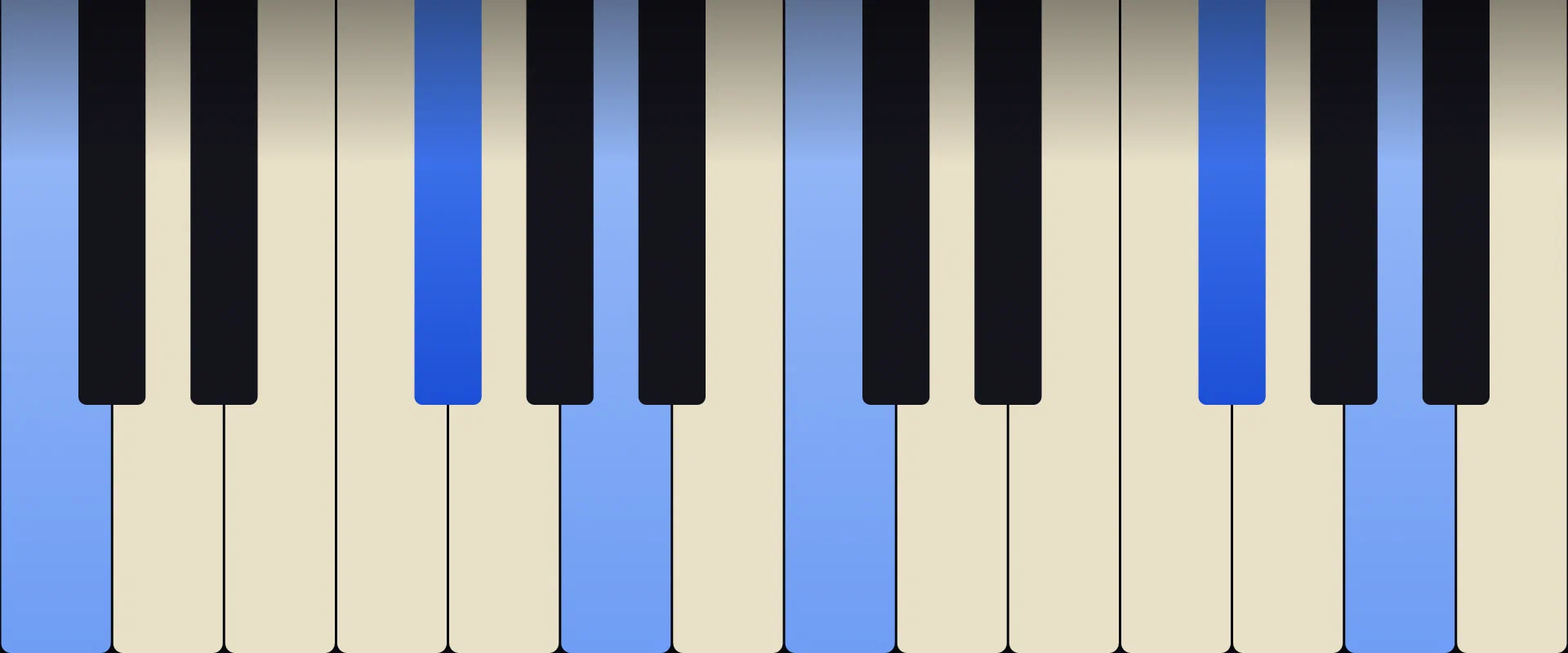
Read the symbol, then read the notes, and the two do not match. F♯dim looks like something out of a late Romantic score. It is F♯, A and C: one black key and two of the plainest white keys on the instrument, all three belonging to C major and to A minor. A beginner who has learned nothing beyond the white keys already owns two thirds of it.
It has the friendliest address of any diminished triad too. F♯dim is the vii of G major, a key of one sharp, which makes it the diminished chord a learner is most likely to need.
Try It: F♯dim in the Chord Finder
The Notes of F♯dim
F♯ diminished contains three notes.
F♯, A, C
| Degree | Note | Interval from root | Semitones |
|---|---|---|---|
| 1 | F♯ | Root | 0 |
| ♭3 | A | Minor 3rd | 3 |
| ♭5 | C | Diminished 5th | 6 |
Six semitones separate F♯ from C, exactly half an octave. That interval is a tritone, and F♯ and C sit directly opposite one another on the chromatic circle, neither of them more stable than the other. That indifference is why the chord refuses to settle.
It is also narrow. Major and minor triads span seven semitones from bottom note to top and this one spans six, so hands find it easier to grab than its reputation suggests.
How F♯dim Is Built
Take F♯ minor, F♯, A and C♯, and lower the fifth a semitone. C♯ becomes C natural and the chord that had two black keys now has one. Do the same from F♯ major and both upper notes drop, which is why the two stacked intervals come out identical: three semitones, then three more.
The more useful view is from above. D7 is D, F♯, A and C. Strip the root and exactly this chord remains. F♯dim is a rootless D7, which is why it pulls towards G so hard while containing no G and naming no dominant. Put E♭ on top and you have F♯dim7, a rootless D7♭9.
F♯dim on the Piano
One black key and two white ones, with the black key at the bottom. Right hand 1 on F♯, 2 on A, 4 on C works well, and so does 1, 3, 5; since the outer interval is a semitone narrower than usual, both feel roomier than they look. Left hand 5, 3, 1.
The two thirds are the same size, yet the hand does not experience them that way. From F♯ to A the fingers come forward and down off the raised key. From A to C they stay level. Play it slowly and you feel the hand settle onto the white row halfway through, a useful cue that you have not slipped onto G♯ or B.
One exercise is worth the trouble. Move the shape up a minor third to A, C and E♭, then again to C, E♭ and G♭. The notes cycle through one family, but the black and white pattern changes at every step, so the hand relearns its depth each time. The keyboard hides the symmetry inside this chord. The fretboard, as the next section shows, puts it on display.
F♯dim on the Guitar
No open form exists, and none is missed: diminished triads on guitar are movable three note shapes. Two are worth memorising here.
Near the nut, x x 4 2 1 x lays out F♯, A and C as a descending diagonal: ring finger on the 4th string at fret 4, middle on the 3rd at fret 2, index on the 2nd at fret 1. Nothing is barred and nothing is stretched. Higher up, x x x 11 10 8 puts the same three notes on the top strings with the root on the 3rd, in the region above the 9th fret where the frets are close together and very little pressure is needed.
In practice a chart marked F♯dim is usually played as the seventh, and that is where the guitar earns its keep. F♯dim7 adds E♭, and those four notes are spaced evenly, three semitones apart the whole way round, so one grip covers the family: x x 1 2 1 2 at the 1st fret holds the same four notes as x x 4 5 4 5, as x x 7 8 7 8, as x x 10 11 10 11. Move it three frets either way and only the inversion changes. With the root on the 5th string, x 9 10 8 10 x gives the same chord.
A guitarist who learns one diminished seventh grip has learned every diminished seventh chord there is, which is true of no other chord type.
Inversions
| Inversion | Notes | Bass note |
|---|---|---|
| Root position | F♯ A C | F♯ |
| 1st inversion | A C F♯ | A |
| 2nd inversion | C F♯ A | C |
First inversion earns its keep. With A in the bass the chord slots between two G chords and lets the bass climb G, A, B without anybody noticing a diminished chord went past. It is also A minor with its fifth swapped, A, C and E becoming A, C and F♯, so it costs one finger to reach from an A minor already under the hand. See Chord Inversions and Voice Leading.
Voicings
The classical instruction is to double the third rather than the root or the fifth. Here that means a second A, not a second F♯ or C, and the reason is practical: F♯ and C form the tritone, both want to move, and doubling either leaves two voices resolving to the same place.
The most honest piano voicing puts D in the left hand and F♯, A and C in the right. The chord then declares itself the dominant of G it has been all along and resolves without further help. Leave the D out and the same right hand turns ambiguous, which is what you want when the chord is passing rather than cadencing.
On guitar, keep to three notes. Thickened with doublings the triad turns muddy fast, and if you want more weight the answer is the seventh.
Which Keys Contain F♯dim
| Degree | Key |
|---|---|
| vii | G major |
| ii | E natural minor |
| ii | E harmonic minor |
| vii | G harmonic minor |
| vii | G melodic minor |
Two roots, G and E, cover the whole list, and G major and E natural minor share one sharp between them. This chord lives in the least decorated corner of the key signature map.
Where F♯dim Shows Up
G, F♯dim over A, G over B. The textbook passing chord in G major. The bass walks up G, A and B while the harmony barely moves, and the diminished chord does nothing more dramatic than fill the gap between two positions of the tonic. Hymn books are full of this.
Em, F♯dim, B7, Em. The ii, V and i of E minor. E minor is the most open minor key on the guitar, so this turns up constantly in fingerstyle writing, with F♯dim voiced on the middle strings while the bass strings ring underneath.
Anywhere a chart says D7. Play F♯, A and C and let the bass supply the D. In a trio that is less a substitution than a division of labour, and it frees the pianist’s left hand for something better than a root.
F♯dim7 as an exit. Any of its four evenly spaced notes can act as the leading note, so the same grip pushes towards G, B♭, D♭ or E. Ragtime and early jazz lean on this, which is why a diminished chord sounds period specific in a way a plain minor chord never does. See Secondary Dominants and Borrowed Chords.
Related Chords
- F♯ Minor Chord, the same chord with C♯ in place of C
- F♯ Major Chord, the other end of the same root
- G Major Chord, the chord this one exists to lean towards
- Seventh Chords: The Complete Guide for F♯dim7 and F♯m7♭5
- Extended Chords and Jazz Harmony for D7♭9 and the chords built on top of it
Learn More
- Diatonic Chords: A Beginner’s Guide, for why every major key has exactly one diminished triad
- What Are Intervals and How to Identify Them, and the tritone at the heart of this chord
- The Circle of Fifths Explained, where F♯ and C sit exactly opposite each other
- The G Major Scale, the one sharp key this chord belongs to
Practice Chords
Drill chord recognition with a metronome, MIDI support, and score tracking.
Start PracticingRelated Articles

A Diminished Chord: Notes, Voicings, and How to Play It
Aug 22, 2026 · 8 min
B Diminished Chord: Notes, Voicings, and How to Play It
Aug 22, 2026 · 8 min
B♭ Diminished Chord: Notes, Voicings, and How to Play It
Aug 22, 2026 · 8 min