F diminished is spelled F, A♭ and C♭, and that C♭ is a white key. It is B, the same B as in any other chord, wearing a flat sign that sends your finger nowhere. Count six semitones up from F, land on B, then read C♭ on the page, and you assume there is a misprint. There is not. The chord sounds a B and the notation says C♭.
The reason is that the 5th of any F chord has to be some kind of C. Count the letters: F, G, A, B, C. Whatever happens to that note, it keeps its letter and takes an accidental instead. Diminish the 5th and you get C♭. Write B and the interval F to B reads as an augmented 4th, which sounds identical and pulls the opposite way: an augmented 4th expands outwards, while this diminished 5th contracts inwards, towards G♭ and B♭. The spelling is not pedantry, it is what tells the reader which way the chord is going.
Try It: Fdim in the Chord Finder
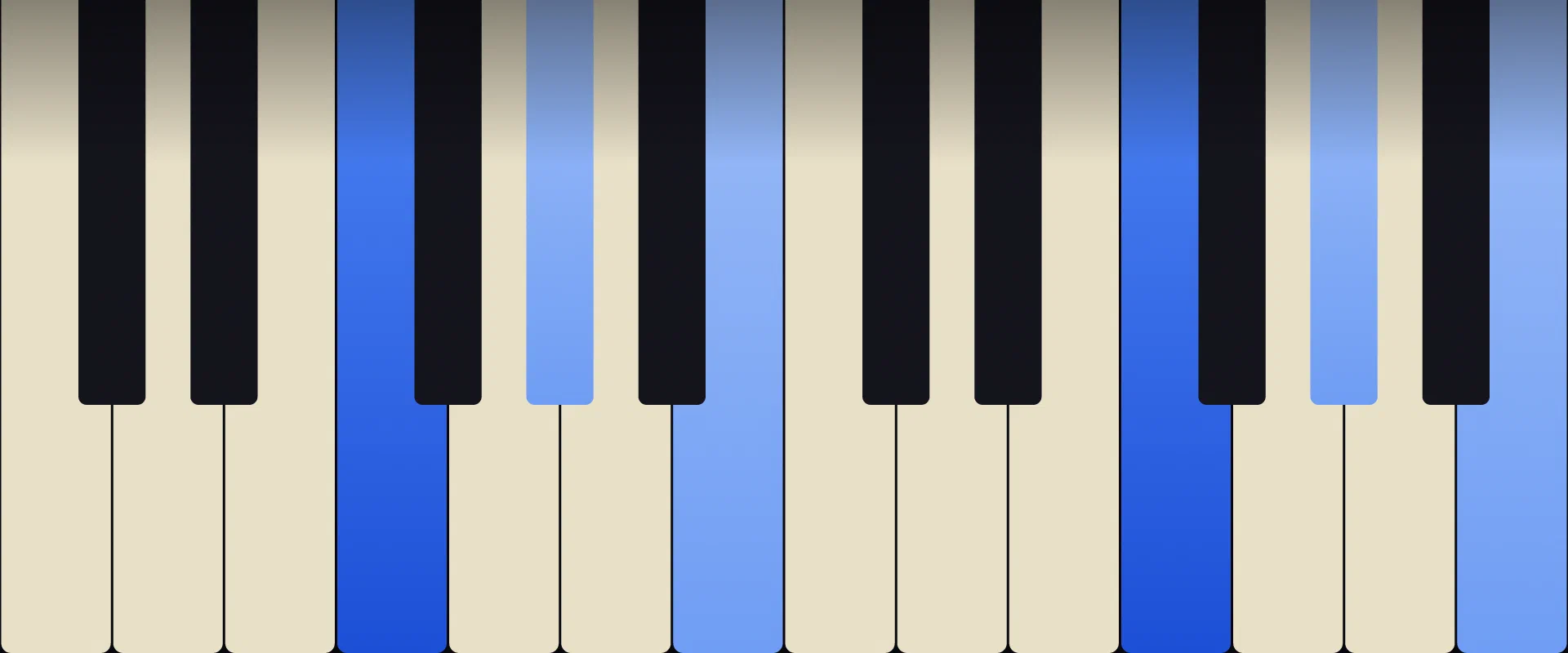
Set F as the root and find the diminished triad. The top note lights up on the key you know as B.
The Notes of Fdim
| Degree | Note | Interval from Root | Semitones |
|---|---|---|---|
| 1 (Root) | F | Perfect unison | 0 |
| ♭3 | A♭ | Minor 3rd | 3 |
| ♭5 | C♭ | Diminished 5th | 6 |
Three semitones, then three more. Two identical intervals stacked, and six semitones from bottom to top, exactly half an octave. Nothing inside the chord points at a root: F is the root only because the notation says so.
How Fdim Is Built
Take F major, F, A and C, and flatten both upper notes. Lower the A and you have F minor. Lower the C as well and you have this. Nothing moves further than a semitone, yet the result is the least settled of the four triads: the outer interval is a tritone, and a tritone never sounds like a place to stop.
Fdim on the Piano
Physically this is the easiest of the F triads to reach, because it is the narrowest. The hand spans six semitones instead of seven, so the little finger comes back one key. Thumb on F. Middle finger on the black key at the centre of the group of three, which is A♭. Little finger on B, the white key immediately left of C.
That last instruction is the one that troubles readers, so here it is plainly. A flat lowers a note one semitone from wherever its letter sits, and one semitone below C is the white key next door, because no black key stands between B and C. The keyboard has exactly two such gaps, B to C and E to F. E♯ is played on F for the same reason C♭ is played on B.
Play F minor and then F diminished one after the other and you can feel the contraction: only the little finger moves, one key to the left, and the chord goes from settled to unsettled.
Fdim on the Guitar
No open form exists, and no barre is any help, because in the useful voicings no two notes of this chord fall on the same fret. What the guitar does offer is a coincidence: the 2nd string played open is B, and B is this chord’s C♭.
That gives one genuinely easy shape near the nut. Middle finger on the 3rd string at fret 1, index on the 1st string at fret 1, the 2nd string left ringing between them: x x x 1 0 1, sounding A♭, C♭ and F. Do not barre those two fretted notes with one finger, because that would deaden the open string supplying the C♭. Add the ring finger on the 4th string at fret 3 for x x 3 1 0 1, the complete chord with the root at the bottom.
Anywhere else on the neck the shape is a diagonal. The standard movable diminished triad carries its root on the 5th string, so F sits at fret 8, A♭ on the 4th string at fret 6 and C♭ on the 3rd string at fret 4. It climbs backwards, higher strings at lower frets, and never settles into the hand as a chord grip.
In real playing the four note version turns up far more often. Add another minor 3rd above C♭, a note written E♭♭ and played as D, and you get Fdim7, which falls neatly under one hand at x 8 9 7 9 x. That grip is the one in the ragtime, gospel and jazz repertoire, and the bare triad mostly lives inside it.
Inversions
| Inversion | Notes | Bass Note | Symbol |
|---|---|---|---|
| Root position | F, A♭, C♭ | F | Fdim |
| 1st inversion | A♭, C♭, F | A♭ | Fdim/A♭ |
| 2nd inversion | C♭, F, A♭ | C♭ | Fdim/C♭ |
Inversions here behave unlike a major or minor triad’s. Root position is two minor 3rds; turn it over and a major 3rd appears at the top or the bottom, so each position has a different outer interval and a different tension. Fdim/A♭ is the mildest, and the one that shows up under a walking bass line.
Expect the last row to be written Fdim/B on an actual chart. Bass players read letters, and few editors will ask for a C♭ in the bass clef.
Voicings
Spread this chord rather than stack it. F to C♭ is already a difficult interval, and low down it turns into noise, so keep those two notes at least a 6th apart down there, or leave the root to the bass alone.
One voicing fact matters more than the rest. Put D♭ underneath and F, A♭ and C♭ become the 3rd, 5th and 7th of D♭7, so the symbol above the stave will say D♭7, not Fdim.
| Shape | Frets, low to high | Sounding notes |
|---|---|---|
| Root position, four strings | x x 3 1 0 1 | F, A♭, C♭, F |
| 1st inversion, three strings | x x x 1 0 1 | A♭, C♭, F |
| Movable triad, root on 5th string | x 8 6 4 x x | F, A♭, C♭ |
| Fdim7, root on 5th string | x 8 9 7 9 x | F, C♭, E♭♭, A♭ |
Which Keys Contain Fdim
- vii° of F♯ major
- ii° of E♭ natural minor
- ii° of E♭ harmonic minor
- vii° of F♯ harmonic minor
- vii° of F♯ melodic minor
- vi° of G♯ melodic minor
Look at the accidentals in that list. Only the two E♭ minor scales spell the chord as F, A♭ and C♭. The other four are sharp keys, writing the same three sounds as E♯, G♯ and B. This chord sits on the seam where the flat and sharp sides of the map meet. On the flat side F♯ major is G♭ major, and there these notes are the leading tone triad. Six flats and six sharps are places most players pass through rather than live in, which is a fair reason to say plainly that you will meet this chord inside something larger more often than alone.
Where Fdim Shows Up
E♭ minor is where it appears under its own name. E♭m, Fdim, B♭7, E♭m is i, ii°, V7, i, and the Fdim does a supertonic’s job: it walks the bass up one step and hands over to the dominant. Six flats keeps that progression off most guitar charts and squarely with keyboard and horn players.
In G♭ major it hides. D♭7, G♭ is the ordinary V to I there, and F, A♭ and C♭ already sit inside the D♭7. Take the root off a D♭7♭9 and what remains is Fdim7.
The four note version earns four jobs at once. F, A♭, C♭ and E♭♭ are spaced three semitones apart the whole way round, so the identical four sounds serve as the leading tone seventh of G♭, of A, of C and of E♭, depending only on which note you decide is the leading tone. Pianists use that as a hinge: play the shape, pick a destination, resolve a semitone upwards.
Related Chords
- F Minor Chord is this chord with the 5th restored to C.
- F Major Chord is two semitones away, one in each upper note.
- Seventh Chords: The Complete Guide covers Fdim7 and the half-diminished Fm7♭5.
- Diatonic Chords: A Beginner’s Guide explains why every major key contains exactly one diminished triad.
- Chord Inversions and Voice Leading covers the passing bass lines that carry it.
Learn More
G♭ major and E♭ minor sit at the six flat mark on the circle of fifths, directly opposite C. For D♭7♭9 and the altered dominants this chord hides inside, see Extended Chords and Jazz Harmony. For every scale that contains this chord, see Scales for Piano and Guitar: The Complete Reference Guide.
Practice Chords
Drill chord recognition with a metronome, MIDI support, and score tracking.
Start PracticingRelated Articles
A Diminished Chord: Notes, Voicings, and How to Play It
Aug 22, 2026 · 8 min
B Diminished Chord: Notes, Voicings, and How to Play It
Aug 22, 2026 · 8 min
B♭ Diminished Chord: Notes, Voicings, and How to Play It
Aug 22, 2026 · 8 min