The note that defines this chord is the one note a guitar will not hand over for free. Three of the six open strings are chord tones here, more than most chords manage, but the B♭ must be fretted, it sits a semitone under the open B string, and it makes a tritone with the two E’s that dominate the open sound. On a keyboard the same notes cost nothing. That is most of why diminished triads feel alien to a guitarist and unremarkable to a pianist.
Try It: Edim in the Chord Finder
Select E as the root and a scale that contains the chord, F major or D harmonic minor.
The Notes of Edim
E diminished takes the root, minor 3rd and diminished 5th:
E, G and B♭
| Degree | Note | Interval from Root |
|---|---|---|
| 1 (Root) | E | Perfect unison |
| ♭3 | G | Minor 3rd |
| ♭5 | B♭ | Diminished 5th |
B♭ is the only accidental and lands on the black key between A and B. It is spelled B♭ and not A♯ because a chord built in thirds on E needs the letters E, G and B; A♯ would put two notes on the A line and none on the B.
How Edim Is Built
Two minor 3rds stacked without variation: E up to G is three semitones, G up to B♭ is three more. The nearest simpler chord is E minor, with the B pulled down to B♭, and that semitone takes away the interval that anchors a triad. What is left spans exactly half an octave and points nowhere.
Seen from a step lower the notes stop floating. C, E, G, B♭ is C7, so this triad is a dominant seventh minus its root, and adding a D♭ on top gives Edim7, which is C7♭9 minus its root. In real music one of those descriptions usually fits better than “diminished triad”.
Edim on the Piano
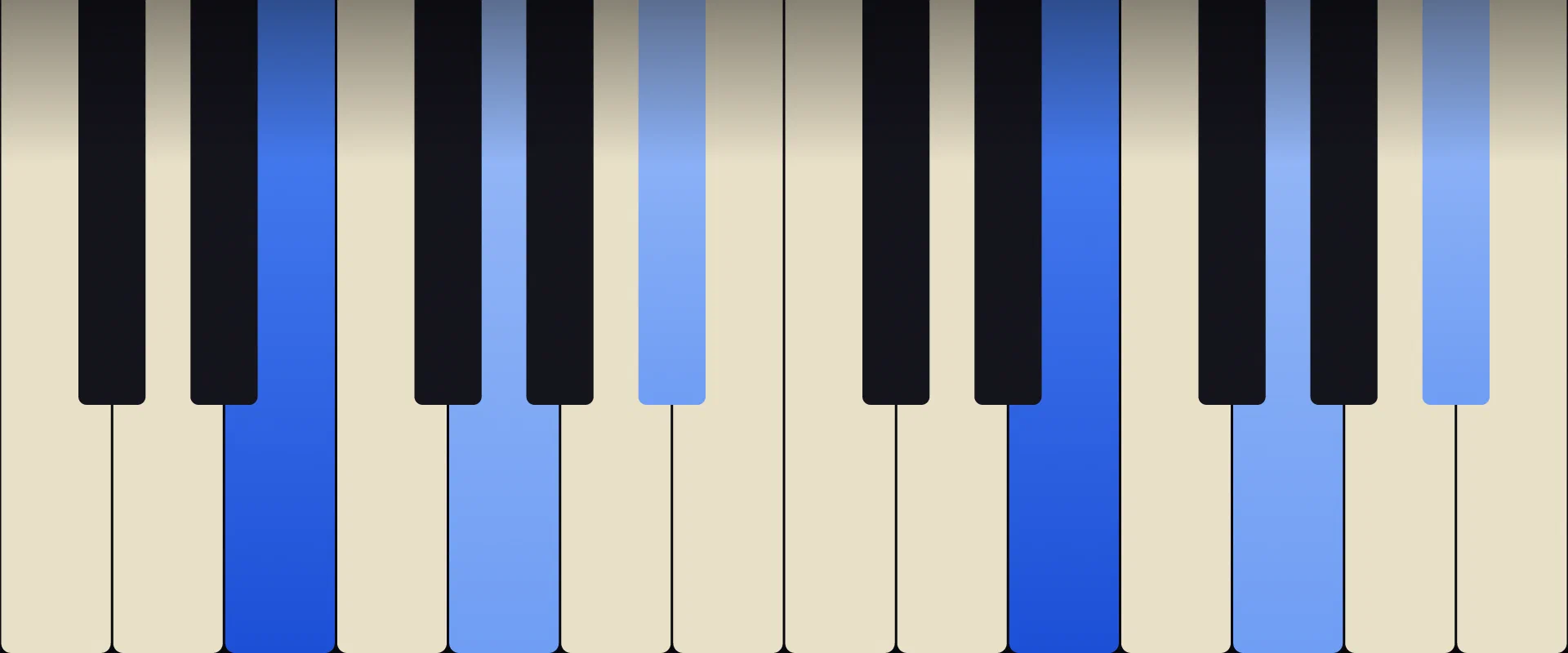
Two white keys and one black, with the black key on top. E up to B♭ is a tritone, a semitone narrower than the E to B of a minor triad, so the hand contracts slightly compared with the shape next door.
Right hand: thumb on E, second finger on G, fourth finger on B♭.
Left hand: fifth finger on E, third finger on G, thumb on B♭.
The right hand fingering is deliberately not 1, 3, 5. The weak fifth finger on a black key at the top of a compact shape makes the chord sound uneven, and 1, 2, 4 spreads the work. In the left hand the thumb has to sit further into the keyboard than it likes, which is the only awkward thing about the chord here.
The difficulty is aural, not visual, so practise by holding E, G and B♭ in the right hand and changing the bass underneath. Over C it snaps into focus as a dominant seventh pulling to F; lift the C away and the notes float again.
Edim on the Guitar
There is no open form, and no standard grip most players carry around. Diminished triads live on the fretboard as movable three note shapes, this one rooted on the fifth string at the 7th fret:
x 7 5 3 x x, sounding E, G and B♭ on the fifth, fourth and third strings.
It slopes backwards two frets for every string crossed, the opposite of a barre chord’s flat front, so the hand rotates rather than clamps. Guitarists who can place a major or minor triad anywhere on the neck often stall on this one.
The top three strings offer something more compact, x x 3 5 3, sounding B♭, E and G. A second inversion, easy under the fingers, and the one most likely to earn its keep behind a singer.
The near miss is worth trying once. Sixth string open, third open, first string at the 6th fret, 0 x x 0 x 6, gives all three notes from two open strings and one finger, but it means deadening the second string, which sits between two that must ring. Killing a string mid voicing is exactly what a beginner’s hand cannot yet do.
Most guitarists skip the triad and learn the fully diminished seventh instead. Edim7 is x x 2 3 2 3, sounding E, B♭, D♭ and G, and being four equal minor thirds the grip repeats every three frets up the neck.
Inversions
| Voicing | Notes | Bass note |
|---|---|---|
| Root position | E G B♭ | E |
| 1st inversion | G B♭ E | G |
| 2nd inversion | B♭ E G | B♭ |
First inversion is the one that matters. Root position is uncommon in classical practice, while the same chord with its third in the bass is everywhere, because it lets the bass move by step. The standard gesture in F major is F, then Edim with G in the bass, then F with A in the bass: the diminished sound passes through as connective tissue rather than as an event. No inversion settles it, though. The tritone between E and B♭ survives every rearrangement, so inverting the chord changes where it goes, not whether it has to go.
Voicings
- Movable triad, x 7 5 3 x x, root on the fifth string at the 7th fret.
- Compact second inversion, x x 3 5 3, on the top three strings.
- Near-open, 0 x x 0 x 6, two open strings and one fretted B♭, second string muted.
- Edim7, x x 2 3 2 3, repeating every three frets, the shape you will actually reach for.
- Piano, E, G and B♭ close together in the right hand over a functional bass note.
Keep the triad tight and let the bass carry the meaning. Three notes with no perfect fifth are thin, and spreading them only advertises it.
Which Keys Contain Edim
Only one major key contains this chord, which is itself the point:
- vii° of F major
- ii° of D natural minor
- ii° of D harmonic minor
- vii° of F harmonic minor
- vii° of F melodic minor
- vi° of G melodic minor
A major key gets one diminished triad and one job for it, leaning from the leading tone to the tonic. Minor keys produce more, because the raised seventh reshuffles the top of the scale.
Where Edim Shows Up
As the vii° of F major. The textbook appearance, nearly always in first inversion between two positions of the tonic. Play F, Edim over G, then F over A, and the chord is only carrying a bass line up a step. Bach chorales are full of that and almost never of the root position triad, and plenty of music that looks like it uses this chord is using C7 with another voice on the C.
As the ii° of D minor. Dm, Edim, A7, Dm is the plain version, and scarcely anyone plays it that plainly: in jazz the ii of a minor key becomes a half-diminished seventh, Em7♭5 (E, G, B♭ and D), giving Em7♭5, A7, Dm. D minor is generous on guitar, with open D and A strings under it, so this is where a guitarist meets these notes on purpose.
As Edim7, the travelling chord. E, G, B♭ and D♭ is one of only three distinct fully diminished sevenths in the system, sharing its notes with C♯dim7, Gdim7 and B♭dim7, the same chord entered at a different rung. Being A7♭9 without the A it pulls to D minor, and being renameable three ways it will pull three other places just as willingly. Hence its standing as the quickest way out of a key.
Be honest about the frequency. As a bare triad in root position, E, G and B♭ is rare. It turns up as a passing sound, as a first inversion inside a stepwise bass, or as the upper part of a dominant. Learn it not because you will strum it often, but because it sits inside a great many chords you will.
Related Chords
- E Minor Chord: Notes, Voicings, and How to Play It is this chord with the fifth restored, the quickest way to hear what flattening it does.
- Seventh Chords: A Complete Guide to maj7, min7, dom7, and More covers Em7♭5 and Edim7.
- Extended Chords: Which Tensions Work, and How to Voice Them explains the flat ninth hidden in this shape.
- E Major Chord: Notes, Voicings, and How to Play It is the same root at the far extreme.
Learn More
- Diatonic Chords: A Beginner’s Guide to Building Chords from Scales on why each major key yields one of these.
- Minor Scales Compared: Which One to Use and Why on what the raised seventh changes.
- Chord Inversions and Voice Leading is the reason first inversion dominates here.
- The Circle of Fifths Explained places F major and D minor side by side.
Practice Chords
Drill chord recognition with a metronome, MIDI support, and score tracking.
Start PracticingRelated Articles
A Diminished Chord: Notes, Voicings, and How to Play It
Aug 22, 2026 · 8 min
B Diminished Chord: Notes, Voicings, and How to Play It
Aug 22, 2026 · 8 min
B♭ Diminished Chord: Notes, Voicings, and How to Play It
Aug 22, 2026 · 8 min