Nearly every D♯dim in real music is doing one job: leaning on E. The chord sits a semitone below the tonic of E major, the most guitar friendly key there is, so despite a name that reads like a warning label, D♯, F♯ and A turn up constantly in songs written on a guitar, usually as the pivot in a bass line walking down from E to C♯.
Try It: D♯dim in the Chord Finder
The Notes of D♯dim
The chord contains three notes: D♯, F♯ and A.
| Degree | Note | Interval from root | Semitones |
|---|---|---|---|
| 1 | D♯ | Root | 0 |
| ♭3 | F♯ | Minor 3rd | 3 |
| ♭5 | A | Diminished 5th | 6 |
Written out it is D♯dim, or D♯° in classical scores.
How D♯dim Is Built
Start from D♯ minor, which is D♯, F♯ and A♯. Lower the fifth by a semitone to A and both upper notes are now flattened relative to the major triad. What remains is two minor thirds stacked on top of each other, D♯ up to F♯ and F♯ up to A, the only triad quality built from a single interval repeated.
The outer interval is a tritone, D♯ to A, six semitones, exactly half an octave, and it is the whole reason the chord sounds unfinished. It wants to close inwards, D♯ rising to E and A falling to G♯, and when it does you have landed on E major.
Why It Is D♯ and Not E♭
A chord’s root is not just a pitch, it is a letter, chosen so the notes above it can be counted off by scale degree: a third two letters up, a fifth four letters up, whatever accidentals that takes. From D♯ the arithmetic is clean. D up to F is a third and F♯ fits. D up to A is a fifth and A itself fits. Two sharps, three ordinary note names.
Spell the same sounds on E♭ and it falls apart. The third has to be a G, giving G♭. The fifth has to be some kind of B, and the only B that sounds like A is B double flat, two flat signs stacked on one letter. E♭ diminished is therefore E♭, G♭ and B double flat, correct, legal and almost never written. D♯ wins because it is a name musicians use daily: the leading note of E major, the third of B major.
The choice runs the other way for the minor chord on this pitch, where E♭, G♭ and B♭ is as tidy as D♯, F♯ and A♯ and the surrounding key decides.
D♯dim on the Piano
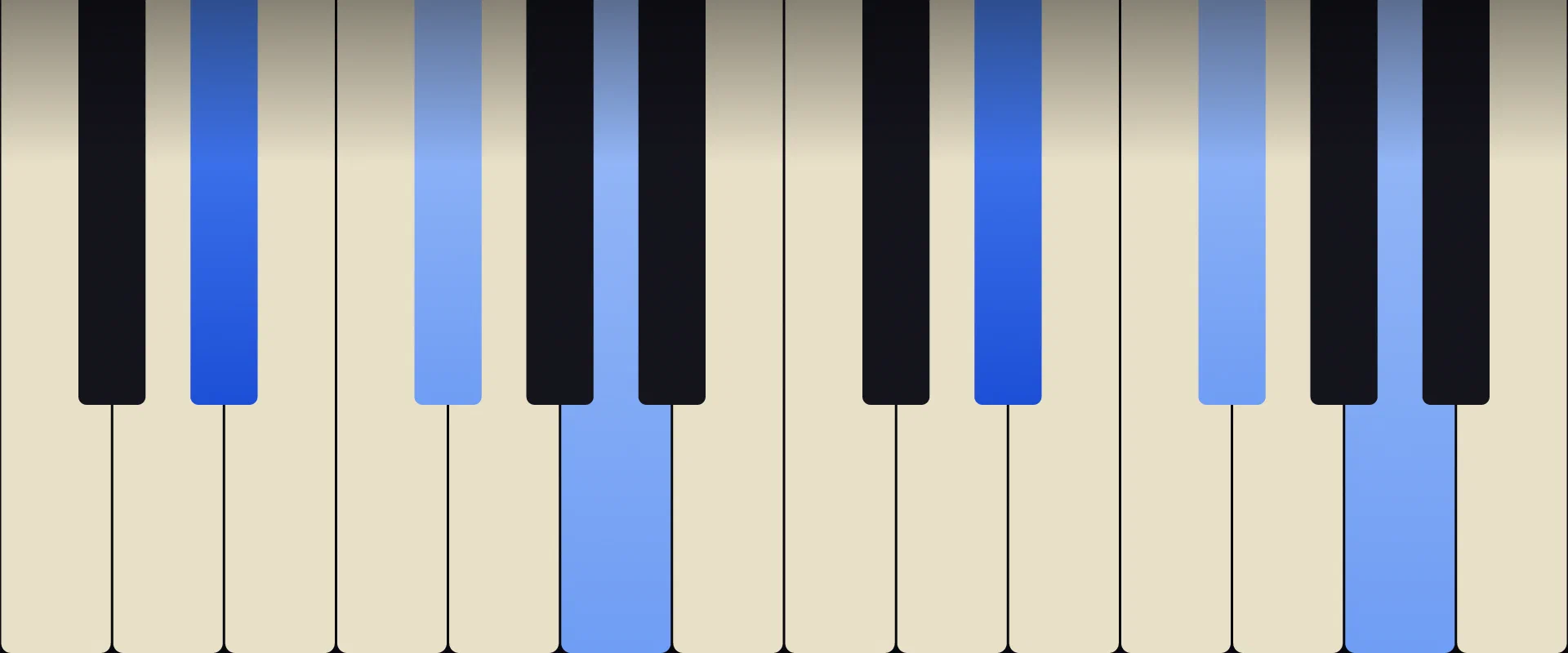
Two black keys and one white, with the white one on top. D♯ is the right hand key of the group of two, F♯ the left hand key of the group of three, one step along. Then the shape leaves the raised keys and reaches forward to A, wedged between G♯ and A♯ at the front of the keyboard.
That forward reach is the whole difficulty. Two fingers stay back among the black keys while the outer one comes out and down, so the hand tilts and the wrist rotates towards the little finger. Right hand 1 on D♯, 2 on F♯, 4 on A handles it, because the fourth finger reaches the white key without dragging the hand forward with it. Left hand: 5, 3, 1.
Compare it with D♯ minor, where the top note is A♯ instead of A. One semitone turns a white key back into a black one and the hand goes from tilted to level, a neat demonstration that fingering follows the keyboard, not the theory.
Because the chord is two identical intervals, the shape transposes upwards in minor thirds without changing. Three semitones up gives F♯dim, F♯ A C, sharing two notes with where you started.
D♯dim on the Guitar
No open form exists, and unlike major and minor triads this one has no CAGED shape worth barring either. Guitarists play it as a small movable grip of three or four notes.
The tidiest is a diagonal on the middle strings: x 6 4 2 x x. That is D♯ on the 5th string at the 6th fret, F♯ on the 4th at the 4th, A on the 3rd at the 2nd, a close root position triad with nothing doubled. Ring, middle, index, one finger per string, walking backwards down the neck as the chord rises in pitch. Near the nut there is a fuller option, x x 1 2 4 2, the open Ddim shape moved up one fret, with no barre at all.
In practice the four note version is what you will hear. Add C and the chord becomes D♯dim7, D♯ F♯ A C, played as x 6 7 5 7 x with the root still on the 5th string at the 6th fret. Because a diminished seventh divides the octave into four equal parts, that grip repeats every three frets: the 3rd, 6th, 9th and 12th all give the same four notes in a different inversion. That geometry is why the seventh has crowded the bare triad out of guitar music almost completely.
Why any of it matters here is the key. E major and C♯ minor sit on open strings, and this chord is the leading tone triad of one and the supertonic of the other. Take the descent E, D♯, C♯ on the 5th string, frets 7, 6 and 4, and you have the bass of a great many songs.
Inversions
| Inversion | Notes | Lowest note |
|---|---|---|
| Root position | D♯ F♯ A | D♯ |
| 1st inversion | F♯ A D♯ | F♯ |
| 2nd inversion | A D♯ F♯ | A |
First inversion is the one classical harmony actually uses. With F♯ in the bass the chord becomes vii°6 in E major and the bass is free to step to E or G♯ rather than sitting on the leading note. Root position sounds more urgent. Second inversion is rare, because A wants to fall and a bass falling from A lands on G♯.
Voicings
In four part writing the rule runs against instinct: double the third, F♯, not the root. D♯ is the leading note, A is the diminished fifth, and both are heading somewhere specific. Double either and you get parallel octaves the moment they resolve.
Add a note and the chord changes job. C on top gives D♯dim7, the fully diminished seventh, which is B7♭9 with its root removed and behaves as a dominant. C♯ instead gives D♯m7♭5, the half diminished chord, the ii of C♯ minor and the way this sound usually appears in jazz. Both are commoner than the bare triad, which is mostly a passing event in a voice leading chain.
On piano, keep the tritone in the middle of the texture and put the resolution note on top, so the ear follows the line.
Which Keys Contain D♯dim
- vii° of E major
- vii° of E harmonic minor
- vii° of E melodic minor
- ii° of C♯ natural minor
- ii° of C♯ harmonic minor
- vi° of F♯ melodic minor
Every one is a sharp key, which is the practical argument for the spelling all over again: flats inside a signature full of sharps force the reader to translate mid bar.
Where D♯dim Shows Up
I, vii°, vi: E, D♯dim, C♯m. The chord’s day job in popular music. The bass steps down E, D♯, C♯ while the upper voices barely move, and the diminished chord is what makes the descent sound deliberate rather than accidental. Songwriters who found it on a guitar often had no name for it.
vii°6 to I: F♯ A D♯ moving to E. The classical version, first inversion, F♯ in the bass. D♯ climbs to E, A drops to G♯, F♯ goes either way. Bach uses the leading tone triad constantly like this, as a lighter substitute for the dominant when a full B major would weigh too much.
ii°, V7, i: D♯dim, G♯7, C♯m. The minor key cadence. Jazz adds the seventh and calls it D♯m7♭5, but the bare triad is standard in classical and folk harmony, and the pull towards C♯ minor is identical.
The spelling argument has a famous precedent. Bach’s eighth prelude in Book I of the Well Tempered Clavier is written in E♭ minor with six flats, and the fugue that follows it is written in D♯ minor with six sharps. Same key, same sounds, respelled halfway through because the fugue’s chromatic lines would otherwise have piled up double flats, exactly as E♭ diminished does.
Related Chords
- E Major Chord
- B Major Chord
- Seventh Chords: The Complete Guide
- Secondary Dominants and Borrowed Chords
- How to Analyse Song Harmony in Five Steps
Learn More
Practice Chords
Drill chord recognition with a metronome, MIDI support, and score tracking.
Start PracticingRelated Articles
A Diminished Chord: Notes, Voicings, and How to Play It
Aug 22, 2026 · 8 min
B Diminished Chord: Notes, Voicings, and How to Play It
Aug 22, 2026 · 8 min
B♭ Diminished Chord: Notes, Voicings, and How to Play It
Aug 22, 2026 · 8 min