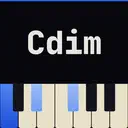
Hold a D minor chord and move one finger. Keep the D, keep the F, and let the A fall a semitone to A♭. The chord that was sitting there patiently as the ii of C major stops being furniture and starts pointing somewhere. That is the whole of Ddim in one gesture, and it is the best way to learn it, because the ear hears what the finger did rather than a new object to memorise.
Where it points is E♭, or C minor. The A♭ turns the outer interval from a perfect fifth into a tritone, and a tritone will not sit still. Nothing else in the triad changed, which is worth noticing: two thirds of a diminished chord is just a minor chord, and one altered note does all the work.
Try It: Ddim in the Chord Finder
The Notes of Ddim
Ddim is three notes: D, F and A♭.
| Degree | Note | Interval from Root | Semitones |
|---|---|---|---|
| 1 (Root) | D | Perfect unison | 0 |
| ♭3 | F | Minor 3rd | 3 |
| ♭5 | A♭ | Diminished 5th | 6 |
The symbol is written Ddim or D°. The flat sits on the fifth, not the third, which trips people up when they read fast: Dm and Ddim share their D and their F, and only the top note tells them apart.
How Ddim Is Built
Start from D major, D, F♯ and A. Lower the third to F and you have D minor. Lower the fifth to A♭ as well and you have Ddim. Both upper notes end up flattened, which is why the chord sounds compressed: six semitones from bottom to top instead of seven, less room than any other triad on this root.
Stacked in thirds it reads D up to F, a minor third, then F up to A♭, another minor third. Two equal intervals, no long side, and that evenness is why the chord has no stable footing. Add one more minor third above, C♭, and you get Ddim7, the symmetrical four note chord players reach for far more often than the bare triad.
Ddim on the Piano
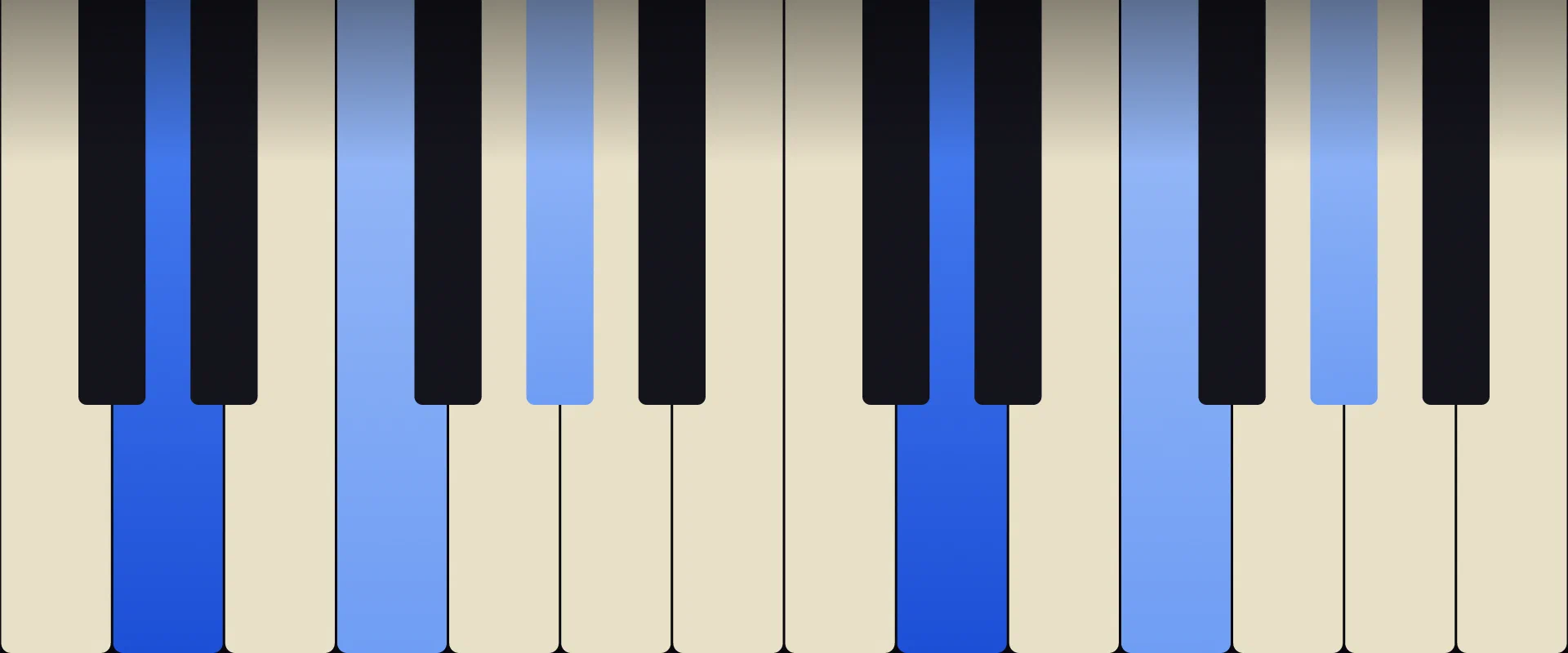
Two white keys and one black. Thumb on D, middle finger on F, little finger on A♭. Those three notes make a tidy picture: D sits in the notch between the two black keys of the group of two, and A♭ is the centre black key of the group of three. Both ends of the chord land on a landmark the hand can find without looking.
The little finger is the problem. It reaches back onto A♭ while the thumb and middle finger stay out at the front edge of D and F, so the hand rotates outwards and the wrist wants to drop. Left hand fingering is 5, 3, 1, which puts the black key under the thumb instead, and most beginners find that version far easier.
Practise it straight against D minor, alternating A and A♭ under an unmoving thumb and middle finger. On the keys the tritone from D to A♭ is narrower than the fifth from D to A by exactly one key, and that key is a black one, so the little finger has to change both its reach and its depth. Teaching it to feel that difference is most of the work of playing diminished chords in time.
Ddim on the Guitar
There is no open form. Nothing about D, F and A♭ lines up with the open strings, and unlike D minor there is no cheap shape near the nut to fall back on. The movable three note grip is the only practical answer, and that is true of diminished triads generally.
The reason is worth spelling out. A chord that fills six strings has to double notes, and a diminished triad has nothing safe to double. Doubling the root or the flattened fifth puts the D to A♭ tritone in two registers at once, which turns to mud below the 5th fret. Doubling the F gives the chord a weight it should not have, because this is a moment of transit rather than a place to land.
Two grips cover most needs. Root position on the top three strings is x x x 7 6 4: D on the 3rd string at the 7th fret, F on the 2nd at the 6th, A♭ on the 1st at the 4th. Three adjacent frets, no stretch, sitting above whatever the bass is doing. Lower down, anchor the root on the 5th string at the 5th fret and the shape runs diagonally back across the neck as x 5 3 1 x x. That diagonal is the standard diminished triad fingering, and it repeats in minor thirds: shift the whole grip up three frets and the same three notes come back rearranged.
Inversions
| Inversion | Bass Note | Notes | Symbol |
|---|---|---|---|
| Root position | D | D, F, A♭ | Ddim |
| 1st inversion | F | F, A♭, D | Ddim/F |
| 2nd inversion | A♭ | A♭, D, F | Ddim/A♭ |
First inversion is the one that appears in real music, because Ddim usually arrives as the second degree of a minor key and putting F in the bass keeps the line moving by step. On guitar that grip is x 8 6 7 x x, inside three frets. Second inversion is rare enough to distrust: with A♭ underneath, the ear reinterprets the chord around that note instead.
Voicings
Guitar, top three strings (x x x 7 6 4). The default. Clean, quiet, easy to mute.
Guitar, close position (x 5 3 1 x x). Darker, in the register where the chord bites.
Piano, close (D, F and A♭ in one hand). Small and tense, best above middle C where the tritone stays clear.
Piano, over a B♭ bass. Put B♭ underneath and the three notes become the upper structure of B♭7. Same chord, different job.
Which Keys Contain Ddim
Ddim is a diatonic chord in six keys:
- vii° of E♭ major
- ii° of C natural minor
- ii° of C harmonic minor
- vii° of E♭ harmonic minor
- vii° of E♭ melodic minor
- vi° of F melodic minor
Two matter day to day. As vii° of E♭ major the D is the leading note, so the chord acts as a dominant with no root. As ii° of C minor it is the standard approach chord to G7.
Where Ddim Shows Up
Notice what is missing from that list of keys: anything called D. The key of D minor contains a D minor triad and D major contains D major, so a player working in either will never meet this chord diatonically. Ddim belongs to the flat side, to C minor and E♭ major, and it arrives as a borrowed or passing event rather than as a native inhabitant.
Rising bass in C minor: Cm, Ddim, E♭. The bass walks C, D, E♭ one step at a time, and Ddim is simply what harmonises the passing D. It needs no explaining to the ear, because it is heard as motion rather than as a chord.
vii° to I in E♭ major: Ddim, E♭. Three voices resolve at once. The D rises a semitone to E♭, the A♭ falls a semitone to G, and the F rises to meet that same G. Play it slowly and listen to the outer voices closing in from both sides. This is the cadence that makes diminished harmony worth learning.
As a rootless B♭7. D, F and A♭ are the third, fifth and seventh of B♭7. Put a bass player on B♭ and the pianist playing Ddim is playing a dominant seventh, which is why the chord leans towards E♭ so hard. It shares its tritone with E7 as well, so the same three notes can be turned around to lead to A instead.
That E♭ connection decides who actually plays this chord. Concert E♭ is home territory for wind bands, where the B♭ and E♭ transposing instruments read it as their own easy keys, so trumpet, tenor saxophone and euphonium parts pass through Ddim far more often than guitar parts do. Guitarists meet it when a song borrows from the parallel minor, and even then usually play the diminished seventh.
Related Chords
- D Minor Chord, one semitone away and the best comparison.
- E♭ Major Chord, where this chord most wants to resolve.
- B♭ Major Chord, the root that turns Ddim into a dominant seventh.
- Seventh Chords: The Complete Guide for Ddim7 and Dm7♭5, both commoner than the plain triad.
- The C Natural Minor Scale, where this chord is the ii.
Learn More
Practice Chords
Drill chord recognition with a metronome, MIDI support, and score tracking.
Start PracticingRelated Articles

A Diminished Chord: Notes, Voicings, and How to Play It
Aug 22, 2026 · 8 min
B Diminished Chord: Notes, Voicings, and How to Play It
Aug 22, 2026 · 8 min
B♭ Diminished Chord: Notes, Voicings, and How to Play It
Aug 22, 2026 · 8 min