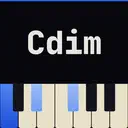
Play an A7 chord, A, C♯, E and G, then take the A away. What remains is C♯, E and G, and it still pulls towards D exactly as the full chord did. That is the working identity of this triad: not an exotic sonority but a dominant seventh with its root missing. It is also the diminished chord most players actually meet, because the key it belongs to is D major, and D major is where an enormous amount of guitar, fiddle and pop music lives.
Try It: C♯dim in the Chord Finder
The Notes of C♯dim
| Degree | Note | Interval from root | Semitones |
|---|---|---|---|
| 1 | C♯ | Root | 0 |
| ♭3 | E | Minor 3rd | 3 |
| ♭5 | G | Diminished 5th | 6 |
The fifth is worth a moment. Counting letters from C to G gives five, so the fifth of this chord has to be some kind of G; take G♯ down a semitone and you arrive at G natural, which needs no accidental at all. Only the root carries one. All three notes sit inside the D major scale, which is why this chord arrives in that key without borrowing anything.
How C♯dim Is Built
Take C♯ minor, C♯, E and G♯, and lower the fifth as well as the third has already been lowered. Both upper notes are now a semitone below where the major triad put them, and what is left is two minor thirds stacked: C♯ to E, then E to G. The outer interval is six semitones, a tritone, exactly half an octave. Nothing sits still on top of half an octave, and that instability is the entire point of the chord.
Symmetry follows from the even spacing. Add B♭ on top and you have C♯dim7, four notes each a minor third apart, and those same four notes also spell Edim7, Gdim7 and B♭dim7. Move the whole thing up three semitones and it becomes itself again. That is why diminished shapes slide freely, and why guitarists learn one grip and stop worrying about which of the four names is written on the chart. The bare triad is less symmetrical than its seventh: C♯, E and G keep two minor thirds, but invert it and one of those gaps becomes a tritone instead.
C♯dim on the Piano
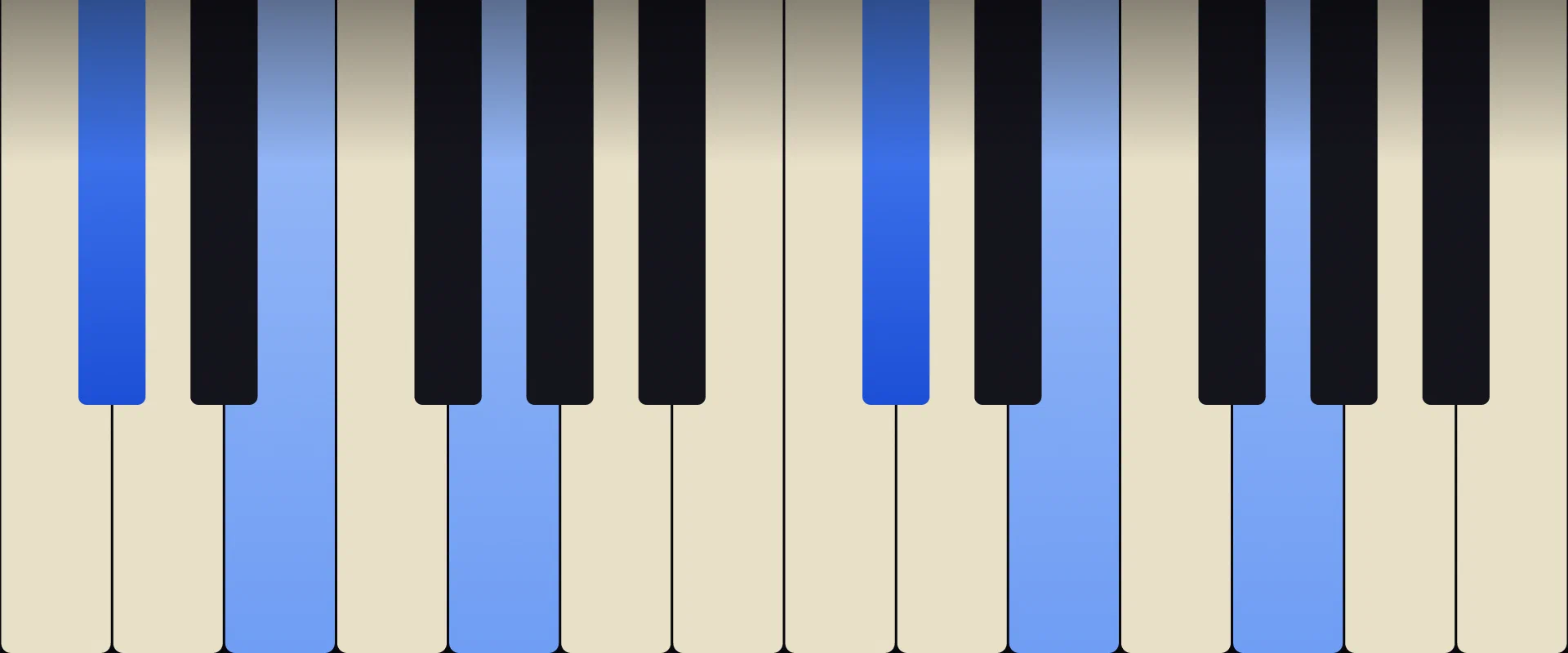
One black key and two white ones, in that order, so the hand tilts. The thumb sits back on C♯ while the third and fifth fingers come forward onto E and G. Right hand root position works as 1, 3, 5, though many pianists prefer 1, 2, 4 for diminished triads because it keeps the hand compact and ready to move. Left hand takes 5, 3, 1.
The spacing never changes as you transpose, since both gaps are three semitones, but the terrain does, and this root is the awkward member of its own family. Slide the shape up a minor third and C♯, E, G becomes E, G, B♭: white, white, black, a completely different feel under the fingers for an identical stretch. Slide it up again and two black keys are involved. Practise the slide rather than the chord, because in real music this is almost never a chord you hold. It is a half bar of movement between two chords that do stand still.
The tritone is also easy to see here. C♯ and G are directly across the octave from one another, one black key and the white key opposite it, and that visual is a reliable way to check the chord before your ear confirms it.
C♯dim on the Guitar
No open form exists, and diminished triads are rarely played as bare triads anyway. The movable shape sits with its root on the 5th string at the 4th fret: x 4 5 x 5 x, giving C♯, G and E, with the G string muted by the underside of the finger above it. That muting is the whole difficulty. Adding a doubled root on the G string at the 6th fret, x 4 5 6 5 x, removes the problem and gives four ringing strings.
What guitarists reach for far more often is the four note seventh, x 4 5 3 5 x. Frets 4, 5, 3 and 5 across the A, D, G and B strings produce C♯, G, B♭ and E, the full C♯dim7. Move that grip three frets in either direction and the notes repeat, so one shape covers the entire family and the chart’s chosen name is a formality. It is the single most economical shape on the instrument.
In the key of D major the alternative is to reach for the top of an open A7 instead and simply not play the A string. Same three notes, no barre, and it is how the chord usually gets played by people who have never heard it called diminished.
Inversions
| Inversion | Notes | Lowest note |
|---|---|---|
| Root position | C♯ E G | C♯ |
| 1st inversion | E G C♯ | E |
| 2nd inversion | G C♯ E | G |
Root position is the one that matters, because C♯ in the bass is what makes the chord a leading note chord and points it at D. First inversion, with E underneath, softens that pull considerably and sounds closer to a rootless A7 in a jazz voicing. Second inversion, G in the bass, puts the most unstable note at the bottom and is normally passing through rather than arriving anywhere.
Voicings
Split the tritone. Left hand takes C♯ and G alone, right hand takes E, G and C♯ above it, and the open space in the middle keeps the chord from sounding thick, which diminished harmony does very easily in the lower register.
What you add underneath or on top decides which chord this actually is. Put A in the bass and it becomes A7. Add B♭ on top and it becomes C♯dim7, the symmetrical version that slides. Add B natural instead and you get C♯m7♭5, the half diminished chord that opens minor key jazz progressions. One triad, three destinations, and the notation on the page often reflects which of them the writer had in mind rather than what the keyboard is doing.
Which Keys Contain C♯dim
- vii of D major
- ii of B natural minor
- vii of D harmonic minor
- ii of B harmonic minor
- vii of D melodic minor
- vi of E melodic minor
Two families, and both are useful. In D, of any flavour, this is the chord one semitone below the tonic, and its job is to deliver the tonic. In B minor it is the ii, the chord that opens a cadence rather than closes one, and there it is usually fleshed out into C♯m7♭5.
Where C♯dim Shows Up
| Progression | Chords | Turns up in |
|---|---|---|
| I vii vi in D major | D, C♯dim, Bm | Descending bass in ballads and folk |
| vii I in D major | C♯dim, D | Rootless dominant, gospel comping |
| ii V i in B minor | C♯m7♭5, F♯7, Bm | Minor key jazz standards |
| A7♭9 to D minor | A7♭9, Dm | Tango, gypsy jazz, film scoring |
The first row is where most people hear it without noticing. A song in D major moves from the tonic down to the relative minor, and rather than dropping straight from D to Bm the bass walks D, C♯, B. Something has to harmonise that middle step. A/C♯ is the plain option; C♯dim is the one with a bite in it, and the difference between the two is a single note, G instead of A.
Row two is the same chord doing its formal job. Resolving into D, the two outer voices close inwards by a semitone each: C♯ rises to D and G falls to F♯. Two contrary semitones inside three notes is about as efficient as harmony gets, and it is why the chord survives in styles that otherwise have no use for it.
The last row explains the seventh’s popularity. A7♭9 is A, C♯, E, G and B♭, and the top four of those are exactly C♯dim7. Play the diminished seventh over an A bass and you have the altered dominant that tango and gypsy jazz run on. Take the bass away again and the same shape is free to slide, which is where most improvised diminished playing comes from.
One warning. This chord will not hold a whole bar without sounding like a silent film. Give it a beat, two at most, and let it move.
Related Chords
- C♯ Minor Chord, the same first two notes with G♯ instead of G, and a perfect 5th that stays put
- C♯ Major Chord
- Seventh Chords: The Complete Guide for C♯dim7 and C♯m7♭5
- C♯ Locrian Scale, the mode built on this triad
- Chord Inversions and Voice Leading
Learn More
- Secondary Dominants and Borrowed Chords, which covers passing diminished chords in detail
- Diatonic Chords: A Beginner’s Guide
- The ii V I Progression
- Extended Chords and Jazz Harmony
- The Circle of Fifths Explained
Practice Chords
Drill chord recognition with a metronome, MIDI support, and score tracking.
Start PracticingRelated Articles
A Diminished Chord: Notes, Voicings, and How to Play It
Aug 22, 2026 · 8 min
B Diminished Chord: Notes, Voicings, and How to Play It
Aug 22, 2026 · 8 min
B♭ Diminished Chord: Notes, Voicings, and How to Play It
Aug 22, 2026 · 8 min