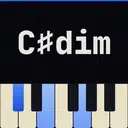
Six semitones separate C from G♭, and that interval is the whole story of this chord. A tritone is exactly half an octave, so it divides the octave evenly and belongs to no key on its own, which is why C diminished cannot sit still. Everything else about the chord follows from wanting that tritone to go somewhere. It is the leading note triad of D♭ major and the second degree triad of B♭ minor, it is almost never where a phrase comes to rest, and in real music the bare three note version is far rarer than the four note diminished seventh built on top of it. Those are unusual things to say about a chord, and they are worth saying before the fingering.
Try It: Cdim in the Chord Finder
Play it, then play D♭ major straight after. The second chord is what the first one is asking for.
The Notes of Cdim
| Degree | Note | Interval from root | Semitones |
|---|---|---|---|
| 1 (root) | C | Perfect unison | 0 |
| ♭3 | E♭ | Minor 3rd | 3 |
| ♭5 | G♭ | Diminished 5th | 6 |
Written out: C, E♭, G♭. The top note is G♭ and not F♯, although your finger lands on the same key either way. A triad has to use alternate letters, C then E then G, and calling it F♯ would give the chord two notes in the F and G region and no G at all. The interval would then read as an augmented 4th rather than a diminished 5th, and the chord symbol would stop matching the arithmetic.
How Cdim Is Built
Take C minor, C, E♭ and G, and pull the G down a semitone as well. Both upper notes are now flattened, which leaves two minor thirds stacked on each other: C up to E♭ is three semitones, E♭ up to G♭ is another three. The perfect 5th that holds a major or minor triad steady has been removed, and with it the sense of a floor under the chord.
The measurement that matters is the outer one. C to G♭ is six semitones, and so is G♭ up to C, because the tritone is the one interval that inverts into itself. Turning the chord upside down does not soften it. Add B♭ on top and you get Cm7♭5, the half diminished chord. Add A instead and you get Cdim7, the fully diminished seventh, a third minor third on top of the other two and completely symmetrical.
Cdim on the Piano
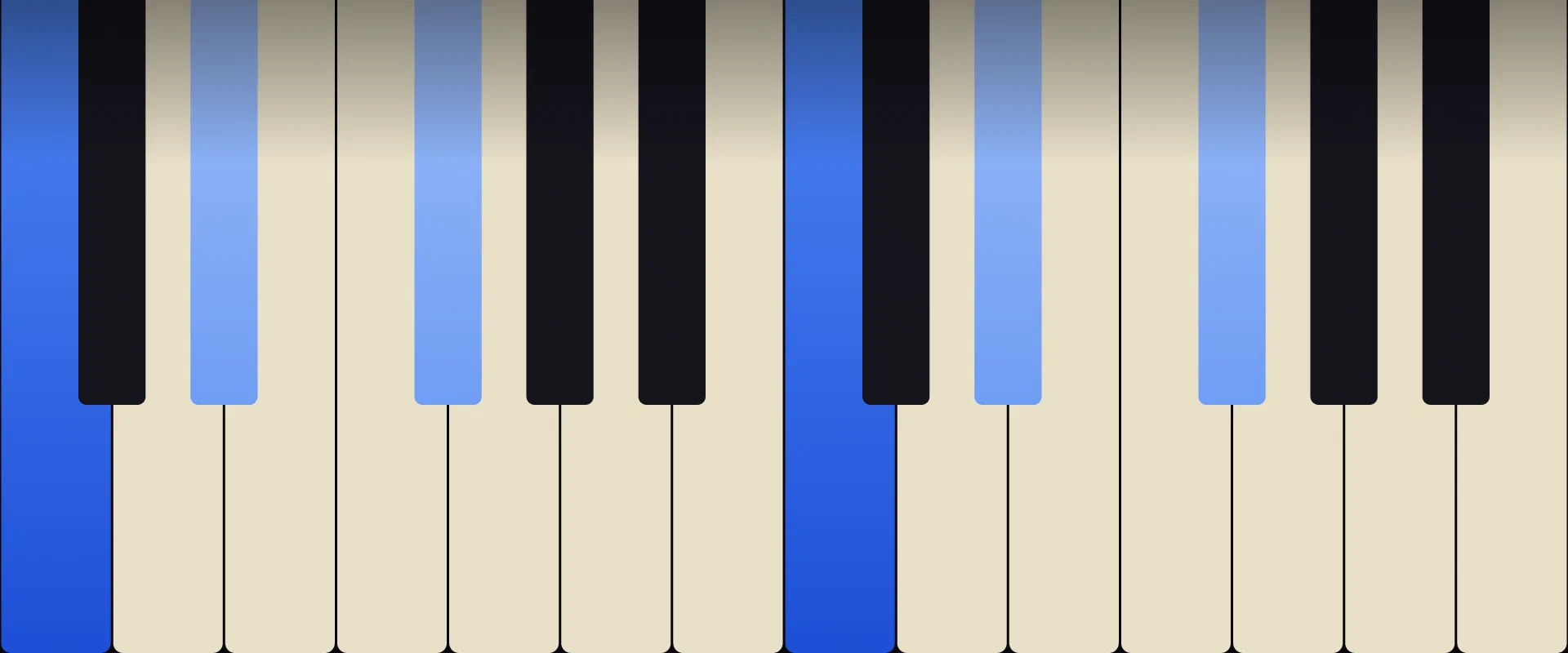
The chord straddles a seam in the keyboard. E and F are one of the two pairs of white keys that sit side by side with no black key between them, and the two black notes of this chord are the keys on either side of that gap: E♭ closes the pair of black keys, G♭ opens the group of three. The root is the second white key to the left of E♭. Once you have seen it that way the shape is unmistakable, because no other triad on C puts a black key on both sides of that gap.
Right hand: thumb on C, second finger on E♭, fourth finger on G♭. The thumb stays out on the broad front of the white key while the two fingers reach in, so the hand is deep in the keyboard on its outer side and shallow at the thumb. Left hand, use 5 on C, 3 on E♭ and 1 on G♭, which keeps the thumb on the black key nearest the middle of the instrument.
The spacing is what makes it easy to remember. Both gaps are three semitones, so the fingers sit at even distances rather than the lopsided four then three of a major chord. That evenness is also why the chord sounds vague when you hold it: nothing in the shape tells your ear which note is the root.
Cdim on the Guitar
There is no open form here, and the guitar makes even the movable version awkward. The tuning has a major 3rd between the 3rd and 2nd strings and perfect fourths everywhere else, which suits chords built on a perfect 5th and fights a chord built on a diminished one. In practice you skip a string.
The standard shape puts the root on the 5th string at the 3rd fret: x 3 4 x 4 x, giving C, G♭ and E♭ with the 3rd string damped by the underside of the fretting finger. It is a small, quiet grip rather than a ringing chord, and it moves anywhere on the neck unchanged.
For a version without the muted string in the middle, take the top three strings at x x x 5 4 2, which stacks C, E♭ and G♭ in that order and sits well under a melody. Add the 3rd string at the 3rd fret for the half diminished sound and you have Cm7♭5 at x 3 4 3 4 x, which is a far more common sight on a jazz chart than the bare triad.
The one every guitarist really learns is Cdim7 at x 3 4 2 4 x. Because its four notes are evenly spaced, that grip repeats every three frets: slide it to the 6th, 9th or 12th fret and you get the same four pitches back in a different order. One shape, four positions, and the reason diminished harmony on guitar is usually taught as a seventh chord and not as a triad.
Inversions
| Inversion | Notes | Bass | Symbol |
|---|---|---|---|
| Root position | C E♭ G♭ | C | Cdim |
| 1st inversion | E♭ G♭ C | E♭ | Cdim/E♭ |
| 2nd inversion | G♭ C E♭ | G♭ | Cdim/G♭ |
First inversion is the normal one. Classical writing puts E♭ in the bass far more often than C, because with the root underneath the tritone is exposed against the lowest note, and with E♭ underneath the chord slips past almost unnoticed. The bass line is usually the reason: D♭, E♭, F walking upwards underneath D♭ major harmony puts Cdim/E♭ in the middle without anybody hearing a diminished chord as such. See Chord Inversions and Voice Leading for how the parts move.
Voicings
Keep it close. Spreading C, E♭ and G♭ across two octaves makes the tritone louder and stranger, which is occasionally the point but rarely what an arrangement wants. Pianists tend to play the three notes inside one hand and let the left hand supply a different bass note, most often A♭, which turns the chord into A♭7 and states plainly what it was doing all along.
| Shape | Frets | Result |
|---|---|---|
| Cdim | x 3 4 x 4 x | Root on the 5th string |
| Cdim | x x x 5 4 2 | Top strings, no mute |
| Cm7♭5 | x 3 4 3 4 x | Half diminished, adds B♭ |
| Cdim7 | x 3 4 2 4 x | Repeats every 3 frets |
Which Keys Contain Cdim
- vii° of D♭ major
- ii° of B♭ natural minor
- ii° of B♭ harmonic minor
- vi° of E♭ melodic minor
- vii° of C♯ harmonic minor
- vii° of C♯ melodic minor
The last two are the same three keys under your fingers, spelled B♯, D♯ and F♯ because the key signature has sharps in it. Sound identical, look nothing alike on the page.
Where Cdim Shows Up
| Progression | Chords | Context |
|---|---|---|
| vii° I (D♭ major) | Cdim, D♭ | Cadence without the dominant |
| I vii°6 I6 (D♭ major) | D♭, Cdim/E♭, D♭/F | Passing chord, rising bass |
| ii° V i (B♭ minor) | Cm7♭5, F7, B♭m | Minor jazz cadence |
| V7 with no root | A♭7 minus A♭ | Cdim inside the dominant |
The bottom row is the honest explanation of all the others. A♭7 is A♭, C, E♭ and G♭, so C diminished is that dominant seventh with its root taken away. When Cdim resolves to D♭ it is doing the dominant’s job: C rises a semitone to D♭ and G♭ falls a semitone to F, the tritone closing inwards onto the third and the root of the new chord.
Respell one note and the destination changes completely. Call the black key F♯ instead of G♭ and those two pitches are the tritone inside D7, which closes onto G and B instead. The same two keys, the same six semitones, two different arrival points depending only on how the chord is written. That ambiguity is exactly what composers exploit when they pivot between distant keys, and it is covered further in Secondary Dominants and Borrowed Chords.
Be sceptical of the symbol when you see it on a chart. Written as Cdim or C°, it very often means the four note Cdim7, because arrangers in ragtime, gospel and jazz reach for the seventh by reflex and rarely bother distinguishing the two in the shorthand. Classical scores are stricter, and there the triad really is a triad, usually in first inversion, and usually gone within a beat. Neither tradition treats it as a place to stop.
Related Chords
- The C Major Chord, the stable chord this one is furthest from
- Seventh Chords: The Complete Guide for Cm7♭5 and Cdim7
- Minor Scales: Natural, Harmonic and Melodic for where diminished triads come from
- Guitar Chord Shapes: The CAGED System for moving these grips up the neck
Learn More
Practice Chords
Drill chord recognition with a metronome, MIDI support, and score tracking.
Start PracticingRelated Articles
A Diminished Chord: Notes, Voicings, and How to Play It
Aug 22, 2026 · 8 min
B Diminished Chord: Notes, Voicings, and How to Play It
Aug 22, 2026 · 8 min
B♭ Diminished Chord: Notes, Voicings, and How to Play It
Aug 22, 2026 · 8 min