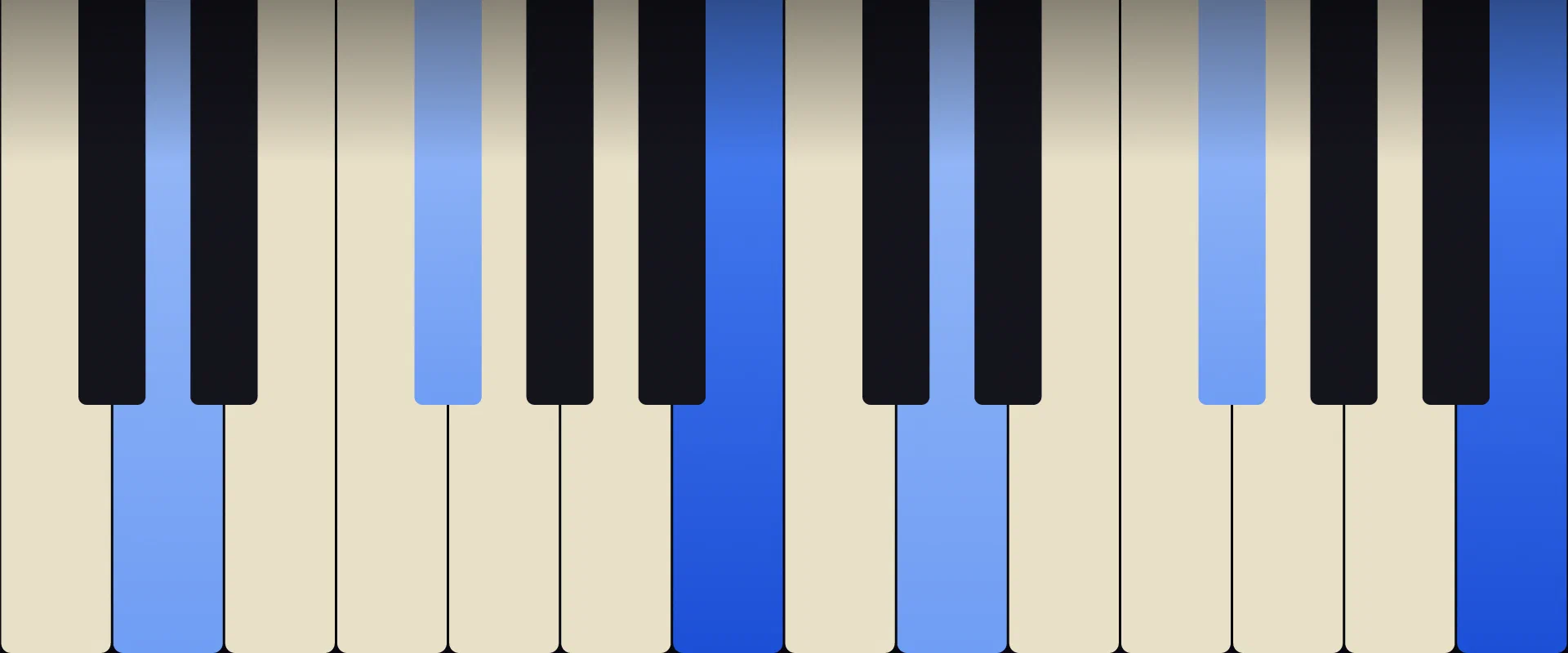
Guitarists meet B minor far too early. It is the vi of D major and the ii of A, and those are the two keys the instrument hands out first, so the chord turns up in bar four of songs people learn in their first month of playing. There is no open shape for it. The working grip is a full barre at the 2nd fret, which is the least forgiving place on the neck to barre anything. More beginners stall here than on any other minor triad, and the reason is timing rather than raw difficulty: the chord arrives long before the technique that plays it.
At the keyboard the story reverses. B minor has one black key where B major has two, which makes it the easier of the pair under the hand.
Try It: Bm in the Chord Finder
The Notes of Bm
| Degree | Note | Interval from Root | Semitones |
|---|---|---|---|
| 1 (Root) | B | Perfect unison | 0 |
| ♭3 | D | Minor 3rd | 3 |
| 5 | F♯ | Perfect 5th | 7 |
One accidental, and it is on top. The third is a plain D, because a third skips one letter and B to D already spans three semitones without help. The fifth cannot be G♭ despite sounding identical, since B up to G of any kind covers six letters and would make the interval a sixth.
How Bm Is Built
Take B major, B D♯ F♯, and drop the middle note one semitone to D. The chord loses an accidental on the way down, which is why the minor version is the gentler of the two to read and to play.
Look at it from D major and something more useful appears. D major is D F♯ A, Bm is B D F♯, so they share two notes out of three and the move from one to the other shifts a single voice: A steps up a whole tone to B and nothing else budges. That is the relative minor relationship in physical terms, and it is why a song in D can drop into Bm without any sense of leaving the key, and why every piece in D eventually asks for the chord.
Bm on the Piano
Two white keys and one black, with the black key on top. B and D sit close together with only C between them, so the hand starts flat and back and reaches forward once for F♯. In B major the middle finger is stranded on a raised key as well. Here it stays on white, which is why pianists find the minor version the softer landing.
Right hand, use 1 on B, 3 on D, 5 on F♯. The little finger takes the only black key, which sounds unpromising, but F♯ is set back and the finger is already extended, so it arrives at the right depth naturally. Left hand, 5, 3, 1 with the thumb on F♯.
The inversions behave unusually well here. First inversion, D F♯ B, puts the black key in the middle with white on either side, which is the most comfortable of the three shapes and also the most musically useful, since D in the bass makes the chord lean towards the relative major. Second inversion, F♯ B D, starts on black and finishes on two whites, so the hand pulls backwards as it goes. In a held chord that is fine. It only becomes awkward if you try to pass the thumb from it.
To teach the difference between major and minor, hold 1, 3, 5 on B, D, F♯ and move only the third finger up a semitone onto D♯. Nothing else changes, so the ear has one variable to track.
Bm on the Guitar
The standard answer is the Am shape barred at the 2nd fret, written x24432: root B on the fifth string, then F♯ and B at fret 4, D at fret 3 on the second string, and F♯ back at fret 2 on the top string.
There is a specific unfairness in that shape. The index barre lies across five strings and only two of them, the root on the fifth and the F♯ on the first, are actually sounding at fret 2. Everything in between is fretted higher by another finger, so three fingers have to crowd into frets 3 and 4 directly behind a full barre, at the widest and tightest end of the neck. Nothing about the grip is efficient.
The honest way in is to stop barring. Take the top three strings on their own, xxx432, and you get B at fret 4 on the third string, D at fret 3 and F♯ at fret 2. Three fingers, no barre, and it comes out in root position with the notes in the right order. Add the fourth string at fret 4 for xx4432 and you have a fuller chord that puts F♯ in the bass. Solo, that version sounds slightly unmoored. In a band, the bass player is on B anyway and nobody notices.
Moving up the neck helps physically and hurts musically. The Em shape barred at fret 7, 799777, sits where the frets are narrow and the tension is lower, and its barre earns four strings instead of one. It is genuinely easier. It also floats an octave away from the open chords a folk song in D is built from, so the voicing stops matching its neighbours.
Two dodges are worth knowing. x20202 is a Bm7 using two open strings and no barre, and its added A is diatonic to D major, so in most songs it passes without comment. A capo at the 2nd fret with the C major shapes turns C, G, Am and F into D, A, Bm and G, which makes the hardest chord in the key an open Am played with three fingers.
Inversions
| Inversion | Notes | Bass Note |
|---|---|---|
| Root position | B D F♯ | B |
| 1st inversion | D F♯ B | D |
| 2nd inversion | F♯ B D | F♯ |
As slash chords, Bm/D and Bm/F♯. Bm/D earns its place in the key of D, where it lets the harmony change while the bass stays on the tonic. Bm/F♯ shares its bass note with D/F♯, so the two swap freely under a held bass line.
Voicings
At the piano, split the chord across the hands. A bare B and F♯ fifth low in the left, D F♯ B in the right. Keeping the third out of the bass matters more here than usual, since a low D under a low B sits in the register where thirds turn to mud.
On guitar, xxx432 is not a compromise, it is a comping voicing. It fits under a vocal without swallowing the arrangement and moves quickly to and from the open D and G shapes this chord lives among.
Which Keys Contain Bm
- VI of D major
- III of G major
- II of A major
- I of B natural minor
- V of E natural minor
- IV of F♯ natural minor
The first three explain the chord’s workload. D, G and A are the keys guitar teaching is built around, and Bm is diatonic to all three at once. No other barre chord is that hard to avoid.
Where Bm Shows Up
| Progression | Numerals | Chords |
|---|---|---|
| Pop loop in D | I, V, vi, IV | D, A, Bm, G |
| Folk verse in G | I, iii, IV, V | G, Bm, C, D |
| Cadence in B minor | i, iv, V | Bm, Em, F♯ |
| Jazz turnaround in A | ii, V, I | Bm, E, A |
The first line is the most played progression in guitar based pop, and three of its four chords are open shapes. The fourth is not. That single mismatch has probably sold more capos than any other fact about the instrument.
In G, Bm turns up as the iii chord and works as a darker stand in for the tonic: G is G B D, Bm is B D F♯, so swapping one for the other shades a verse without moving it. Songwriters use it mid phrase rather than at either end.
The third line needs a note. B natural minor gives A natural, so its fifth chord comes out as F♯m, which resolves to Bm with no pull at all. Raise the A to A♯ and F♯m becomes F♯ major, and the cadence closes. Supplying that one note is what B harmonic minor is for.
Away from the guitar, B minor is a heavyweight orchestral key. Bach’s Mass in B minor, Schubert’s Unfinished Symphony and Tchaikovsky’s Sixth all live here, and string players are comfortable in it because the scale falls in first position and the D and A strings ring open under the harmony. The chord that costs a guitarist a barre costs a violinist nothing at all.
Related Chords
- B Major Chord
- D Major Chord
- Suspended Chords: Sus2, Sus4 and Tension
- Guitar Chord Shapes: The CAGED System
- Chord Progressions Every Musician Should Know
Learn More
Practice Chords
Drill chord recognition with a metronome, MIDI support, and score tracking.
Start Practicing